
Essays · Contemporary Art
Tony Oursler. The Influence Machine.
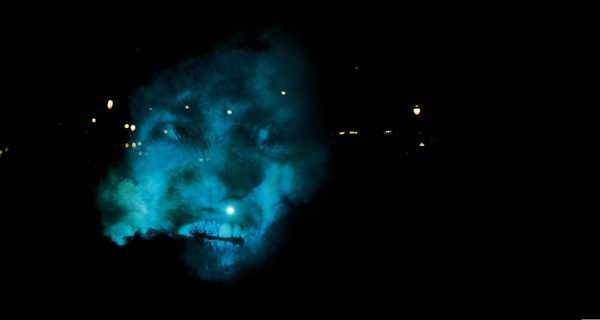
A face appears on smoke. The smoke goes, and so does the face.
Tate · Tate
A park that speaks
The Influence Machine is an outdoor work by the American artist Tony Oursler, made in 2000. It was first shown in Madison Square Park, New York, from 19 to 31 October 2000, then in Soho Square, London, from 1 to 12 November the same year.
After dark the park changed. Huge human faces appeared on clouds of machine made smoke. Images were projected onto trees and onto the facades of the surrounding buildings. A fist hammered again and again on a wall.
There was sound too. Monologues written by Oursler, streams of thought with no clear start or end. In London a chorus of young men chanted from a hospital overlooking the square. A character called the Medium spoke out of the smoke.
The work was co-commissioned by the Public Art Fund in New York and Artangel in London. It was later restaged in Manchester in 2011 and Adelaide in 2013, and is now in the Tate collection.
A history of machines
Oursler was not staging a light show. He was telling a history. The title comes from an early way of describing television: an influencing machine. From there he reached back to the people who first sent images and voices over distance, apart from the body that made them.
Étienne Gaspard Robertson, who staged ghost shows with projectors in Paris at the end of the eighteenth century. Samuel Morse, behind the electric telegraph in the 1830s. John Logie Baird, who experimented with television in the 1920s.
Each of them made something appear where it was not. A ghost on a screen of smoke. A message along a wire. A face on a screen in someone else's living room.
In New York, the knocking hands projected on trees and buildings alluded to Morse code and other early forms of communication. The sound had no clear meaning, but its rhythm was that of a signal trying to get through.
Sound from the dark
The sound mattered as much as the image. In New York the musician Tony Conrad composed an original score for the project. There was radio feedback. There was the glass harmonica, an instrument made of glass bowls, played by Dean Shostak.
None of these sounds came from a fixed point. Viewers walking through the park heard a voice from one side and saw a face on another. Image and sound came apart, as they once did in the history of media, when voices travelled by wire and pictures by airwaves.
Oursler had long projected faces onto things that are not screens: cloth dolls, spheres, objects in a room. Here he took that method outdoors, onto surfaces even less stable. Smoke does not stay still. Leaves shift in the wind. The faces kept warping, breaking up, gathering again.
Why it is worth remembering
In 2000 the internet was just entering daily life. Screens were starting to be everywhere. The Influence Machine was a reminder that the mix of fascination and unease we feel before a talking machine is not new. It has been there since the first ghosts appeared on smoke.
The work also did something rare: it took the history of media out of the museum and into a public park, for anyone passing at night. No ticket. No need to know who Robertson or Baird were. Viewers only had to stop and look at a face on the smoke.
Decades earlier, Nam June Paik had set television sets among the plants of a garden. Oursler went a step further: he dropped the box altogether and let the images cling to trees and smoke.
When the machines switched off, the park was a park again. The smoke cleared. The trees stood still. No trace of the faces remained, only the memory of those who had stopped to watch.
Contemporary Art