
Essays · Contemporary Art
Yayoi Kusama. Infinity Mirrored Room: Filled with the Brilliance of Life.
Inside infinity, there is only one path.
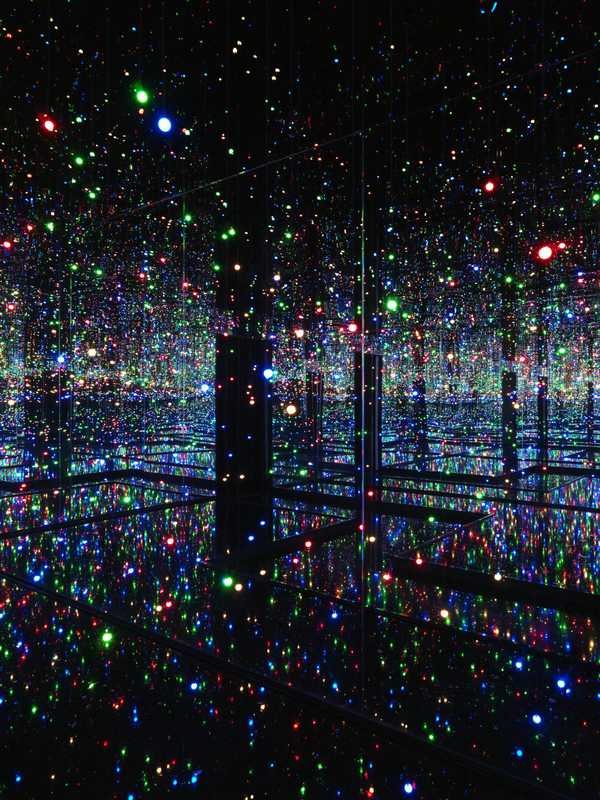
Tate · Tate
A path across water
Tate dates the work 2011/2017. Its materials, according to the museum: mirrored glass, wood, aluminium, plastic, ceramic and LEDs. It was first shown in Kusama's retrospective at Tate Modern in 2012 and later entered Tate's collection.
Stepping inside, visitors find themselves on a walkway. On either side is shallow, flat, dark water. From the ceiling hang hundreds of small lights at different heights, changing colour in sequence. The walls are mirrors. The ceiling is a mirror. The water is one more mirror, lying flat.
The result is an unmeasurable space. The points of light stretch in every direction, up and down. Visitors see themselves repeated countless times, smaller and further away, among clusters of light.
But the path does not repeat. It is the only thing with a direction. It starts at the door and ends at the door.
Two minutes in a room
In May 2021 Tate Modern opened Yayoi Kusama: Infinity Mirror Rooms on the fourth floor of the Blavatnik Building. The show ran until April 2024, almost three years. Beside Filled with the Brilliance of Life stood another room, Chandelier of Grief, where rotating crystal chandeliers suggest a bottomless universe.
Each group of visitors had about two minutes in each room. Tate also notes that Filled with the Brilliance of Life was adapted for wheelchair access, with enough space to turn.
It sounds technical, but it says something about the work. A room about infinity must still account for the width of a wheelchair and the turning circle of a wheel. However large the illusion, it rests on a real floor measured in centimetres. Infinity here is built from wood, aluminium and mirror, and planned so that anyone can enter, on foot or on wheels.
Dots, nets and self-obliteration
Yayoi Kusama was born in Matsumoto, Japan, in 1929. From early on she worked with repetition: dots covering surfaces, fine nets without end. She moved to New York in the late 1950s and from the mid 1960s began using mirrors to multiply those repeated forms into space.
The mirror room is a natural extension of the net paintings. On canvas, dots repeat across a plane. In the room, light repeats in three dimensions, and the viewer's body becomes one more dot.
Kusama has often spoken of self-obliteration, of letting the self dissolve into something larger. Standing on the path, watching their image repeat until it can no longer be told apart, visitors understand something of what she means.
Life as a rhythm of lights
The title speaks of life. Yet the room also suggests death. Lights floating over dark water could be stars, fireflies, or lanterns set adrift. They glow, go out, and glow again somewhere else.
That rhythm is what keeps the room alive. If every bulb shone constantly, the space would become a photograph. Because they change colour and switch off, visitors always see a scene slightly different from the second before.
Compared with The Souls of Millions of Light Years Away, where visitors stand still on a small platform for under a minute, the Tate room lets people walk. Only a few steps, on a single path. But walking through infinity is different from standing in it. Each step shifts the view. With each step, hundreds of lights move too.
Contemporary Art