
Essays · Contemporary Art
Rafael Lozano-Hemmer. Pulse Room.
Each bulb holds a heartbeat, until the next one arrives.
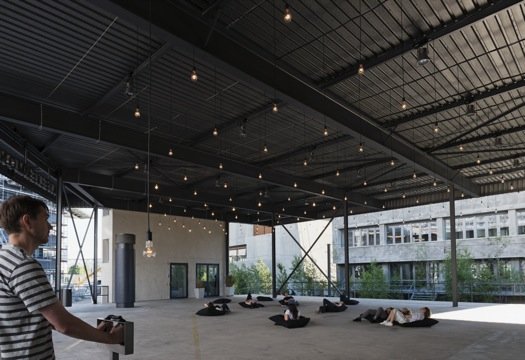
Rafael Lozano-Hemmer (official artist site) · Rafael Lozano-Hemmer (official artist site)
A room full of heartbeats
Pulse Room is an interactive installation Rafael Lozano-Hemmer made in 2006. Its Spanish title is Almacén de Corazonadas. It exists in two versions, with one hundred or three hundred bulbs, each a 300 watt incandescent bulb hung on a cable three metres up, arranged as an even grid across the room.
At one end of the room is an interface with a heart rate sensor. When someone holds it, a computer reads their pulse and at once makes the nearest bulb flash in exactly that rhythm.
When they let go, all the lights go dark for a moment. Then the recorded beat is sent to the first bulb of the grid, pushing every existing recording one bulb along. The oldest falls out of the room.
So at any moment the room holds only the heartbeats of the most recent participants. One hundred or three hundred strangers, flashing at once, each to their own beat.
From a film about candles
Lozano-Hemmer names several sources for the work. One is Macario, the 1960 Mexican film directed by Roberto Gavaldón. In it the starving protagonist has a vision: a cave where every human being is a burning candle.
That image sits very close to Pulse Room. Each bulb is a life. But unlike a candle that burns once, the bulb here is handed from one person to the next.
The second source is the minimalist and serialist music of Conlon Nancarrow, Steve Reich and Glenn Branca, composers who worked with repetition and phase. When hundreds of different pulses flash together, the room produces exactly that kind of pattern: no shared beat, yet an order.
The third is cybernetic theory from the National Institute of Cardiology in Mexico City, where the heartbeat is measured and read as a signal.
Present, then giving way
Pulse Room was first shown at Plataforma, in the Fábrica La Constancia in Puebla, Mexico, in 2006. In 2007 Lozano-Hemmer brought it to the Venice Biennale, in the Mexican Pavilion.
What it does is simple: it shows visitors their heartbeat outside their body, as light. Then it takes the beat away, places it in a long line of others, and finally lets it disappear.
Participants may stay after letting go, looking for their bulb. For a few minutes they can still find it. Then the grid shifts, someone else arrives, and their pulse merges into the crowd of light.
Why those bulbs still glow
Pulse Room is now in many collections: the Museum of Modern Art in New York, the 21st Century Museum of Contemporary Art in Kanazawa, Fundación Jumex Arte Contemporáneo, the Musée d'art contemporain de Montréal, and the Museum of Old and New Art in Tasmania.
It lasts because it touches something everyone knows and rarely thinks about: a life is both entirely private and very like any other. Every heartbeat is only on and off. Yet no two coincide.
Among works made from bare bulbs, it stands beside Martin Creed's room of lights going on and off. Creed gives the light a mechanical rhythm. Lozano-Hemmer hands that rhythm to the visitor.
It is a memorial with no names, no dates, only pulses. And it is always being rewritten by whoever comes next.

Contemporary Art