
Essays · Contemporary Art
Martin Creed. Work No. 227: The lights going on and off.
When there is nothing to look at, we begin to see the room.
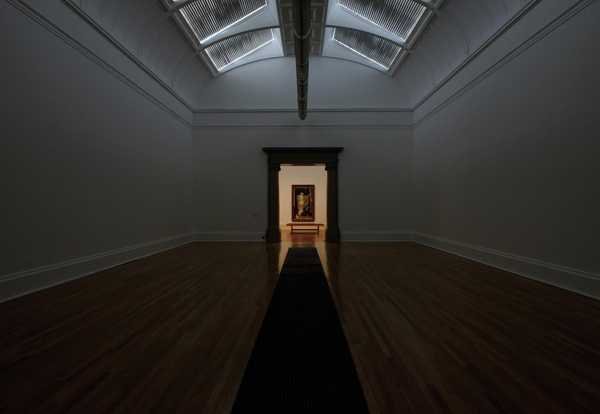
Tate · Tate
A room with nothing in it
Walking in, the viewer finds a white room. No painting, no sculpture, no label on the wall. There are lights in the ceiling. Then the lights go off. The room goes dark. A few seconds later the lights come back on. Then off again.
That is the entire work. Its title says exactly what it does: Work No. 227: The lights going on and off. Martin Creed, a British artist, made it in 2000. It is now in the Tate collection.
Creed numbers every work in sequence. A crumpled ball of paper, a piece of tape on a wall, a line of neon: each is Work No. something. The number makes no distinction between large and small, important or not. The room with lights going on and off is number 227, among the others, nothing more.
Turner Prize 2001
In 2001 Work No. 227 was shown at Tate Britain in the Turner Prize exhibition, from 7 November 2001 to 20 January 2002. The four shortlisted artists were Richard Billingham, Martin Creed, Isaac Julien and Mike Nelson.
Creed won and received twenty thousand pounds. The prize was presented that year by Madonna, a choice itself criticised as a marketing move.
According to Tate, the jury praised the deftness and breadth of Creed's work, the audacity of showing a single piece, and called it strong, rigorous, witty and sensitive.
The press grew more and more irritated. Many articles said the prize was remote from the public, too full of conceptual art and obscure language. One critic joked that a bare white room and a light going on and off was all it took to win.
Creed, when asked, said in effect that people could make of it what they liked, and that explaining it was not his job.
The room becomes the work
In an ordinary gallery, the room is the background. Nobody looks at the walls or the lights. They look at what hangs on the walls. Creed took away what hangs on the walls. The background became the only thing left to see.
And the light, which usually helps us see, became the thing seen. Each time it goes off, we notice it had been there. Each time it comes on, we see the walls again, the other people in the room, ourselves.
The work also deals with time. On and off make a steady beat, like breathing or a clock. Viewers begin to count, to wait. The way a habit becomes a work here recalls On Kawara's I Got Up postcards: no event, only repetition.
Nothing is hidden in the room. No complex machinery, no effects. Only the room's own lights, connected to a timer. Anyone can understand how it works. The hard part is staying long enough to notice what it does to you.
Why an empty room is remembered
More than twenty years later, Work No. 227 is still cited whenever someone asks whether contemporary art is still art. It has become an example, for both sides.
But those who stood in the room tend to remember something more specific: the feeling of a few seconds of dark. The person nearby falls quiet. Someone laughs. Someone stands still, waiting for the light.
The work gives nothing to take home. No beautiful image, no object to admire. Only a small thing: after leaving that room, we notice the lights in other rooms a little more.
Contemporary Art