
Essays · Photography
Sophie Calle. The Hotel.
The guest has gone out. The belongings stay and speak.
Tate · Tate
A chambermaid's job
In 1981 Sophie Calle took a temporary job as a chambermaid in a hotel in Venice. She was given twelve rooms on the fourth floor. The job lasted three weeks.
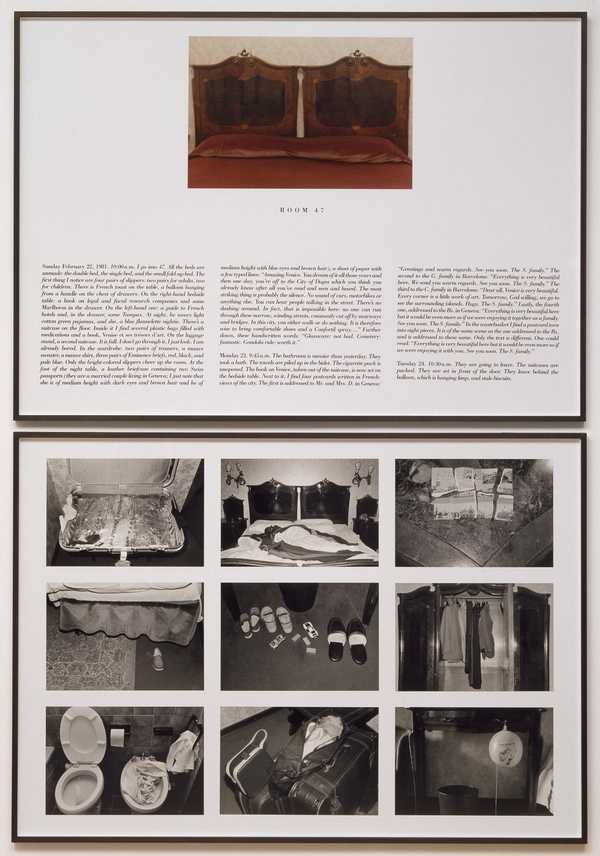
She made beds, changed towels, wiped basins like any other chambermaid. But in her mop bucket she hid a camera and a tape recorder. When guests went out, she opened wardrobes and unlocked suitcases, looked at what they had brought, and photographed it.
She noted the state of the beds, the books and newspapers on the tables, postcards, travelling clothes, costumes for Carnival, the bottles of perfume and cologne lined up by the basin. She looked in the wastepaper basket. She read letters and diaries.
No guest knew. They came back in the evening, found the bed made, and thought nothing more of it.
Pictures and words, room by room
The work is divided by room number. Each room becomes its own set: photographs of objects placed beside the text she wrote, logged by date and hour, of what she saw and did.
Tate holds four of these sets: rooms 28, 29, 44 and 47. Each is a portrait, but a portrait without a face. Only what the occupant touched, opened, left on the bed or the table.
Calle’s text is dry, almost a report. She records and rarely comments. That care is what sets the reader imagining. What does this person read before sleep? Are they travelling alone or with someone? How long do they mean to stay? The text does not answer. It only adds detail, and leaves the reader to build the rest.
The Hotel was later published as a book in French in 1984, then included in Double Game, and only recently appeared as a book of its own in English.
The edge of privacy
The Hotel puts the viewer in an uneasy place. We look over Calle's shoulder at things that are not ours. It is curiosity, and it is intrusion. The work does not hide that.
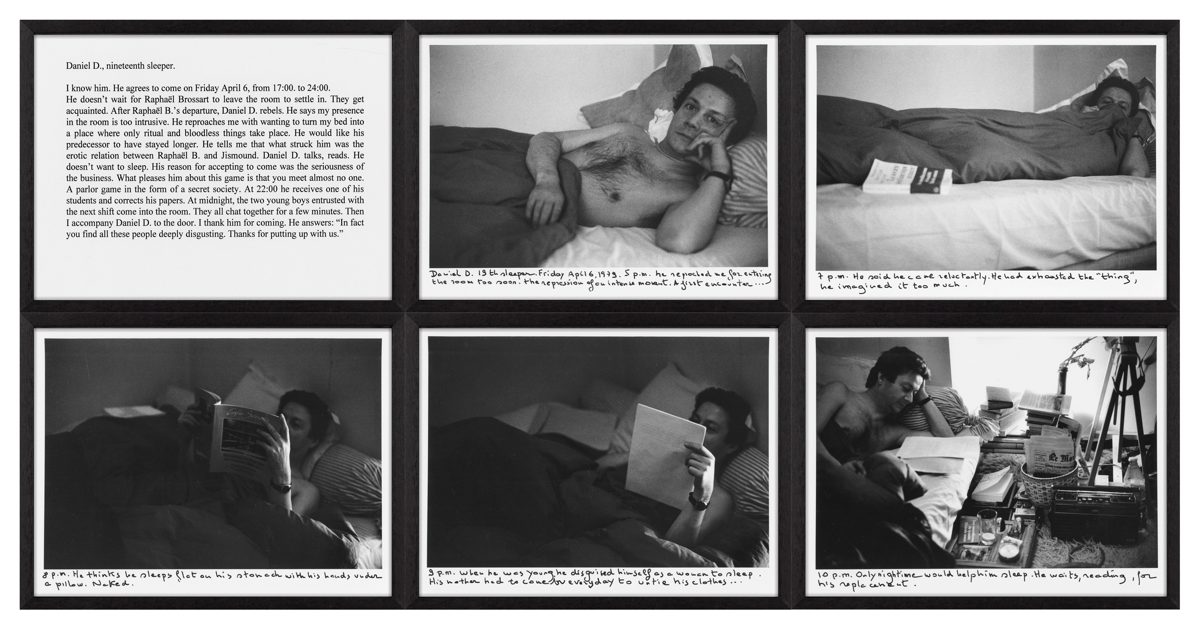
Calle made many projects around this edge. Two years earlier, in The Sleepers, she invited strangers to sleep in her bed. In The Hotel she goes the other way: into the beds and belongings of strangers, while they are absent.
Calle does not hide her own role. The text is in her own voice, logging what she did in each room: when she went in, what she opened, what she found. So the viewer looks not only at the guests’ things, but at someone looking, and wonders where they themselves stand.
A hotel room is the most private space and the most temporary. People stay a few nights, spread their things out as if at home, then leave. Calle slips into exactly that short interval, while objects still hold the warmth of whoever just used them.
Objects as traces
What stays after The Hotel is nobody's secret. No scandal is uncovered. What Calle finds is ordinary: toothpaste, books, clothes, rubbish.
Yet those ordinary things say the most. How someone folds a shirt, what they keep by the bed, the perfume they bring on a trip. The objects become traces of absent people, clear enough that a viewer can almost rebuild a character.
Calle never saw them. Neither does the viewer. All that remains is the room, on a morning in 1981, just after its occupant stepped out.
Photography