
Essays · Contemporary Art
Sol LeWitt. Wall Drawing #1136.
The work lives in the instructions. The wall is only where it appears.
Tate · Tate
Seven colours on three walls
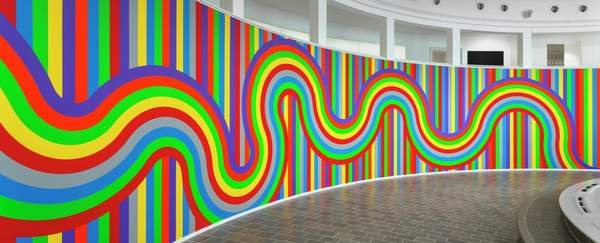
Wall Drawing #1136 is made of solid bands of colour, curved and straight, painted in acrylic directly on the wall. Seven colours are used: the primaries red, yellow and blue; the secondaries green, orange and purple; and grey.
A large curve of nine interlocking bands snakes along the wall, touching the top and bottom edge at several points. Red and green each appear twice, the others once. Behind the curve the same seven colours return as vertical stripes in an irregular order, forming the ground.
Every band is the same width. No part of the wall is left empty. Tate describes it as a chromatic environment that envelops the viewer. The work's own description is brief: curved and straight coloured bands.
Sol LeWitt, 1928 to 2007, made it in 2004, in the last years of his life, when he produced a number of such brightly coloured wall pieces.
The artist does not paint it
Apart from his very first wall drawing, shown at Paula Cooper Gallery in New York in 1968, LeWitt did not execute the wall drawings himself. Draughtsmen or assistants followed his instructions, copying and enlarging his diagram onto the wall.
Wall Drawing #1136 was first installed at Fraenkel Gallery in San Francisco in September 2004. Eight people drew it: Marta Ayala, Sachiko Cho, Matt DeJong, Amanda Eicher, Melissa Levin, Amy Rathbone, Rick Salas and Paul Wackers. Their names appear on the certificate, signed by the artist.
There it covered three walls eleven feet high, seventeen, thirty six and seventeen feet long. In a new location the number of walls may change, as long as the proportions of the original diagram hold.
LeWitt said in 1970 that on large walls viewers would see a drawing in sections, one after another, rather than the whole wall at once. This work suits that way of looking: walking slowly along connected walls, letting the curve lead the eye.
The paper is the signature
Tate's records hold a letter of instruction, an installation diagram and a certificate for the work. The letter, from LeWitt's studio manager, is clear: these documents are the signature of the wall drawing, must accompany it whenever it is sold or transferred, and the studio will not issue a new certificate under any circumstances.
So the paint on the wall is not the most precious part. Wall Drawing #1136 can be installed, removed, and installed again elsewhere, as often as exhibitions require. There are periods when it exists in no physical form at all. It exists only as an idea written down.
The curator John S. Weber observed that because the wall drawings are ideas others can draw, paint over and redraw, they reshape the nature of art towards greater public access. Their nature is collaborative.
Painted, still called drawing
From 1968 LeWitt drew on walls with pencil, crayon, chalk and ink, the traditional materials of drawing. In the 1990s he turned increasingly to acrylic, technically a painting medium. He kept calling them wall drawings.
LeWitt helped establish conceptual art in the 1960s. Looking at this work, one might think the looping bands were improvised. In fact, as Tate notes, the work follows precise instructions that set the order of colours and the width of each band. The playfulness sits inside a strict system.
The work belongs to ARTIST ROOMS, jointly owned by Tate and the National Galleries of Scotland. The idea of a structure rebuilt, enlarged and turned upside down by others has been taken up by later artists, as in Haegue Yang's work addressed to LeWitt.
Contemporary Art