
Essays · Contemporary Art
Richard Long. Cornish Slate Ellipse.
The shape stays. The stones move.
Tate · Tate
An ellipse on the floor
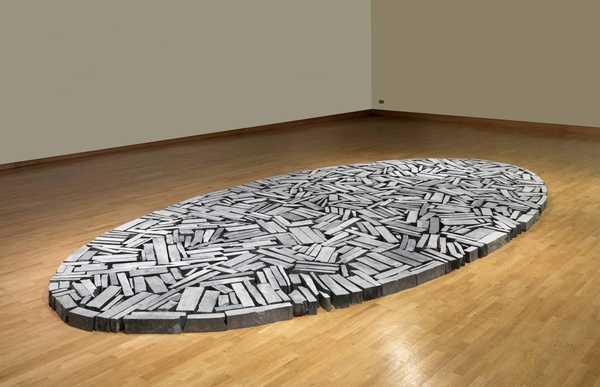
The work lies flat on the floor. No plinth, no barrier. Only an ellipse more than seven metres long and over three metres wide, filled with pieces of slate set on edge, packed close together.
Each piece is roughly a block. Standing on its side it is about ten centimetres high, so the top of the whole work is nearly level. Lengths vary, from around twelve to thirty eight centimetres, because the stone is sawn at the quarry and no one trims it to match.
The main colour is grey. Look closely and some pieces carry reddish brown traces of iron. On the upturned faces the layers of the slate show as fine lines. From a distance the work is clean geometry. Up close it is hundreds of small surfaces, none alike.
Richard Long made Cornish Slate Ellipse in 2009. It belongs to ARTIST ROOMS, the collection owned jointly by Tate and the National Galleries of Scotland, built from a gift by the dealer Anthony d'Offay. Since 2010 it has toured museums across Britain and Northern Ireland: the Ulster Museum in Belfast, Abbot Hall in Kendal, The Hepworth Wakefield and others.
Stone from a Cornish quarry
The slate comes from the Delabole Slate Company in Cornwall, at the far south west of England. According to Tate, Long had been sourcing stone there for more than twenty five years before he made this work. The same slate appears in Stone Line of 1980, now in Edinburgh, and South Bank Circle of 1991, in Tate's collection.
Long is best known for works tied to walking through landscape. But Cornish Slate Ellipse records no particular walk. This is quarried stone, cut by machine and shipped to the gallery. What Long brings into the room is not a memory but the substance of a place, with its real weight and surface.
The weight is considerable. In storage the work is 4,237 kilograms of slate. Not all of it is used each time. There is always more stone than needed, so the installer has something to choose from.
Built anew each time
Cornish Slate Ellipse is not stored as a single object. Every time it is shown it has to be made again. First a string is stretched across the floor to mark the ellipse. Then the most solid, stable stones are set along the edge to keep the outline crisp.
The inside is filled with the rest, placed irregularly and asymmetrically, turning in curves like a current. So each showing is slightly different. Long installs it himself when he can. When he cannot, installers follow his instructions.
That gives the work an odd kind of life. It was signed once and arranged many times. A visitor in Belfast in 2010 and a visitor in Derby in 2017 saw the same ellipse, but not the same arrangement.
Between order and chance
Long has said that as a student in Bristol he saw an exhibition at the Tate in 1964 and was struck by a piece by Isamu Noguchi, a simple convex form on the floor. Back at college he made a plaster work to step on, like stones across a stream. From then on the floor became his ground.
His early floor works were usually lines or circles. The ellipse arrived later, from the late 1990s, in stone and also in paintings made with mud.
Cornish Slate Ellipse sets two things side by side. On one side, human geometry: the clean, tight outline. On the other, stone: rough saw marks, iron stains, layered grain, laid down almost at random. Long has described his work as the place where human abstractions such as lines and circles meet the patterns of nature.
The ellipse keeps the stones in place. The stones keep the ellipse from ever being quite the same. The meeting of form and material recalls another line of twentieth century sculpture, such as Donald Judd's concrete blocks in the Texas desert, though Long lets the hand and chance show far more.

Contemporary Art