
Essays · Contemporary Art
Donald Judd. 15 untitled works in concrete.
The object stays still so the light can move.
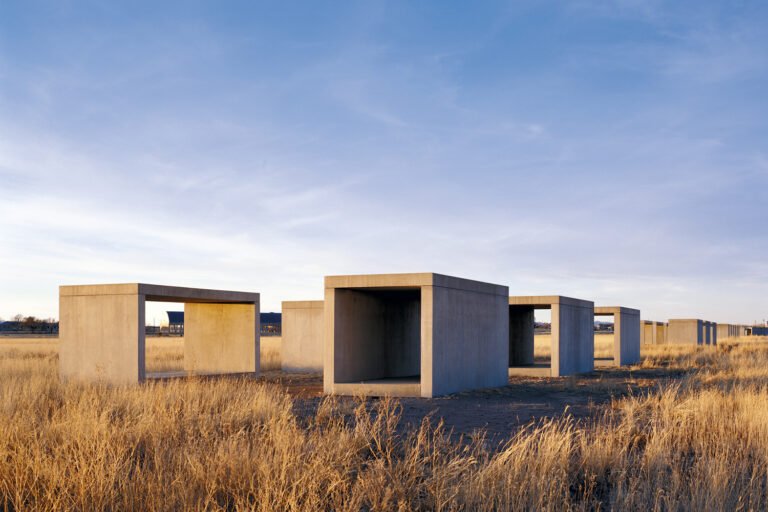
Photo: Florian Holzherr; courtesy Chinati Foundation · The Chinati Foundation
Concrete boxes on the grassland
On the edge of Marfa, in far west Texas, on low dry grassland, fifteen groups of concrete units stand in a long line. They run along the border of the Chinati Foundation's property, the museum Donald Judd created on the grounds of a former army post, Fort D.A. Russell.
Each unit is a hollow box measuring 2.5 by 2.5 by 5 metres. Its walls are concrete slabs 25 centimetres thick. Some are open at both ends, some closed on one side, some divided by an inner wall. The groups hold different numbers of units, arranged in different ways: in a row, in parallel, in a triangle.
No plinths. No fences. No labels on each unit. They sit directly on the ground, like structures of unclear purpose left in the middle of a field.
According to Chinati, these were the first works installed at the museum. They were cast and assembled on site over four years, from 1980 to 1984, with support from the Dia Art Foundation.
One size, many variations
Judd is often placed among the minimalists, though he disliked the label. His work returns again and again to simple, repeated forms made of industrial materials: steel, aluminium, plywood, concrete.
The concrete works show that method most clearly. The outer size stays the same, so the eye is not drawn to differences in scale. What changes is the interior: what is open, what is closed, where the divisions fall. And what changes most lies beyond the artist's hand.
In the morning, sunlight slants through the openings and lays long patches of light inside the boxes. At noon the shadows shrink almost to nothing. Late in the afternoon they stretch across the grass, linking one unit to the next. Walking along the line, one sees the land behind appear through the openings, then vanish, then return, like frames in sequence.
No clock is needed. Stay long enough and the length of the shadows tells the hour.
Placed once, never moved
In 1978 Judd began restoring Fort D.A. Russell with support from the Dia Art Foundation. Chinati opened to the public in 1987 as an independent, nonprofit museum. Today the site covers 340 acres.
Chinati rests on the idea that works of art should be placed and never moved again. Judd distrusted the short exhibition, where works are crated, shipped and rehung in another white room. He wanted art, architecture and landscape to be thought through together, fixed, so that visitors could return and find them where they were.
The concrete works are the plainest proof of that idea. They cannot be moved. They are heavy, cast in place, bound to the ground. They belong to this grassland, this light, this horizon.
The landscape framed
The Marfa country is wide and sparse. Grassland runs to low mountains in the distance, and the sky is nearly always clear. In such a space the eye drifts. The concrete units hold it. Each opening is a frame, cutting out a piece of land just small enough to look at closely.
This brings Judd's units close to land art of the same years, such as Nancy Holt's Sun Tunnels in the Utah desert, where concrete tubes also frame the sky. But Judd did not align anything with solstices or stars. He simply set identical boxes side by side and left the rest to the day.
The fifteen groups have stood there for more than forty years. Grass has grown and faded around them. The concrete has weathered in sun and rain. The objects have barely changed. Only the light, each day, draws them once again.
Contemporary Art