
Essays · Contemporary Art
Dan Flavin. untitled (Marfa project).
Colour appears only when it has somewhere to fall.
The Chinati Foundation · The Chinati Foundation
Six buildings, twelve corridors
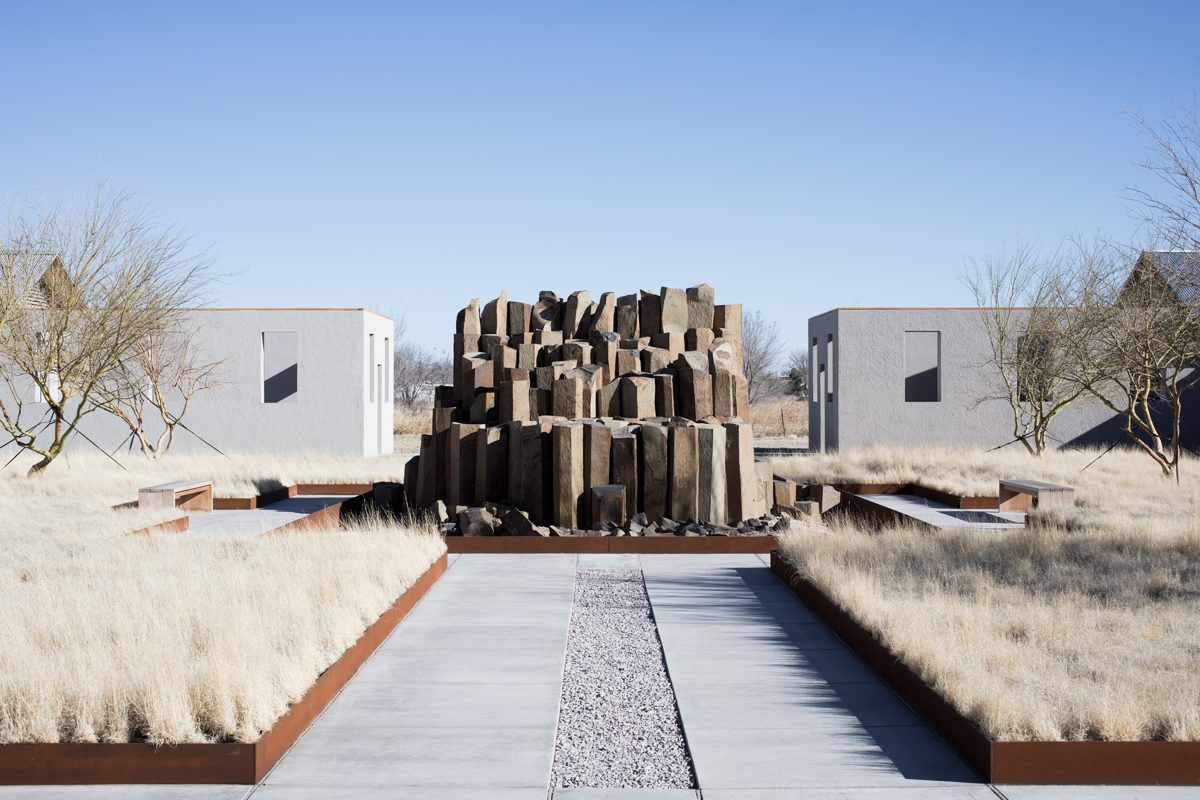
On the grounds of the Chinati Foundation in Marfa, Texas, stand six low, long, U shaped buildings. They were barracks of the former army post, Fort D.A. Russell. Inside each, in the two long arms of the U, run two parallel corridors.
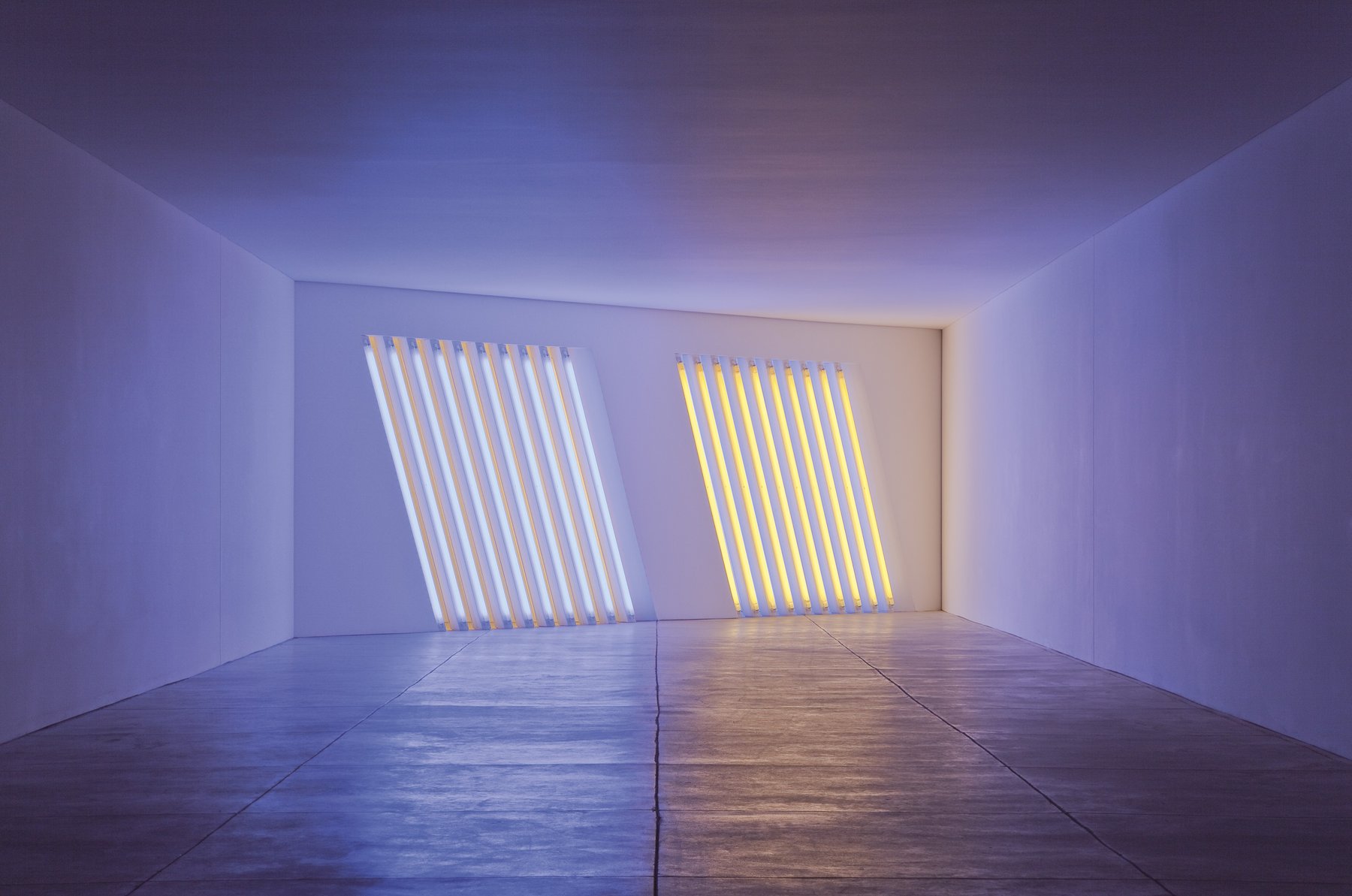
Dan Flavin chose to place his work in exactly those corridors. Each is blocked by a barrier of light that fills its full height and width. The barrier is made of eight foot fluorescent fixtures set side by side, spaced just enough to allow a view through.
Visitors cannot pass the barrier. They stand before it, look through the gaps, and see the other half of the corridor flooded with another colour. To reach the far side, they must turn back and go around.
At the end of each long arm are two windows. Daylight from the Texas grassland enters, mixes with the lamps, and gives a view out to the wide landscape.
Two colours in one fixture
What sets the work apart lies in each fixture. Each holds two bulbs of different colours, shining in opposite directions. One face of the barrier casts one colour, the other face another. The same barrier makes two different rooms, depending on where one stands.
The colours follow a sequence across the six buildings. The first two use pink and green. The next two use yellow and blue. The last two bring all four together.
Moving from one building to the next, the eye carries the colour it has just seen. Stepping into noon light after a green corridor, everything may turn pink for a few seconds. Entering a yellow corridor after a blue one, the yellow seems brighter than it is. The work is not contained in one building. It lives in the walk between them.
The last project
Flavin began discussing the project in the early 1980s, in the years when Donald Judd was building Chinati. The final plans were settled in 1996. That same year Flavin died in Riverhead, New York. He was born in 1933.
He did not live to see it finished. Installation continued after his death, and the work was unveiled at the museum's annual Open House in October 2000. It is the last large scale work he designed.
There is something quiet in that. An artist who spent his life working with light left his largest work as a set of plans, for others to switch on.
Materials from the store
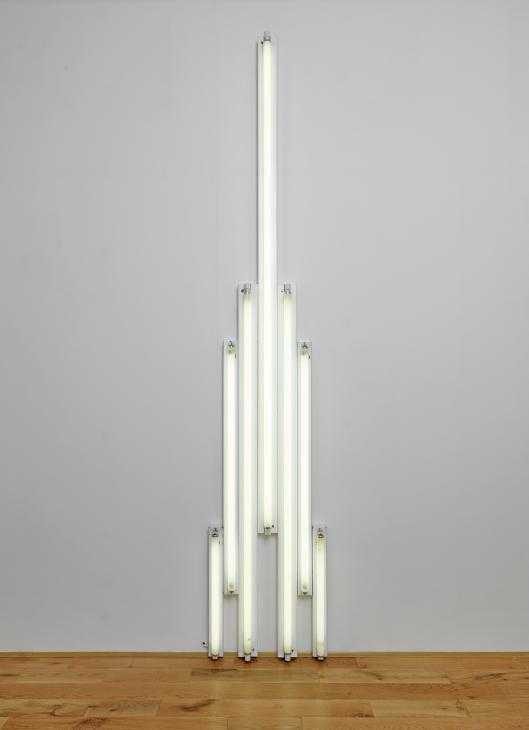
From the early 1960s Flavin worked almost entirely with one material: commercial fluorescent lamps, sold ready made, in standard lengths and a limited range of colours. He did not make his own tubes or bend glass. He chose, arranged, and placed them in space. Early works such as 'monument' for V. Tatlin already show that approach.
In Marfa the approach reaches the scale of architecture. The material is as ordinary as in any office. But arranged into barriers, repeated across twelve corridors, set in buildings where soldiers once slept, it is no longer office lighting. It is colour one can walk into.
Fluorescent light is usually thought of as cold, flat, indifferent. Flavin used that very light to make a slow, quiet place, where visitors stand a long time before a barrier just to watch one colour drift into another.

Contemporary Art