
Essays · Contemporary Art
Dan Flavin. 'monument' for V. Tatlin.
A monument made from what anyone can buy.
Tate · Tate
Tubes standing as a tower
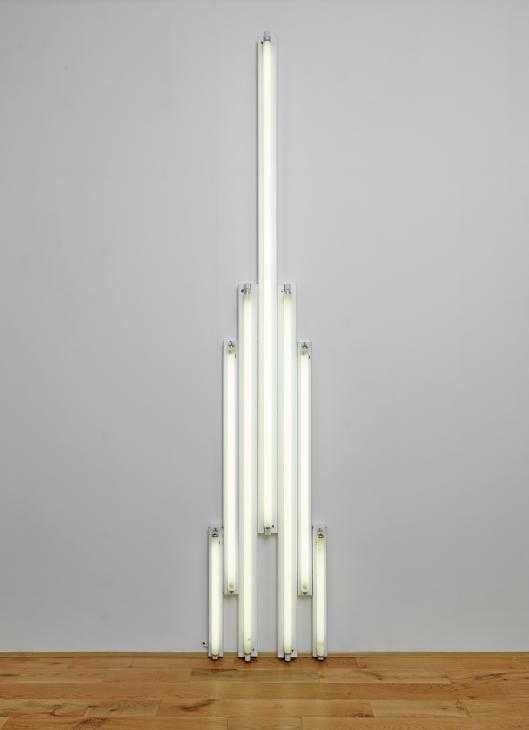
The work hangs on a wall, about three metres tall and under sixty centimetres wide. It is made of ordinary white fluorescent tubes mounted on a metal backing. The tubes stand upright side by side, the central one highest, those on either side stepping down, forming a pointed tower.
Nothing is specially made. The tubes are industrial goods, the kind bought for office ceilings, workshops, corridors. When one fails it can be replaced with another of the same type. Flavin said as much: the tubes are, as far as industrial quality control allows, practically identical.
The light is cool white. All of Flavin's Tatlin monuments use this cool white, so that attention falls on structure rather than colour.
The work is dated 1966 to 1969. Tate bought it from the artist through John Weber Gallery, New York, in 1971.
Tatlin's tower
V. Tatlin is Vladimir Tatlin, the Russian artist who lived from 1885 to 1953. He is remembered above all for a project that was never realised: the Monument to the Third International, designed in 1919 and 1920. It was a revolving spiral tower, and had it been built it would have stood taller than the Eiffel Tower.
The tower exists only as drawings and models. Yet for many twentieth century artists it was the image of a promise: art and engineering side by side, serving common life.
Flavin admired Tatlin deeply. In a 1972 letter to Tate he described him as an unassuming artist engineer, working outside the institutions that keep art apart from daily concerns. In December 1964, speaking in public for the first time at the Brooklyn Museum Art School, Flavin listed three twentieth century projects he felt had not been pursued far enough. Tatlin's tower was one of them.
A monument in quotation marks
Even so, Flavin said the series did not take its form directly from Tatlin's design. There is no spiral, nothing turns. Only upright tubes of different heights.
The word monument sits in quotation marks, partly, Flavin said, as a joke. These were monuments, but made of standard lighting equipment. A traditional monument needs stone, bronze, a high plinth and many years. Flavin's needs a few tubes, a socket and a wall.
The distance between the two is what the work asks us to see. On one side, a great tower that never rose. On the other, the cheapest, most replaceable things. Flavin honours Tatlin through the very modesty he praised in him.
Twenty drawings and a subway ride
Between 1964 and 1970 Flavin made some twenty sketches for the series. He said he never counted them. In some the tubes stand upright as a tower; in others they lie diagonally or break apart at various angles.
The first Tatlin monument was installed in May 1965 at the Institute of Contemporary Art of the University of Pennsylvania. Tate's work is a variant of a 1966 design, with the central tube raised by about a foot. Flavin recalled that its sketch was first noted inaccurately, because he drew it on a subway ride in Manhattan, and had to be reworked for his retrospective in Ottawa in 1969.
Each design exists in an edition of five. This belongs to the idea too: the work does not lie in one irreplaceable object, but in an arrangement that can be set up again.
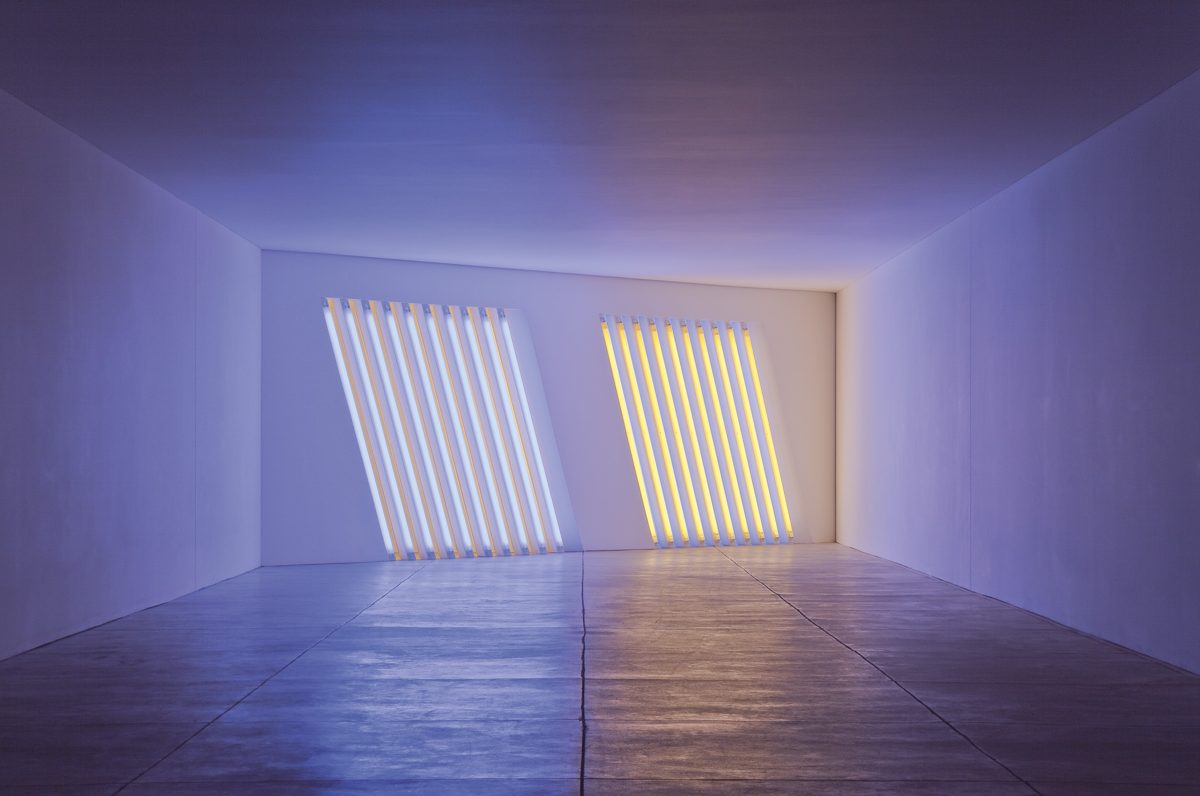
Another essay, on the Marfa project, shows Flavin's coloured light filling entire buildings. Here everything is smaller and whiter. One wall, a few tubes, and the name of a man who dreamed a tower.
Contemporary Art