
Essays · Modern Art
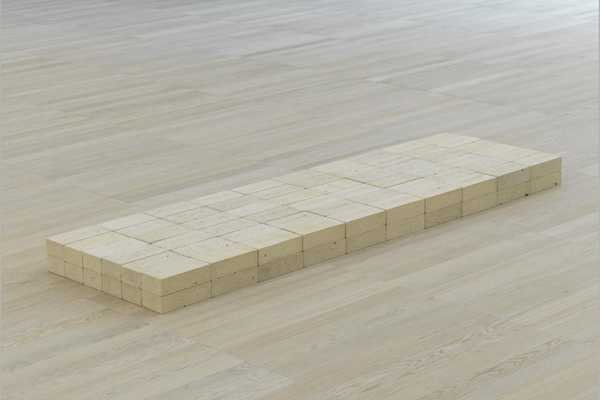
Carl Andre. Equivalent VIII.
The same hundred and twenty bricks. Only the arrangement differs.
Tate · Tate
A low block on the floor
Equivalent VIII is 120 yellowish brown firebricks laid as a solid rectangle directly on the floor. Two layers, one on the other. Sixty bricks per layer, six rows of ten. The block is under thirteen centimetres high, about sixty eight centimetres wide and nearly two metres thirty long.
No plinth. No mortar. No brick cut or carved. The bricks sit tight against each other, and their weight holds the block in place.
Carl Andre made the work in 1966. Tate in London bought it in 1972, directly from the artist through the John Weber Gallery in New York. Four years later this low block of bricks became one of the most talked about works in the history of a British museum.
As level as a lake
According to the critic David Bourdon, Andre had long felt his sculpture should be low. In the summer of 1965, canoeing on a lake in New Hampshire, he realised it had to be as level as water.
In March 1966, for his second show at the Tibor de Nagy Gallery in New York, he laid eight blocks of 120 bricks each on the parquet floor. He chose 120 because it divides by so many numbers. The bricks were stacked in two layers so the blocks would not drift apart and would have enough mass. He used four divisions: 3 by 20, 4 by 15, 5 by 12 and 6 by 10. Depending on how the bricks were turned, one division could become a long strip or a near square.
The eight blocks had eight different shapes but the same height, mass and volume. They were equivalent. Andre titled the show Equivalents, the same title as Alfred Stieglitz's series of cloud photographs.
Nothing sold. Andre returned nearly all the bricks to the brickyard for a refund, keeping only 200. The originals were bluish white sand lime bricks from a works in Long Island City. When he decided to remake the series in 1969, that works had closed, so he used firebricks of about the same size, yellowish brown. Tate's block is one of those remakes.
The bricks affair of 1976
On 15 February 1976, The Sunday Times ran an article by Colin Simpson with a punning headline about Tate dropping a costly brick. The national press piled in. The argument ran for weeks. Tate later called it the bricks scandal.
The public question was blunt: why had museum money gone on a pile of bricks anyone could buy from a builder's yard? The question touched exactly what Andre intended. He stressed that his turning point was moving from cutting into material to building works from standard units that were already cut.
Andre belonged to the American minimalists of the 1960s, the generation of Donald Judd. They dropped the plinth, the mark of the hand, the story. What remained was material, number, and the space around it.
The work is the room
Tate stresses one point: Andre's sculptures always lie on the floor, never on a plinth. They are not only objects to look at. They become part of the space and change how the viewer stands in the room.
Before Equivalent VIII you have to look down. The block does not rise to impress. It lies at the level of your feet. The whole room suddenly appears: the floor, the walls, the distance between person and thing.
Fifty years after the row, the question of 1976 still holds, but turned around. Not whether bricks deserve to be art, but whether we have the patience to look at an ordinary thing for more than a few seconds.
Modern Art