
Essays · Contemporary Art
Mona Hatoum. Impenetrable.
From afar, light. Up close, a fence.
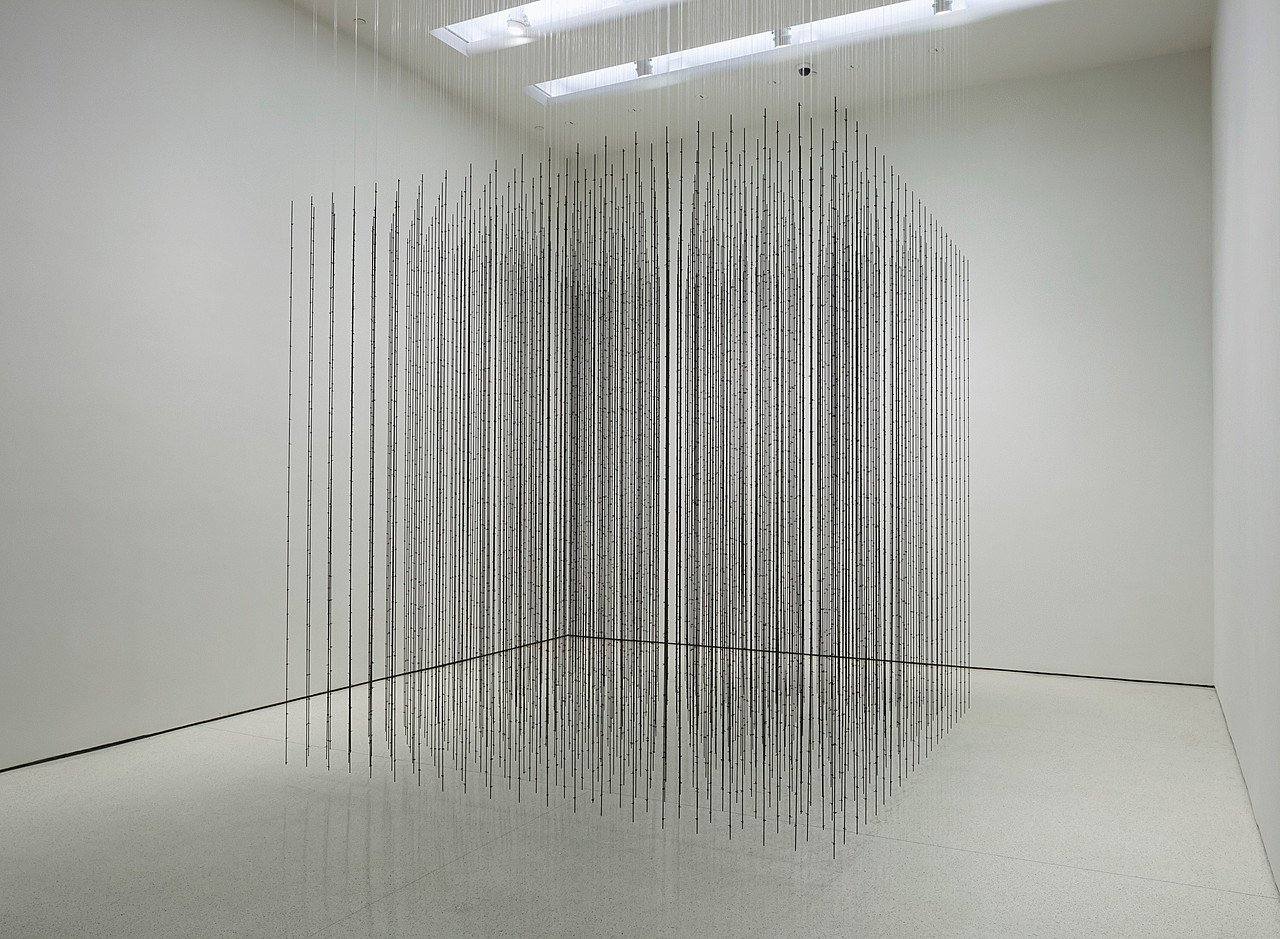
Solomon R. Guggenheim Museum · Solomon R. Guggenheim Museum
A floating cube
The collection of the Solomon R. Guggenheim Museum in New York holds a 2009 work by Mona Hatoum called Impenetrable. The medium is listed briefly: steel and nylon monofilament. It measures 300 by 300 by 300 cm, a cube three metres on each side.
From a distance it looks like a hazy cube hovering in the room. Dense vertical lines build a volume that seems drawn in very fine pencil. Light passes through. It could be mistaken for a minimal drawing suspended in the air.
Up close the cube shows something else. It is made of hundreds of barbed wire rods, each hanging from a fishing line above. Small barbs run down every rod. What seemed a drawing turns out to be a fence.
The grid and what it holds
The Guggenheim points out that, like many of Hatoum's installations since the early 1990s, Impenetrable takes the form of a grid. Its austere geometry recalls Minimalist sculpture, the art of cubes, regular grids and industrial materials.
But Hatoum does not stop at form. Barbed wire is the material of fences, prisons, camps: structures built to keep people in or push them out. Arranged into an elegant cube, opposites share one place. Beauty and threat. Delicacy and sharpness.
Hatoum's work is often discussed in relation to her life as a Palestinian exile. Yet the artist has said she finds it more exciting when a work carries many meanings, paradoxes and contradictions. Impenetrable is not only about one border. It can be read as a question about any border.
A joke with Soto
The title is a reply. From 1967 to 1997 the Venezuelan kinetic artist Jesús Rafael Soto made his Penetrables: large cubes, often in one bright colour, made of countless hanging plastic cords. Visitors were invited to walk in and through them.
Soto blurred the line between static and moving, inside and outside. Hatoum takes the same structure, swaps plastic for barbed wire, and changes the name: from something you can pass through to something you cannot. The Guggenheim calls it a touch of the dark humour common in her work.
Hatoum's cube still invites, like Soto's. It is still light, still beautiful, still made of glinting vertical lines. But the invitation is blocked. Visitors can only look in from outside.
The viewer's body
According to the Guggenheim, the human body runs through Hatoum's practice. Early on she used her own. From the late 1980s she began building situations for the viewer's body instead, and Impenetrable is one of them.
That means the work is incomplete in a photograph. It needs someone moving through the room, seeing the cube turn from haze to sharpness, feeling their steps slow. That small hesitation in front of barbs hanging at eye level is the material.
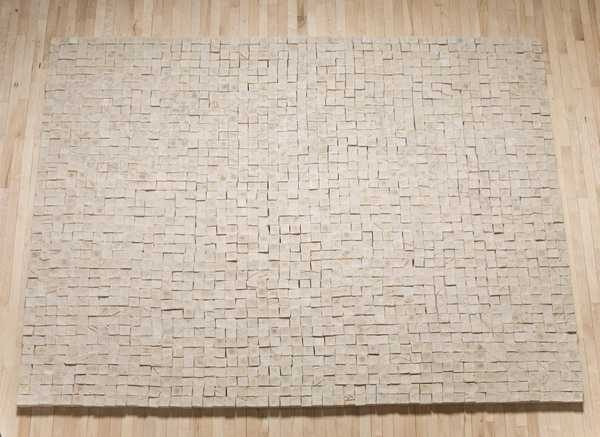
Hatoum has also made works from the materials of a particular place, such as Present Tense, blocks of soap laid out as a map. Impenetrable needs no map. It needs only a distance, and someone crossing it.
People leaving the room often remember both images: the soft block of light from the door, and the barbs from up close. The work lives between the two.
Contemporary Art