
Essays · Contemporary Art
Susan Hiller. From the Freud Museum.
Each box is a memory given a name.
Tate · Tate
Fifty boxes
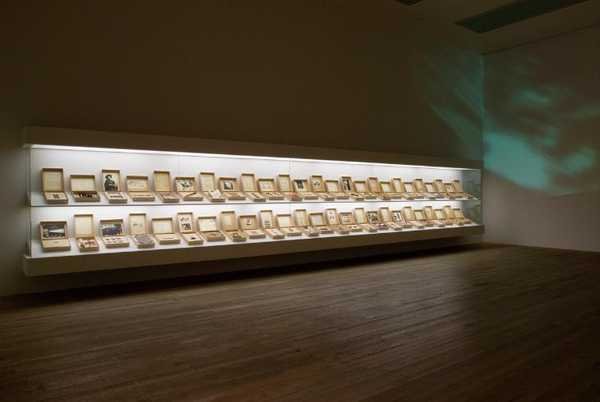
From the Freud Museum is a work Susan Hiller made over several years, from 1991 to 1996. Tate, which holds it, lists glass, fifty cardboard boxes, paper, video, slide, light bulbs and other materials.
The boxes are the cardboard kind used in archaeology to store excavated finds. Each holds a few small, humble things: a flask of holy water, some earth, photographs, maps. Each comes with a label and a caption.
Side by side, the fifty boxes look like a research collection. Yet no panel says what the collection proves. Viewers have to go through the boxes one by one.
Freud's house
The title points to the Freud Museum in London, Sigmund Freud's last home. He moved there in 1938 after leaving Vienna, bringing the collection of antiquities he had gathered all his life. Small Egyptian, Greek, Roman and Chinese figures crowded his desk.
Freud often compared psychoanalysis to archaeology: digging layer by layer, finding buried fragments, piecing a story together. His house is where the two kinds of digging meet, one in the earth, one in the mind.
Hiller took up exactly that frame. She used archaeological boxes, labels, a vitrine, the whole language of the museum. But what she stored was not precious antiquity. It was small, ordinary things, the kind usually left at the edges of official collections.
A museum of the overlooked
Hiller trained in anthropology before becoming an artist. Her way of looking at objects carries that training: each thing is evidence of how people live, believe and remember. Holy water speaks of faith. A handful of earth speaks of a place. A map speaks of how someone pictured the world.
Placed in a box and labelled, these things take on a new position. No longer rubbish, not quite antiquity. They sit in between, like the dreams Freud studied: fragmentary, muddled, yet meaningful if we look closely.
The work also includes video, slides and light bulbs. Light and moving images slip in among still objects, so the collection is never entirely at rest. Something is still happening inside the archive.
Other artists have also used the archive to hold memory, as Christian Boltanski did when he recorded the heartbeats of thousands of people. Hiller's archive is smaller and more personal. It belongs to one person, yet invites everyone in.
Read the label, then look again
In an ordinary museum you look at the object, then read the label, and the label tells you what the object is. In From the Freud Museum that order is no longer certain. A label need not explain its object. It can open a line of thought the object would not suggest on its own.
Viewers have to slow down. Read a caption, look into the box, recall something of their own, move to the next. Fifty times. In the end what they take away is not knowledge of each object, but a sense of how memory gets arranged.
Hiller does not say which memory is right, or which culture matters more. She shows only that choosing what to keep, and what to call it, is already a decision. Every museum is a story someone chose to tell. Hers is one such story, told with things others passed over.
Contemporary Art