
Essays · Contemporary Art
Roger Hiorns. Seizure.
A home, once people leave, belongs to matter.
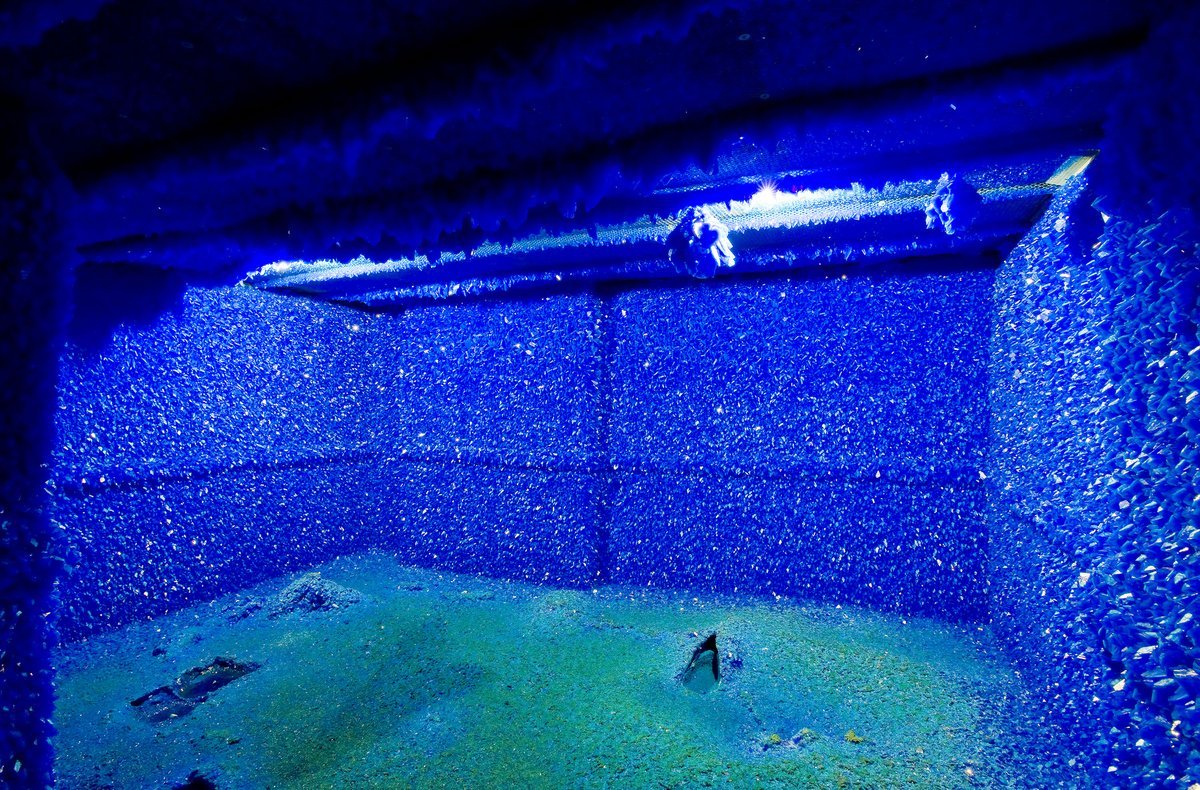
courtesy Artangel · Artangel
A flat on Harper Road
At 151 to 189 Harper Road, Elephant & Castle, in south London, stood a council estate due for demolition. In 2008 Roger Hiorns chose a ground floor bedsit there. A small, ordinary flat with nothing to look at.
The flat was sealed. Copper sulphate powder was mixed with boiling water into a heavily saturated solution. The solution was pumped in until every room was full to the ceiling. According to Artangel, it came to 75,000 litres.
Then came the wait. The liquid cooled over a month. As the temperature fell, the water could no longer hold all the dissolved copper salt. It crystallised, gripping whatever surface it met.
Finally, the remaining liquid was siphoned off. The door opened.
Inside the blue cave
Whoever stepped in no longer saw a flat. Walls, ceiling and floor were covered in sharp blue crystals, glittering under the lights. Corners lost their straight lines. Every surface looked alike, as if the room had been carved from a single mineral.
The only sign that anyone had lived here was the bath. It had crystallised too, but its shape was still recognisable. A private object of daily life, now standing in the cave like a fossil.
Visitors were given wellington boots and gloves. Only a few could enter at once. The space was tight and damp, and the material was not for bare hands. People moved slowly, bent low, looked closely.
The work was open from 2 September 2008 to 3 January 2010. It was commissioned by Artangel and the Jerwood Foundation, with support from Arts Council England and Channel 4. In 2009 Hiorns was shortlisted for the Turner Prize.
When the building came down
The Harper Road estate was already scheduled for demolition. The work was made knowing its home would not last. But Hiorns wanted to keep the room.
In February 2011 the whole crystal body, weighing more than 31 tonnes, was cut free and moved. It went to Yorkshire Sculpture Park in Wakefield, in the north of England, where Adam Khan Architects designed a building to shelter it. From June 2013 visitors could walk in again.
There is something strange in this. The flat, as a place to live, is gone. So is the building around it. But its interior, the mould of air a tenant once lived in, has been cast by crystal and carried away. The space outlived the building.
Matter does the work
Seizure has several meanings in English: taking hold, confiscation, a fit. The title suits the work. The flat is taken over. Not by people, but by a chemical process.
Hiorns set up the conditions, but he did not draw the final form. Each crystal grew by its own rule. This links Seizure to his other works, discussed in the essay on Hammer Projects: Roger Hiorns. Here there is one more layer: it is a home.
A flat in an estate facing demolition carries stories of policy, of people moved on, of a city changing. Hiorns does not tell them. He lets matter cover the place people left.
The result is beautiful and uneasy at once. A blue everyone wants to look at, in a room no one could live in.
Contemporary Art