
Essays · Olfactory Art
Hammer Projects: Roger Hiorns.
The artist starts the process, then steps back.
Hammer Museum · Hammer Museum
A young artist in Los Angeles
From 11 September 2003 to 18 January 2004, the Hammer Museum in Los Angeles gave a room in its Hammer Projects series to Roger Hiorns. The curator was James Elaine. The room was given entirely to a British artist then twenty-eight years old.
Hiorns was born in Birmingham, England, in 1975. He studied at Bournville College in Birmingham, then took his BA at Goldsmiths College, London, in 1996. At the time of the Hammer show he lived and worked in London.
The materials in the room were strange: a car engine, dried thistles, ceramic pots, steel grating, fire, soap foam, perfume, and a great deal of blue crystal.
Materials that do not stay still
The Hammer described Hiorns as working with immaterial and temporary media: fire, soap, perfume and its scent. Traditional sculpture avoids these. Stone and bronze are chosen because they last. Fire, foam and smell vanish as soon as they appear.
Two Forms Yellow and Brown, 1999, consists of ceramic pots that keep pushing out foam from detergent. The foam rises, spills over the rim, collapses, rises again. The work never has the same shape twice.
A work titled Vauxhall, 2003, is a steel grate of the kind set in pavements, from which a flame rises. The same year, at Tate Britain, Hiorns cut a drain into the floor of the sculpture court, and instead of water running down through the grating, fire came up.
And there were steel sheets stained with perfume. Steel is cold, hard, industrial. Perfume is warm, soft, volatile. Setting them together, Hiorns let visitors smell something their eyes read only as metal.
Blue crystal and alchemy
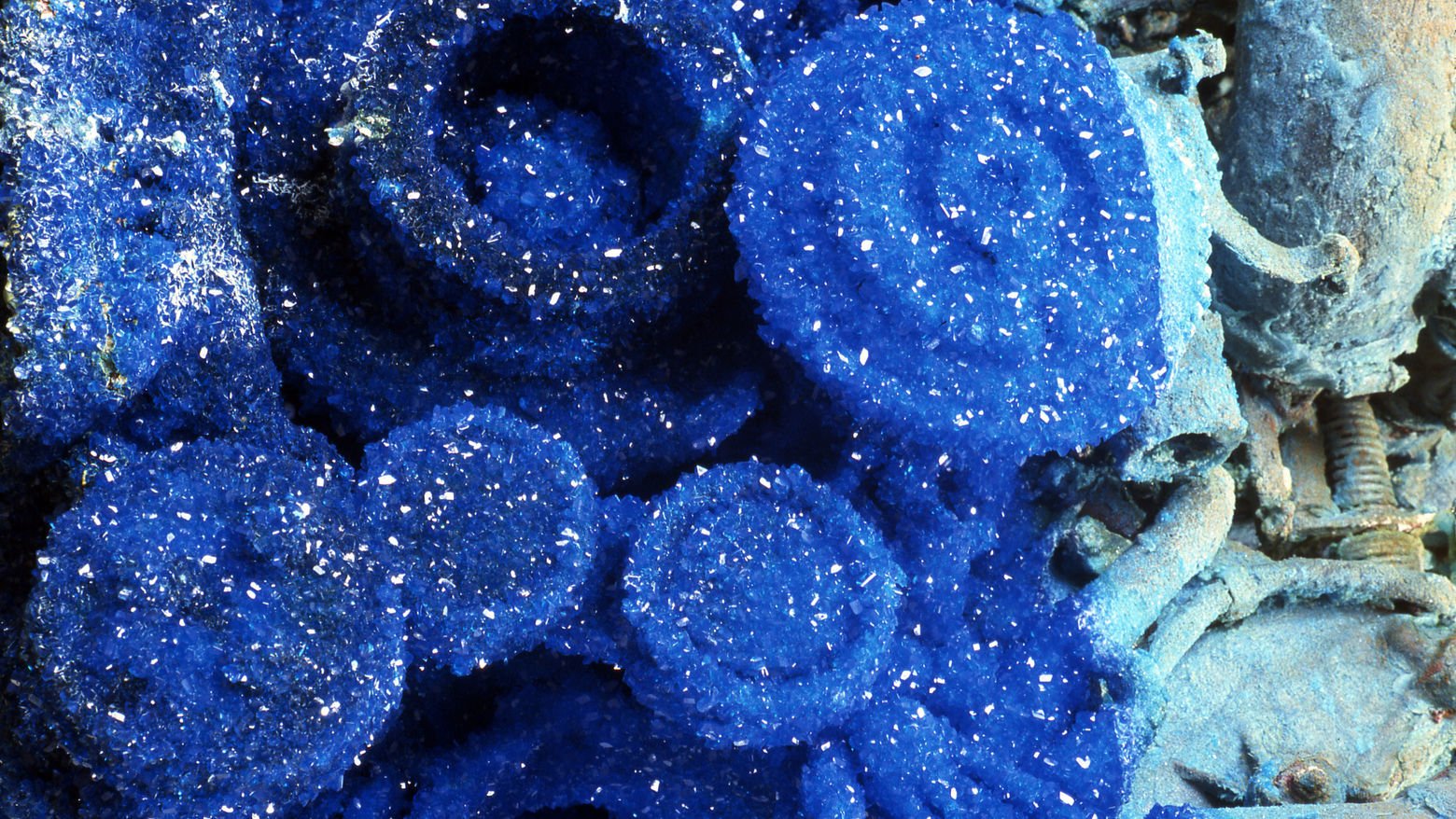
The most visible part of the show was blue. The Architect's Mother, 2003, is a BMW 8 series engine covered in copper sulphate crystals. Intelligence and Sacrifice, also 2003, sets crystallised thistles on a perforated steel panel.
The method is simple. Hiorns immerses an object in a saturated copper sulphate solution and lets crystals grow on its surface. He does not decide where they grow, how large, how sharp. Chemistry decides.
The Hammer placed these works alongside the idea of alchemy: turning an ordinary thing into something else, strange and precious. A car engine becomes a mineral mass. A wild thistle becomes jewellery.
Five years later, in 2008, Hiorns pushed the idea to its limit in Seizure, pumping copper sulphate solution into an entire abandoned flat in London.
Taking the artist's hand away
At the centre of Hiorns's approach is the deliberate removal of the artist's hand. He sets a chemical, biological or fiery process in motion, then lets it decide the outcome. The work is not something he makes. It is something that happens.
Smell suits this method better than any material. No one controls a smell once it leaves its source. It follows the air, the temperature, the people passing. A perfumed steel sheet cannot keep its smell unchanged for weeks; the smell weakens and shifts in ways no one sets in advance.
Hammer Projects: Roger Hiorns lasts because it showed, early on, an artist who treats sculpture as conditions rather than form. Fire, foam, crystal, perfume. Each does its own part. The visitor stands outside and watches, and smells, a thing taking shape.

Olfactory Art