
Essays · Contemporary Art
Rirkrit Tiravanija. untitled (he promised).
A house is complete only when someone is inside.
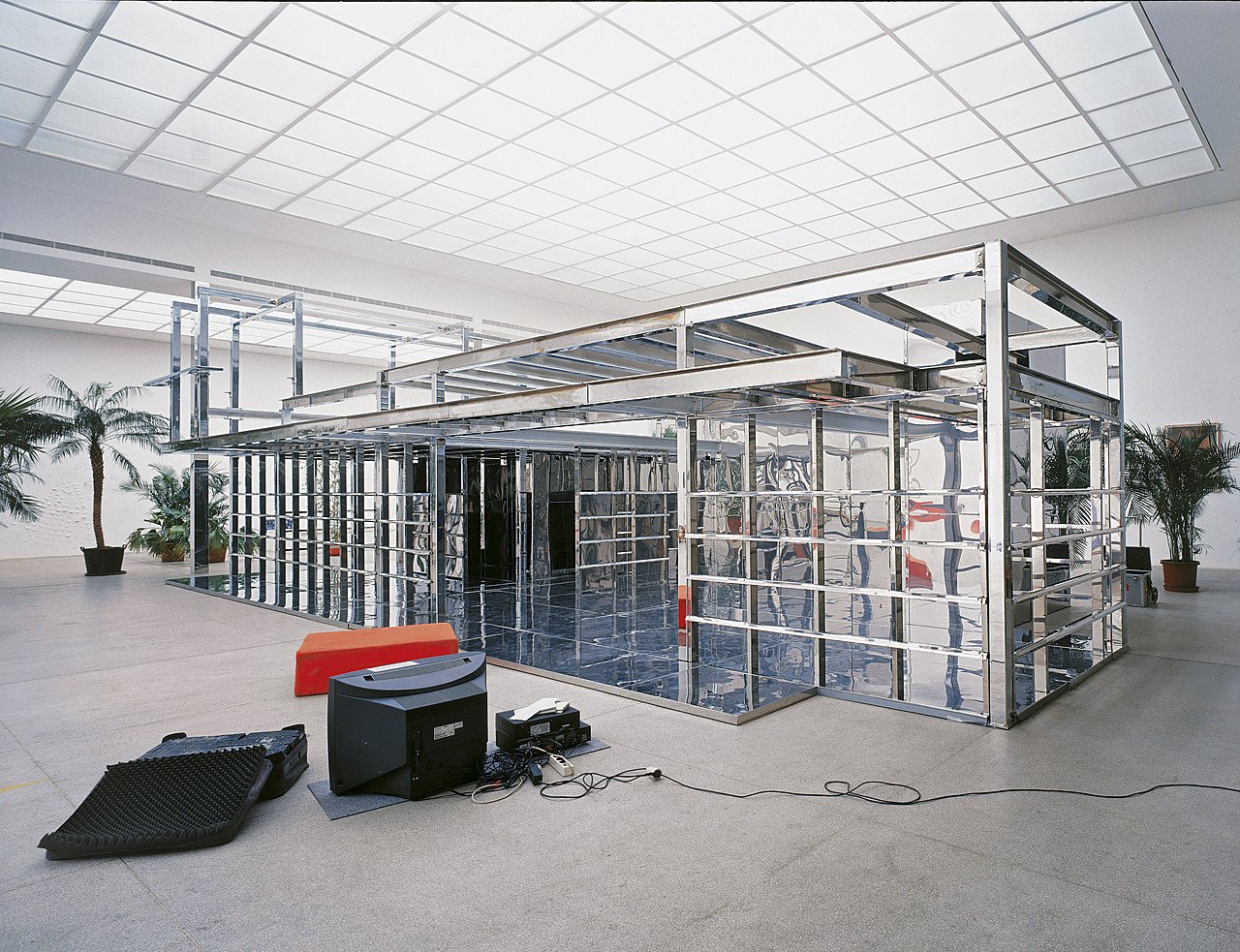
Solomon R. Guggenheim Museum · Solomon R. Guggenheim Museum
A house in West Hollywood, remade in metal
In 1922 the architect Rudolph M. Schindler built his own house on Kings Road in West Hollywood. It became known for its open plan: rooms flowing into one another, inside and garden barely divided. Wood, concrete, glass. A place designed for living together.
Eighty years later, Rirkrit Tiravanija took that house as a template. He did not rebuild it in wood and concrete. He replaced them with stainless steel and chrome plated steel. According to the Guggenheim, the work is roughly 2.9 metres high, 12 metres long and 6 metres deep, made of the metal frame, seating and live plants, with regular public programming.
The title is written in lower case: untitled 2002 (he promised). The part in brackets is the only hint of a story, and it only says that a promise was made.
The work is in the collection of the Solomon R. Guggenheim Museum in New York.
The artist who cooks
Tiravanija became known in the early 1990s for a very simple gesture: he cooked in the gallery and invited visitors to eat. Nothing to hang on the wall. Only a stove, pots, bowls, and strangers sitting down side by side. Before him, Fluxus artists had already turned food preparation into a work, as in a salad tossed in front of an audience. The Guggenheim describes him as setting aside the traditional art object to put the viewer at the centre.
He was born in Buenos Aires, the son of a Thai diplomat, and grew up in Thailand, Ethiopia and Canada. That life of moving shapes how he works. Each piece changes with the place it is built and the people who show up. The same idea, in another city, becomes another evening.
From 1998 he and other artists began The Land in Sanpatong, Thailand: a plot for growing rice, building houses, testing solar power. Art there sits closer to a way of living than to an object to be looked at.
The Guggenheim places his work in line with Joseph Beuys's idea of social sculpture, in which society itself is a material that can be shaped. For Tiravanija that material is small interactions. Eating from one pot. Sharing one long bench.
Chrome instead of wood
Why polished metal? The Guggenheim quotes Tiravanija saying the reflective surfaces create a multifaceted image of reality. People inside see themselves on the chrome, bent and multiplied. One meal becomes many. One conversation appears from several angles at once.
When installed, the frame becomes a stage for all kinds of activity: DJ sets, film screenings, panels, workshops for children. None of it is fixed. The work accepts whatever its users bring.
In 1997 Tiravanija had done something similar with Philip Johnson's Glass House, building a child sized version in the sculpture garden of MoMA. He takes model houses of modern architecture, usually photographed and admired, and returns them to daily use.
In 2004 Tiravanija received the Hugo Boss Prize, awarded by the Guggenheim. The same year the museum brought this work into its collection.
A work that needs residents
Standing before he promised when it is empty, you see a metal frame, a few chairs, a few plants. Nothing mysterious. Nothing to decode. The work is almost silent.
It only begins to speak when someone arrives. A person bringing food. A group of children drawing. A film night, the light of the screen running along the chrome. When everyone leaves, the house returns to waiting.
This is a hard question for a museum. How do you keep a work whose most important part is gatherings that are already over? The museum can keep the steel. The conversations, the smell of food, the laughter, no one can keep. They exist only in the people who were there.
Perhaps that is the promise in the title. The house promises to stay. The rest depends on who comes.
Contemporary Art