
Essays · Contemporary Art
Mona Hatoum. Present Tense.
A border can dissolve. A smell is recognised at once.
Tate · Tate
A map on the floor
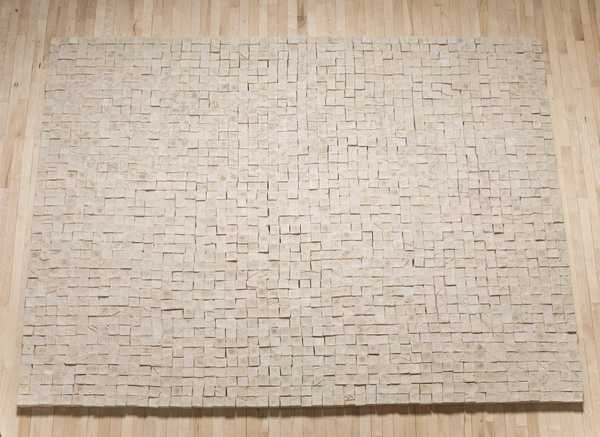
Present Tense is a floor level work of about 2,200 square blocks of soap laid tightly together into a flat rectangle, more than two metres each way. The surface is creamy and slightly translucent. Into it Mona Hatoum pressed tiny red glass beads. At a glance the beads look like an abstract drawing. Up close, they are the outline of a map.
The map is the one drawn up under the 1993 Oslo Accords between Israeli and Palestinian authorities, marking land to be handed back to the Palestinians. The red beads trace those areas, separate and scattered.
Hatoum made the work in 1996 and first showed it that year at the Anadiel Gallery, a Palestinian gallery in the Arab part of Jerusalem. It is now in Tate's collection in London, presented by Tate Members in 2013.
Nablus soap
The material was not chosen at random. The soap is made from olive oil, a traditional Palestinian product. According to Tate, the industry began in the city of Nablus, north of Jerusalem, in the tenth century and continues today.
Hatoum recalled that the Palestinians who came to see it recognised the smell and the material at once. She said she saw the soap as a symbol of resistance. The map, in her words, looked like hundreds of little islands with no continuity and no territorial integrity.
The two things set side by side make a contrast. A political border is newly drawn; it can change, it can be erased. The soap trade is over a thousand years old. Tate describes the work as showing the fleeting nature of recent remapping against the long history of a people.
A tense present
The title holds several meanings at once. The curator Nina Zimmer pointed out that it is the grammatical present tense, the tense situation still unfolding, and that present can also mean to give a gift or to present arms. Two words carry both the gift and the threat.
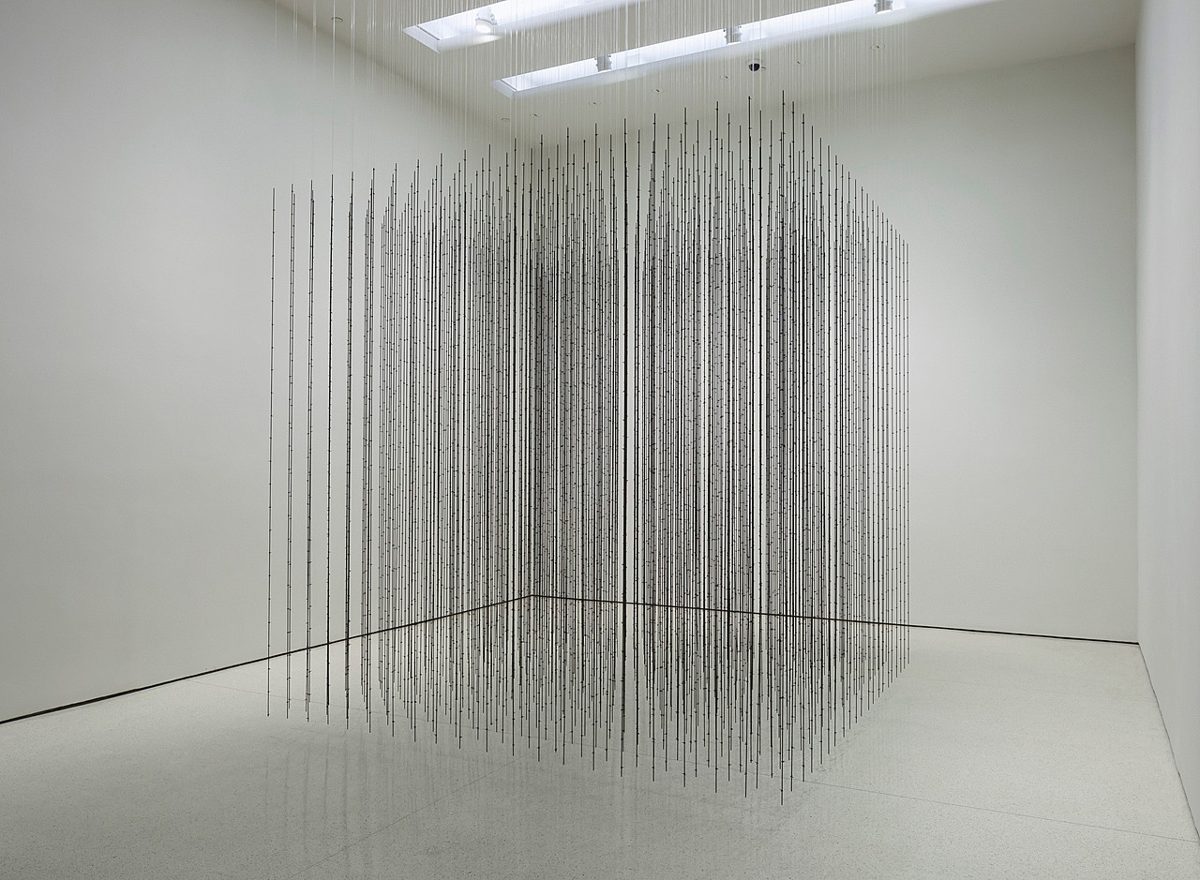
Hatoum's biography deepens those layers. She was born to Palestinian parents living in Beirut. In 1975, while visiting London, the Lebanese civil war broke out and she could not return. Maps, borders and confinement appear again and again in her later work, as in Impenetrable, a suspended cube made of barbed wire.
Even so, Tate notes that Present Tense does not deliver a single political message. It leaves the viewer standing among the ambiguities and contradictions of power.
Grid and curve
Formally, the work borrows the language of minimalism: a regular grid, identical blocks laid on the floor. But Hatoum has said that unlike minimal objects, her works are not only about themselves.
The curving line of the map breaks the order of the grid. On one side, geometry. On the other, a border bent by negotiation. Between them lie the bars of soap, a soft material that wears away with water and changes colour over the years.
The work is named in the present tense, yet it is made of a material that ages. Perhaps that is why Present Tense still stands after almost thirty years: it does not freeze a moment of history, it lets that moment keep dissolving.
Contemporary Art