
Essays · Contemporary Art
Louise Bourgeois. Cell (Eyes and Mirrors).
The viewer stays outside the cage. Only the gaze gets in.
A cube shaped cage
Cell (Eyes and Mirrors) is a room in the form of a cube, a little over two metres each way. The ceiling and two walls are woven iron mesh joined by iron bars, hinged in places. The other two walls are welded iron grids holding large square panes of glass, like oversized windows. Some of the squares are empty.
In the middle of the ceiling a hinged circular panel carries a large round mirror. The panel turns, so the mirror reflects different parts of the interior.
Louise Bourgeois made the work between 1989 and 1993. Tate in London received it in 1994, a gift from the American Fund for the Tate Gallery. Tate's record lists its materials as steel, limestone and glass.
The eyes and the mirrors
At the centre is a rough grey block of stone on two lengths of steel girder. Out of it look a large pair of eyes: two polished black marble eyeballs staring blankly outwards. Tate notes that this is a later version of a 1984 work, Nature Study (Velvet Eyes), and that Bourgeois went on to carve several more pairs of marble eyes.
Around the eyes are mirrors of every size. Small ones hang on the mesh behind. On either side stand a large oval mirror and a small round one on tall, old fashioned wood and metal stands. A square mirror leans on the floor.
One detail can only be seen in a mirror. On the back of the stone Bourgeois carved bulges like breasts. The viewer cannot look at that side directly; it appears only as a reflection. Tate reads it as a sign that the eyes belong to a woman.
The result is a dense web of reflection. Mirror reflects mirror, eyes, viewer. No line of sight stays straight or simple.
The Cells
The work belongs to a series of installations Bourgeois began in 1989, known as the Cells. They are usually built from salvaged architectural materials: old doors, windows, wire mesh, with found objects and fragments of sculpture added.
Bourgeois said, in effect, that pain was her business, and that the Cells stood for different kinds of pain: physical, emotional and psychological, mental and intellectual. She asked when the emotional becomes physical, and the other way round, like a circle with no starting point.
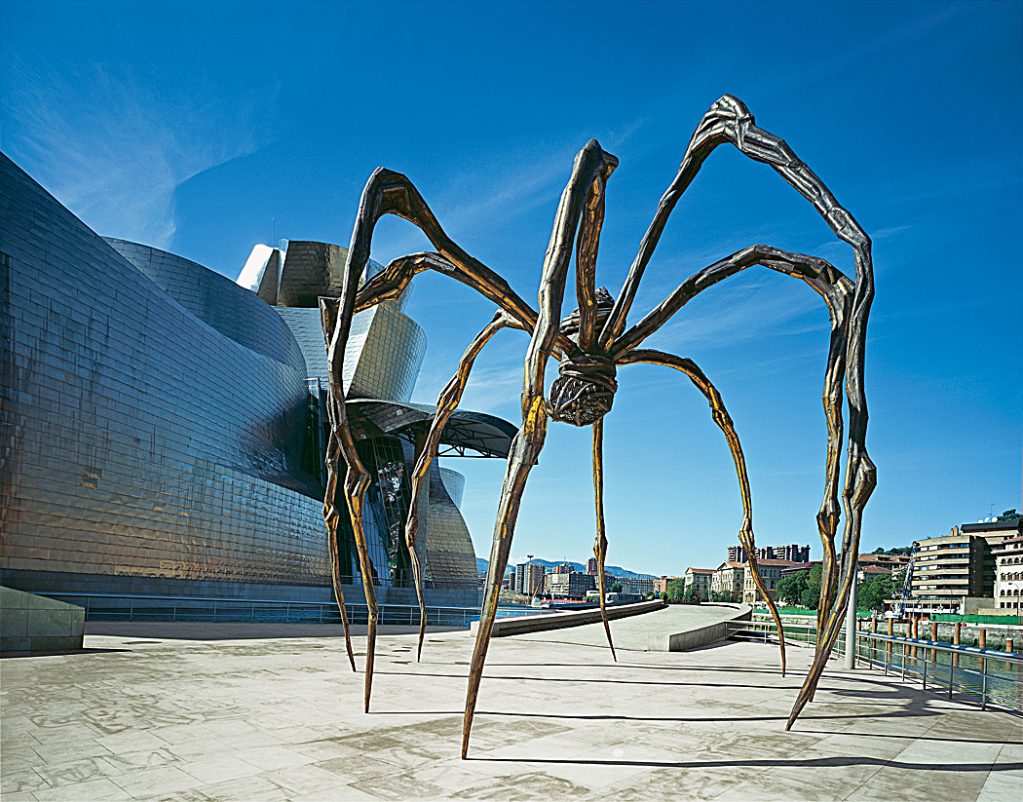
The Cells share a structure: the viewer is usually kept from entering, but invited to look in. The body stays outside; the eye passes through the bars. Looking and being looked at are positions Bourgeois returned to all her life, from prints to the giant spider Maman later on.
The courage of the mirror
A mirror can be taken as vanity. Bourgeois said that is not all it means. For her, looking into a mirror takes the courage to look at yourself and face yourself. She also said that reality changes with every new angle.
In this room the stone eyes are trapped in a space where they themselves become something for others to look at. The viewer comes to observe, then sees themselves in the glass, sees themselves looking. Watcher and watched trade places several times in a few seconds.
That is why the work keeps its weight. It tells no particular story. It builds a room that draws anyone who comes near into a circuit of looking with no way out.
Contemporary Art