
Essays · Contemporary Art
Louise Bourgeois. Maman.
A mother remembered through the work of her hands.
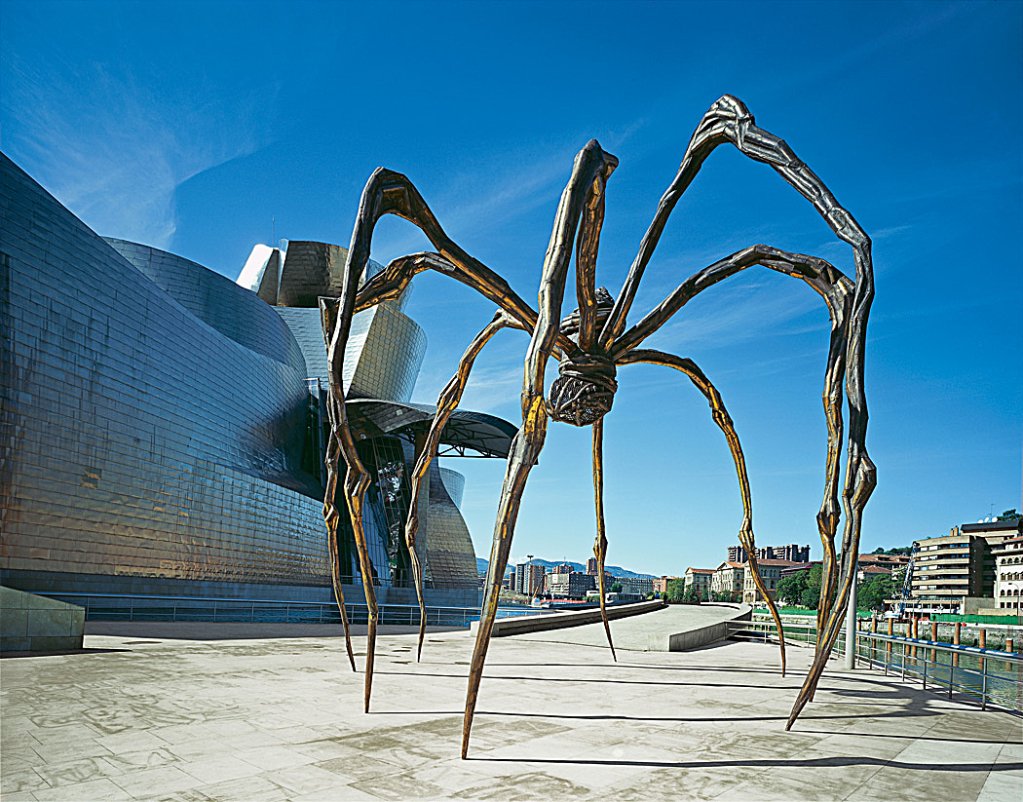
Guggenheim Museum Bilbao · Guggenheim Museum Bilbao
A spider by the river
In Bilbao, next to the footbridge near the Guggenheim museum, a spider stands almost ten metres tall. The collection lists it at 927 x 891 x 1023 cm. The body is bronze, with stainless steel, and under the belly hangs a sac of marble eggs.
Eight long legs, pointed and curved like needles. They touch the ground at eight small points, so the whole heavy mass seems to stand on tiptoe. People walking by can step between the legs, stand right under the body and look up at the eggs.
The work dates from 1999. The Bilbao piece was cast in 2001, number two in an edition of six plus an artist's proof. Other casts of Maman have stood in many cities, each time against a different backdrop: museums, squares, riverbanks.
Maman first appeared in public in connection with Tate Modern in 2000, as part of the Unilever Series in the Turbine Hall, which Louise Bourgeois opened. Since then the spider has become her best known image.
A name, a trade
Maman is French for mother. Bourgeois did not give the spider an abstract title. She named it directly. The Guggenheim Bilbao describes the work as a tribute to her mother, a weaver.
The Bourgeois family in France restored tapestries. Old hangings came in, torn places were opened, threads were joined again one by one. It was patient, repetitive work that needed sharp eyes and steady hands. Bourgeois grew up among those frames.
A spider works the same way. It spins a web, and when the web tears it spins again. It does not complain or leave. Seen this way, her choice is not strange. She was not looking for a symbol of motherhood. She was looking for a creature with the same trade as her mother.
The museum also notes the two sides of the image: the spider is both protector and predator, both strong and fragile. The egg sac is attached precariously under the body. The most precious thing is kept where it could most easily fall.
Standing under the spider
Most public sculpture is made to be seen from a distance. Maman is different. It invites people in. Under the body, the viewer becomes small, in the proportion of a child beside an adult.
Some feel safe: a large roof, eight columns, shade. Some feel uneasy: an animal standing still, and no one knows when it will move. Bourgeois does not choose for the viewer. Both feelings are true, and they often arrive together.
The materials play their part. The bronze is dark, its surface rough like bark or skin. The marble eggs are smooth and pale. Hard and soft, dark and light, placed together in one body.
Rain in Bilbao falls on the spider's back and runs down each leg. When the sun comes out, the shadows of eight legs stretch across the stone. The work changes with the hour, like a living thing outdoors.
Why Maman stays
Louise Bourgeois made Maman when she was nearly ninety. All her life she worked with childhood memory: the house, the family, what was left unsaid, as in the Cell rooms she built in the same years. The spider was an image she returned to many times, at many sizes, before it reached this scale.
Maman stays in memory because it does not explain itself. There is no text on the body, only the name. Those who know about the weaver mother see tenderness. Those who do not still see a giant animal, and feel the need to look up.
A work about a mother with no mother in it. Only the work she left behind.
Contemporary Art