
Essays · Contemporary Art
Pipilotti Rist. Ever Is Over All.
A flower has weight too.
Guggenheim Museum Bilbao · Guggenheim Museum Bilbao
Two projections meeting in a corner
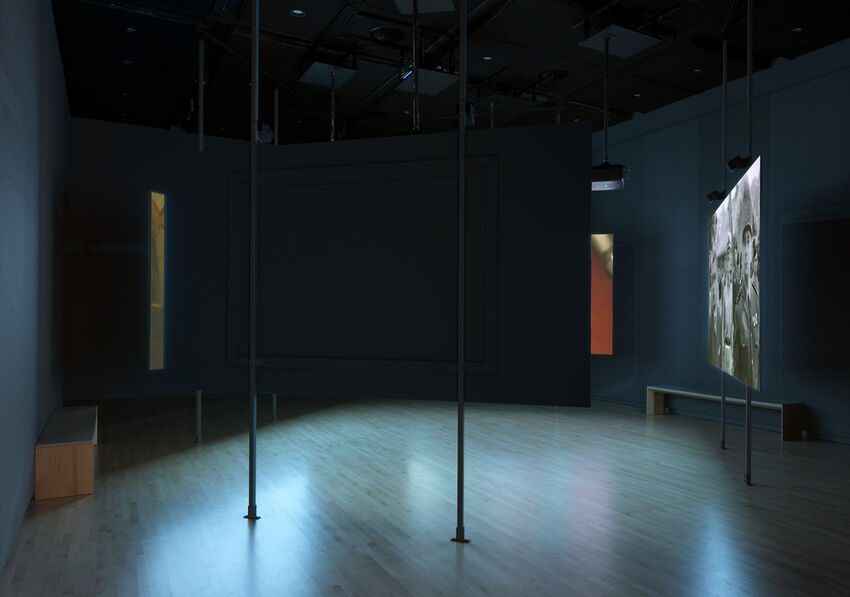
Ever Is Over All is a two-channel video installation Pipilotti Rist made in 1997. Two large projections sit on two walls that meet in a corner, and their edges overlap.
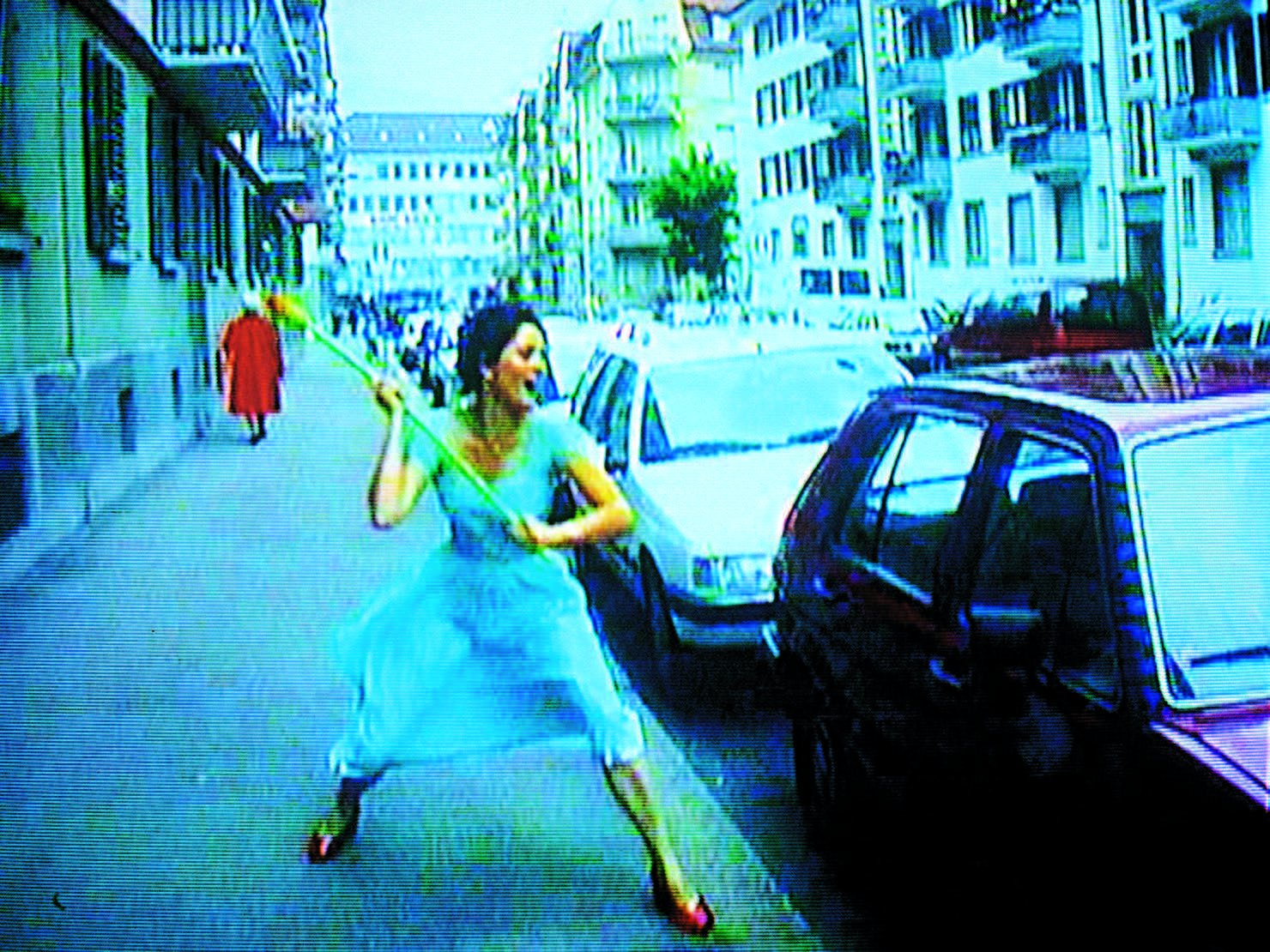
On one side, a woman in a light blue dress walks along a sidewalk lined with parked cars. She carries a long flower with a straight stem and a red head. She strolls, smiling. Then she swings the flower into a car window. The glass shatters. She walks on to the next car and swings again.
On the other side, the camera drifts slowly through red and green tropical flowers, so close that petals and stems fill the frame. No people, no street. Only colour and slow motion.
The two images do not tell the same story. But they stand side by side long enough for the viewer to start joining them. The flower in the woman's hand looks like the flowers in the next projection, as if the weapon had been picked from that very field.
Slow sound, quick gesture
The soundtrack is by Rist with the musician Anders Guggisberg: a slowed, humming melody, close to a lullaby. It does not change when the glass breaks. No climax, no dramatic cue for the blow.
That mismatch is what makes the work stick. The eye sees vandalism. The ear hears something gentle. The woman's face sides with the sound: calm, almost happy. The viewer is caught between two signals, unsure whether to worry or to smile.
One moment is often mentioned. A policewoman passes her on the sidewalk. We wait for an intervention. Instead the officer greets her and walks on. The order of the street is not broken. It simply looks away.
The work loops. She walks, strikes, walks on, and starts again. There is no ending in which the act is explained.
Violence and tenderness side by side
Rist was born in Switzerland. From the late 1980s she made videos with saturated colour, layered images, music, and the female body at the centre. Ever Is Over All is often read in that line: a cheerful, free woman stepping past the rules for how a woman should behave in public. By then video had left the television set to take over the whole room, a direction Nam June Paik had opened in the 1970s when he set televisions among living plants.
Yet the work sets out no clear message. She is not angry. She gives no reason. The cars belong to no one in particular. The blow reads more like release than accusation.
The Guggenheim Bilbao describes the work in terms of magical realism: a flower becomes a weapon, and from that comes a gesture both cathartic and hopeful. This reading keeps both sides. Breaking and relief happen at once.
Accounts of the work give its first showing as the 1997 Venice Biennale. Almost thirty years later, the Guggenheim Bilbao installed it in a room of its own, from January 2026 to January 2027.
Why it stays
Many video works ask viewers to sit, read labels, learn the context. This one does not. A few seconds are enough: blue dress, red flower, breaking glass, a smile.
It stays because it flips two things we thought we understood. Flowers are gentle. Car windows are solid. In the video the flower wins, not through its strength but because no one stops it.
In the corner where the two projections touch, the field and the street blur into a narrow band. That is where the work speaks most plainly: tenderness and violence are not on opposite sides. They share one wall.
Contemporary Art