
Essays · Contemporary Art
Richard Serra. The Matter of Time.
Time is not looked at. It is walked through.
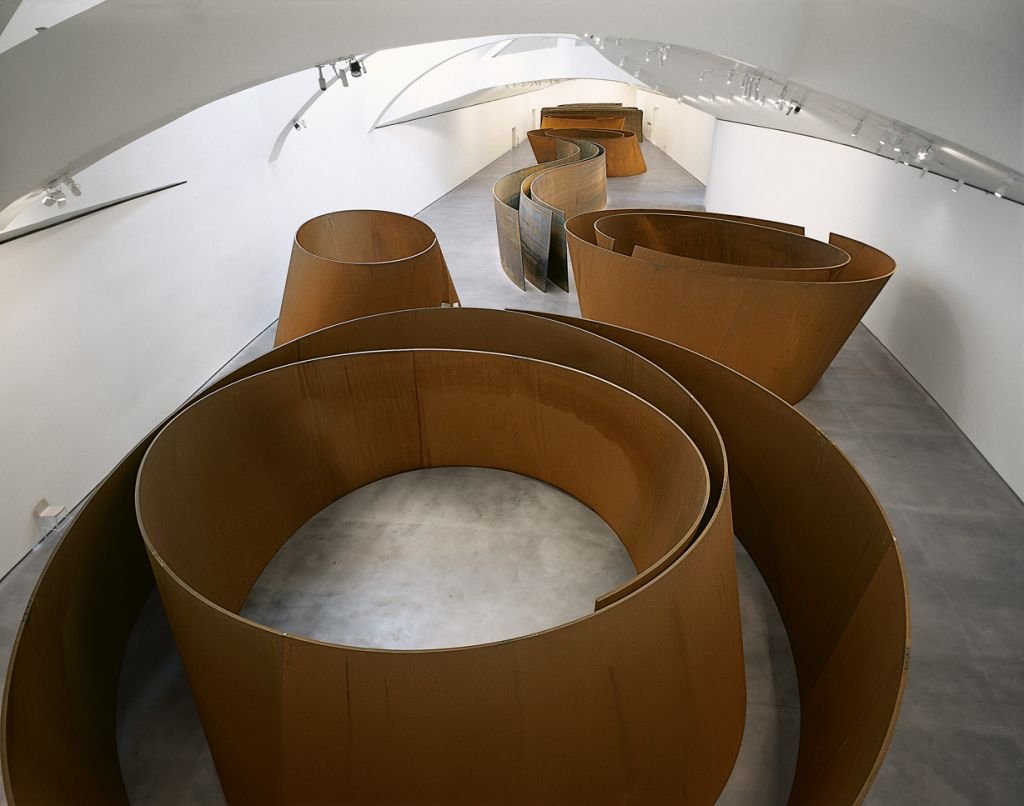
Guggenheim Museum Bilbao · Guggenheim Museum Bilbao
Eight forms in one gallery
The Matter of Time is a group of eight sculptures by Richard Serra, made between 1994 and 2005 and installed permanently in Gallery 104 of the Guggenheim Museum Bilbao in Spain.
The material is weathering steel. Left in the air, it develops a layer of brownish orange rust, and that layer protects the steel beneath from further corrosion. The surface of the work always carries the mark of time, even indoors.
Each piece is made of huge curved steel plates, rising well above head height. None has a plinth. None has a front. They stand directly on the floor like curved walls, for people to walk around and into.
The overall dimensions are listed as variable. The work is not measured in metres. It is measured in the time a person needs to walk through it.
From ellipse to spiral
The museum explains that the eight pieces follow the evolution of Serra's forms. First come double ellipses, relatively simple: two rings of steel, one inside the other, with a narrow path between.
Then come spirals, more complex. The latest pieces use sections of toruses and spheres. The torqued spirals of 2003 and 2004 produce sudden spatial shifts that make the walker feel the ground is moving.
Walking the gallery end to end, the visitor passes through a decade of the artist's work. They do not read about that process. They feel it in their feet and shoulders, and in their ears, as footsteps echo differently between the walls of steel.
Corridors you cannot predict
Serra arranged the pieces to move viewers through them and through the space around them. Between them run corridors of constantly changing proportion: wide, narrow, long, compressed, high, low.
In an ellipse the steel wall leans in, then out. From inside you cannot see the end. At times the path opens into a round clearing. At times it closes until your shoulder nearly grazes the steel. The body reacts before the mind catches up: it slows, leans, stops.
The museum speaks of vertigo. Space does not stay still; it expands and contracts with every step. Walking through the same piece twice feels different each time, depending on speed, direction, and who walks with you.
Two kinds of time
According to the museum, the work holds two kinds of time. The first is clock time: how many minutes it takes to walk and look from beginning to end. The second is the time of memory: fragments of image and bodily sensation, combined and lived again as the visitor moves on.
Coming out of a spiral, you still carry the feeling of the narrow passage behind you. Entering the next piece, old and new sensations overlap. By the end of the gallery nobody remembers the whole route. Only pieces remain. And each person keeps a different set. Two people walking together through the same eight forms come out with two maps that do not match. The work stays still; what it leaves in each person does not.
That is why the title deserves a slow reading. The Matter of Time does not tell a story about time. It turns time into something with weight, surface and direction. For steel of another kind, resting quietly beside a stone, read Lee Ufan's Relatum.

Contemporary Art