
Essays · Contemporary Art
Lee Ufan. Relatum.
The work is not in the stone, nor in the steel. It lies between.
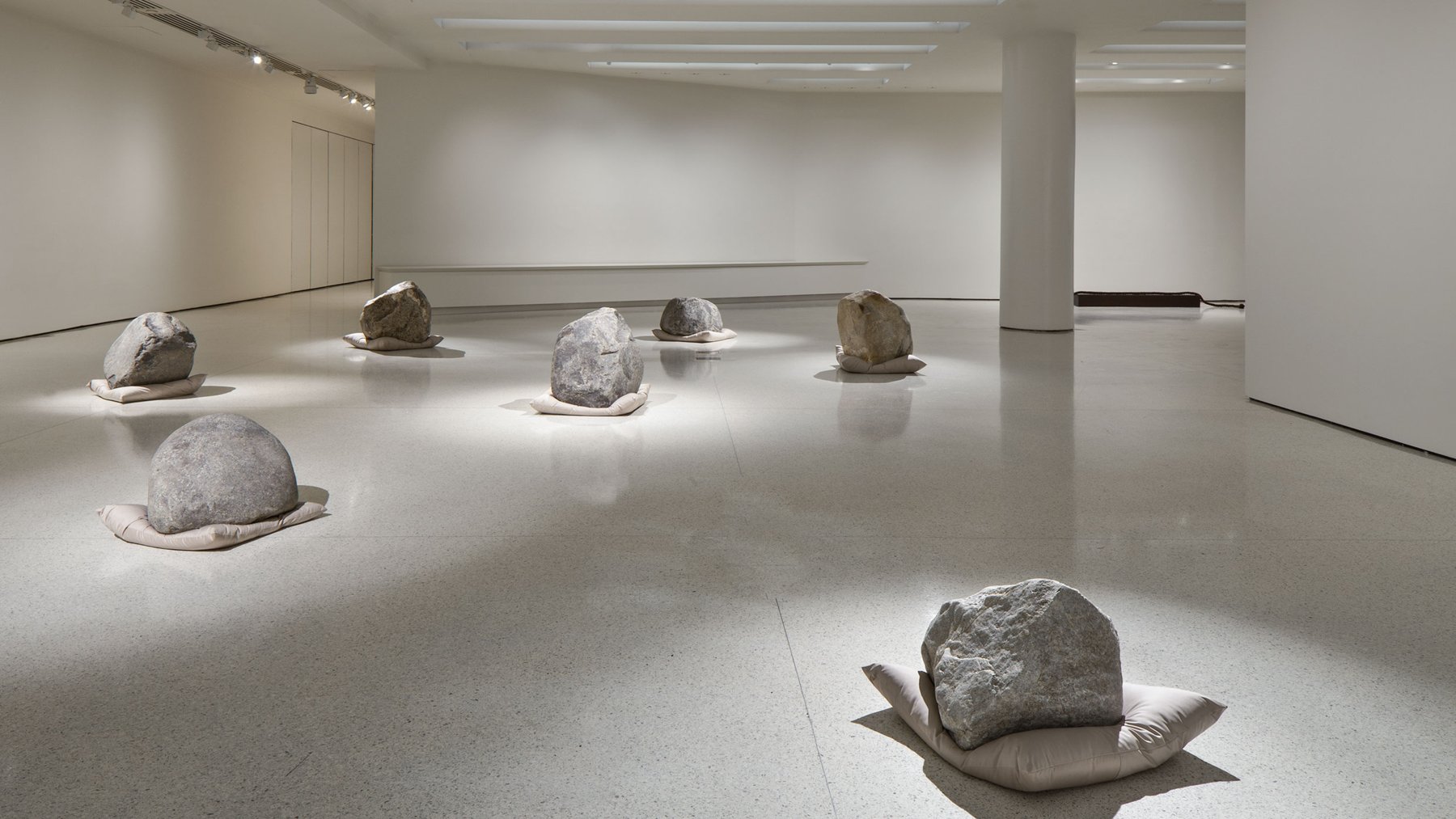
Solomon R. Guggenheim Museum · Solomon R. Guggenheim Museum
Stone, steel and a gap
In the summer of 2011, from 24 June to 28 September, the Solomon R. Guggenheim Museum in New York opened Marking Infinity, a retrospective of Lee Ufan. It was arranged the way he works: in series, repeated, spanning the 1960s to the present.
Of these, the Relatum series is the easiest to recognise. A natural stone. An industrial steel plate. Two things on the floor, close, not touching, or touching lightly. No plinth. No carving.
Lee has made the series since 1968. Its title is a philosophical term for objects or events between which a relation exists. For him, what matters is not the object itself but the network of forces the arrangement sets up in space.
The viewer belongs to that network too. Stepping closer, walking around, standing back: each position changes what the distance between stone and steel means.
The made and the not made
Since the Mono-ha period, Lee has kept his sculptural materials almost entirely to steel plates and stones. The choice is not casual.
Steel is hard, heavy, solid, the stuff used to build the modern world. Stone, in its natural state, belongs to somewhere outside the self and outside modernity. According to the museum, Lee treats stone as an image of the other, of the outside.
Placing the two with great precision, Relatum sets up a lasting coexistence: between what is made and what is not, between matter and the invisible things around it.
An earlier work in the show, once titled Phenomena and Perception A, from 1969, makes the idea clear. Three stones rest on a latex band marked like a measuring tape. Their weight stretches and buckles the band. The measure no longer measures true. What you see depends on where you stand.
A life between places
Lee Ufan was born in 1936 in southern Korea. He grew up through the Japanese occupation and the Korean War, which left the peninsula divided in 1953. He studied painting at Seoul National University, then moved to Japan and took a degree in philosophy.
In the late 1960s he became the theoretical voice of Mono-ha, literally School of Things, a Japanese movement. He was also a key figure in tansaekhwa, Korean monochrome painting. For forty years he has lived and worked between Korea, Japan and France.
Painting runs alongside the sculpture. In the From Point and From Line series, 1972 to 1984, he mixed mineral pigment with animal skin glue and used a single colour on white, cobalt blue or burnt orange. He dabbed the canvas left to right until the brush ran dry, then began again. The fading rows are a record of time passing through a body.
An emptiness that is not empty
The exhibition ended on Tower Level 7 in an empty room. On each of three adjoining walls Lee placed one broad, thick brushstroke. The work, Dialogue, space, from 2011, belongs to the Dialogue series he began in 2006.
The three strokes do not fill the room. They make its emptiness visible. Standing in the middle, you start to feel the air, the distances, the rhythm between the walls.
That is what ties Relatum to the rest of the show. Lee uses very little: a stone, a plate of steel, a stroke of paint. That restraint opens a space both empty and full, which viewers step into and become part of the relation. For steel taken in the opposite direction, read Richard Serra and The Matter of Time.
Contemporary Art