
Essays · Modern Art
Tony Cragg. Stack.
Each layer is something left behind.
Tate · Tate
A cube made of castoffs
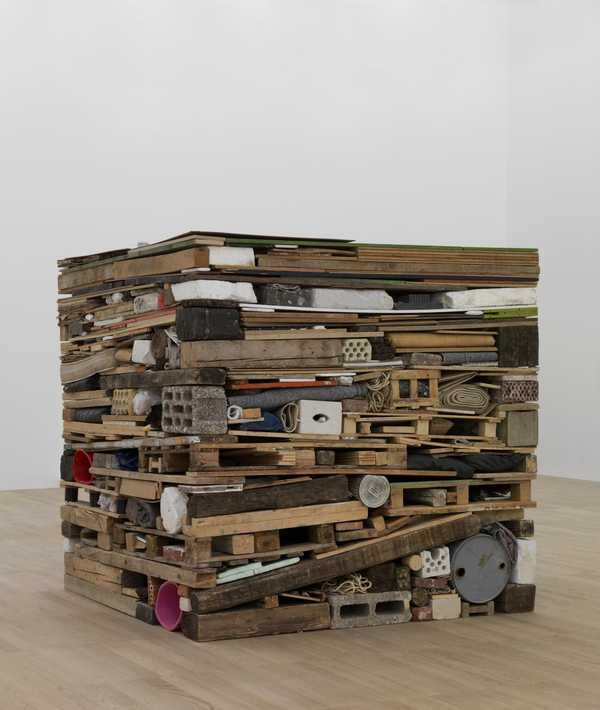
Stack is a solid cube, roughly two metres on each side. It was not cast or carved. It was stacked. Wood, concrete, brick, metal, plastic, textile, cardboard and paper are piled up and packed tightly into a neat block.
The materials range from building supplies to old magazines. Lengths of wood of different sizes run horizontally through the structure, pressing everything into dense strata. From the side, the cube looks like a cut through the ground, each layer a period of time.
Tony Cragg, born in 1949, made Stack in 1975. Tate bought it in 1997. The museum's label says that while making it Cragg gathered miscellaneous objects and materials at random and then ordered them into a solid geometric structure.
Nothing is repainted or hidden. Brick is still brick, paper still paper. Only the arrangement is new.
Geometry meets chance
Two opposites share one block. Outside is order: a cube, straight edges, right angles, the kind of form minimal sculpture of the 1960s relied on. Inside is disorder: whatever happened to be at hand, nothing picked for beauty.
Cragg does not hide the disorder. He lets it show on every face. Standing before Stack you do not see a uniform surface, as with Carl Andre's bricks or the steel boxes of the minimalists. You see paper edges, wood ends, broken brick, one by one.
Tate describes Stack as resembling a cross section of long forgotten buried rubbish. The image is both geological and archaeological. A geologist reads rock layers to learn what the ground has gone through. An archaeologist reads soil layers to learn how people lived. Stack asks the viewer to do both, with the things of their own time.
No line between landscape and city
Cragg trained in science before turning to art. He has said he refuses to distinguish between the landscape and the city. For him, what we call the natural world is more and more made by people.
Stack puts that into form. Natural strata are laid down by water, wind and millions of years. The strata in Stack are laid down by building, printing, trade and waste. Both are histories of a piece of land. Only the speed differs, and who made it.
In 1992 Cragg spoke of each material having a balloon of information around it. Wood's balloon is already very full: thousands of years of use and stories. Plastic and other industrial things have almost nothing attached. He wanted to build a new mythology for those materials, beyond their practical use.
Why Stack stays
Stack is early Cragg, yet it already holds the themes he would follow throughout his career: our relationship with the natural world, and the effect of industry on it. Tate notes that the reference to geology and archaeology runs through all his work.
The piece needs no long explanation. You stand in front of it and recognise things: a brick like the bricks of your own house, a sheet of paper like this morning's news. They are no longer in use. They simply lie there, pressed between other things.
That is what Stack leaves behind. Everything we use and discard goes somewhere. It does not vanish. It piles up, slowly, into a layer that someone later will have to read.
Modern Art