
Essays · Contemporary Art
Doris Salcedo. Untitled.
A void filled in is still a void.
Tate · Tate
A piece of furniture that no longer works
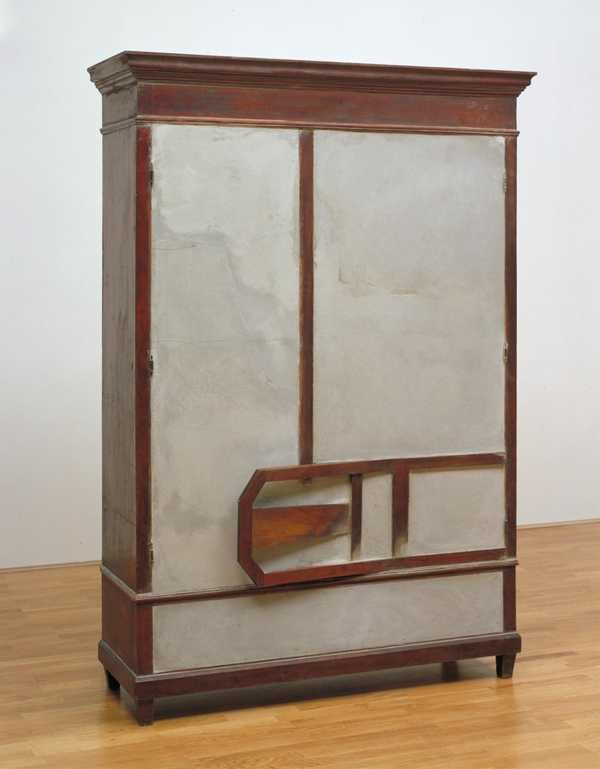
Untitled, 1998, is a work by Doris Salcedo in the Tate collection. Its materials are listed simply: wood, cement and metal. It is a piece of domestic furniture, the kind we see in bedrooms and living rooms, but its inside has been filled with cement.
From a distance it is still furniture. Up close, the viewer sees cement packed into the places meant to be empty: drawers, compartments, the gaps of doors. Nothing opens. Nothing can be held any more. The object has lost its function and become a heavy, mute block.
Salcedo, born in Bogotá in 1958, made this series of cement filled furniture throughout the 1990s. Wardrobes, tables, chairs. None has its own name. All are called Untitled.
From the testimony of those left behind
Colombia went through decades of armed conflict. Many civilians were killed, taken, or disappeared without trace. Their families were left with questions that had no answers, and with the belongings of those who were gone.
Salcedo's work of the 1990s grew directly out of the testimony of those civilian victims. She listened to the people left behind. She did not retell their stories through images of violence. She chose household objects, the things closest to daily life.
A wardrobe that once held someone's clothes. A table where someone once sat to eat. When that person is gone, the furniture remains, as if waiting. Salcedo took that waiting and made it set hard.
Cement as silence
Cement is a material of building sites, foundations, walls. It does not belong inside a home. Poured into the body of a wardrobe, two worlds collide: private life and something cold, hard, immovable.
In some works in the series, the cracks and gaps in the wood are sealed with white cement. Sometimes one piece of furniture is pressed into another. The results are objects carrying a heavy sense of absence, close to a memorial, though no name is carved on them.
The viewer is told no story. No photographs of victims, no dates, no place names. Only an object. And precisely because nothing is told, the viewer must stop and ask: who once used this, and where are they now?
Why it stays
Salcedo has kept asking what it means to make art in a time of war. In 1995 she made Atrabiliarios, with the shoes of disappeared women. In 2007 she made Shibboleth, a long crack running through the floor of Tate Modern's Turbine Hall. Each work is another way of touching the same wound.
Beside Rachel Whiteread's House, two uses of concrete to hold on to a home appear. Whiteread cast the inside of a house due for demolition, keeping the shape of its empty space. Salcedo filled furniture with cement, sealing that space shut. One reveals the emptiness. The other buries it.
Untitled does not ask the viewer to understand Colombia. It simply places a familiar object before them, made unusable, and lets that familiarity do the rest.

Contemporary Art