
Essays · Modern Art
Michelangelo Pistoletto. Venus of the Rags.
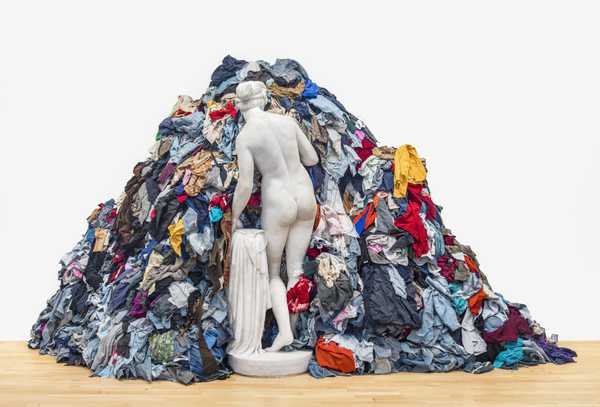
The statue does not look at us. It looks at the cloth.
Tate · Tate
A goddess and a heap of rags
A statue of Venus, larger than life and classical in pose, stands with its back to the viewer. In front of it rises a tall heap of old clothes, every colour, crumpled. The statue's face and body press lightly into the heap, so the front of the goddess is hidden. We see only her back, her shoulders, her stone hair.
This is Venus of the Rags, in Italian Venere degli stracci, by Michelangelo Pistoletto. The version in Tate's collection in London was made in 1974, from an idea Pistoletto first realised in 1967. Tate acquired it in 2006.
The two things in the work oppose each other on almost every point. Hard and soft. Formed and formless. One colour and many. Fixed and movable. Precious and discarded. Old and now. Tate lists these pairs in its account of the work, and a few minutes in front of it is enough to see them appear without explanation.
A statue from a garden centre
The most memorable detail is where the statue came from. For the first version in 1967, Pistoletto did not use an antique. He bought a cement Venus from a garden centre, the kind placed beside a flower bed, and covered it with a layer of mica so the surface glittered.
That same year he made three more versions from plaster casts of it. In 1970 came two versions with a larger plaster Venus, 160 cm tall. In 1972, one with a gilded goddess. Tate's version is unique: the figure was carved by stonemasons in Tuscany from a Greek marble containing mica. In 1980, in San Francisco, the work was even staged as a performance with a live model in place of the statue.
So the goddess is not an antiquity. She is a copy of a copy, an image of classical beauty that has passed through the casting workshop and the shop floor. Tate plainly calls the original statue kitsch.
The rags have their own history. In the first version they were cloths Pistoletto had used to clean his mirror paintings of the early 1960s. In Tate's version they are replaced by second-hand clothes. Pistoletto said that when the work is reinstalled the old rags may be kept or changed, as long as the heap stays multicoloured and rumpled.
Arte Povera: every material is available
Venus of the Rags appeared in 1967, the year a group of Italian artists began to be called Arte Povera, poor art. According to Tate, the movement ran roughly from 1967 to 1972, with Pistoletto as one of its central figures.
Poor did not mean money. It meant material: rags, earth, plants, stone, things not counted as art materials. Pistoletto said in effect that every form, material, idea and means was available to him. Cheap, pliable, colourful old clothes appear in several of his works of the time, such as Monumentino and Orchestra di stracci, both 1968.
The same circle included Jannis Kounellis, who once brought twelve live horses into a gallery. Seen from there, Arte Povera did not reject the past. It set the past, like the Venus, beside everyday life, like the clothes, and let the two collide.
Why the work still stands
It is easy to read Venus of the Rags as a verdict on consumer society. The clothes are what we buy and throw out; the goddess is lasting beauty. But the work is subtler. The goddess herself is mass produced. Classical beauty itself was sold in a shop.
What remains is the posture. The statue does not stand proudly on a plinth looking down. It turns its back on the viewer and leans on the heap as on a support. One can read beauty needing the discarded. One can also read attention: the goddess looking closely at what we no longer bother to see.
The work also changes over time. Each installation may bring different cloth. Pistoletto recalled that one of the 1967 plaster figures broke, and he rejoined it with the cracks left visible, like the tears in the rags. Statue and cloth both carry time.
From October 2026, according to Tate's records, the 1974 version travels on loan to the Ashmolean Museum in Oxford for the exhibition From Aphrodite to Venus. A goddess remade from a garden centre will stand among old images of herself.
Modern Art