
Essays · Olfactory Art
Jannis Kounellis. Untitled (12 Horses).
The work breathes, eats, and smells.
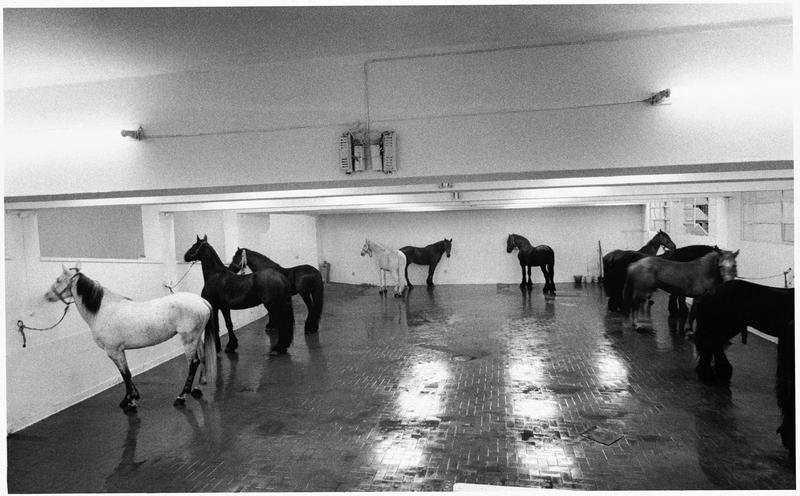
Jannis Kounellis, senza titolo, L'Attico, Roma 1969. Foto Claudio Abate · MACRO, Museo d'Arte Contemporanea di Roma
A garage on via Beccaria
On 14 January 1969 the gallery L'Attico in Rome opened a new space. Its director, Fabio Sargentini, had just moved into an old garage at 22 via Beccaria. The first artist to show there was Jannis Kounellis.
Kounellis hung nothing on the walls. He brought twelve live horses into the garage and tethered them along the walls. They stood in a row, like cars in a car park. The work had no title. It came to be called Untitled (12 Horses), or in Italian Dodici cavalli vivi, twelve living horses.
No frame. No plinth. No label. Only animals breathing, shifting their weight, eating, and a garage floor slowly covered in hay and dung.
The photographer Claudio Abate recorded the room. His black and white pictures are most of what we know of the work today. But a photograph holds only the image. What visitors to L'Attico remembered most lay outside every frame.
The smell of a large animal
According to MACRO, Rome's museum of contemporary art, many at the time saw the work as a provocation, a Dada gesture, a piece of intellectual snobbery. They found it revolting because of the smell, the encumbering presence of the animals, and the risk of being kicked.
All three complaints are bodily. No one objected that the work was hard to understand. They objected that it was too real. A horse is large, warm, able to move at any moment. Its smell fills the room and clings to clothes; it cannot be ignored the way a painting on a wall can.
The critic Claudio Cintoli argued that the work was about something very simple: liberation. Liberation from the painting, from the frame, from the idea that art must stand still and stay clean.
Smell is where that liberation is clearest. A bronze horse has no smell. Twelve real ones do. Kounellis did not depict life. He invited it into the room, with everything it carries.
Arte Povera and living material
Kounellis was born in Greece in 1936 and moved to Rome in 1956. He was one of the central figures of Arte Povera, the group of Italian artists in the late 1960s who used poor, raw, everyday materials: earth, coal, wool, fire, plants, and here, living animals.
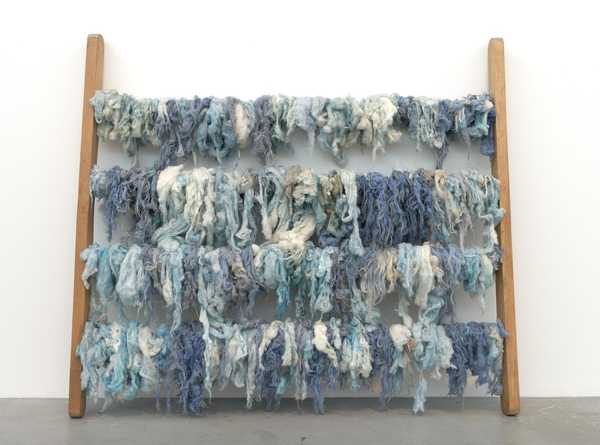
In the same years he also brought raw wool and fire into his work. In a 1968 piece, bundles of grey wool draped over wooden frames recall shepherds and market days. The horses at L'Attico went one step further: the material did not merely come from rural life, it was a living part of it.
The work was restaged at the Venice Biennale in 1976 and became one of the most cited images of twentieth century Italian art. In 2021 MACRO devoted an evening to it with the scholar Giuseppe Garrera, in a series where each session reads a single work.
More than fifty years on, what remains is not only Abate's photograph. It is the question the smell of a stable raised inside a gallery: may art live, breathe, eat and stink? Kounellis answered with twelve horses. And visitors, like it or not, answered with their noses.
Olfactory Art