
Essays · Modern Art
Jannis Kounellis. Untitled.
A painting without paint.
Tate · Tate
Two posts, four bars, some wool
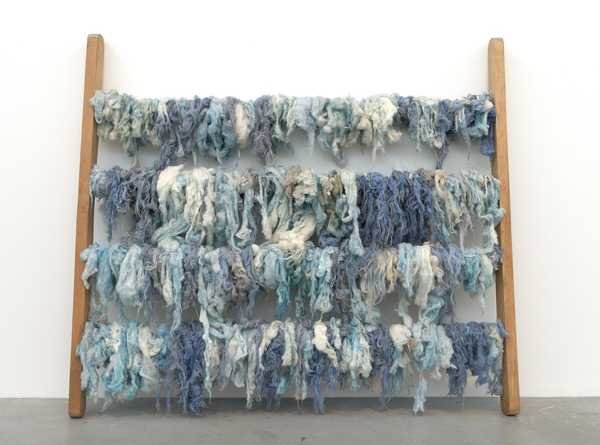
The work stands at an angle, leaning against the wall. Two upright wooden posts hold four cross bars. Over the bars hang loose hanks of wool, uncarded and unspun. Most of it keeps its ivory white. Some hanks are dyed a pale blue, very lightly, as if the colour had only just soaked in.
No frame. No plinth. On display it is about two and a half metres high and nearly three metres wide, yet only some forty five centimetres deep. It is thin like a stretched canvas, but a canvas not yet woven.
Jannis Kounellis made it in Rome in 1968. It has no title beyond Untitled. Tate bought it in 1996, and since then it has travelled: Tate Modern, an exhibition in Rome around Alberto Burri, then the Walker Art Center in Minneapolis and Museo Jumex in Mexico City during the Kounellis survey of 2022 and 2023.
Standing before it, the viewer takes a moment to know where to look. At the wood, at the wool, or at the patches of wall showing between the bars.
Leaving painting
Kounellis was born in Greece and left in 1956 for Italy. By the late 1960s he was one of the central figures of Arte Povera, the Italian artists who turned from precious materials to poor, everyday ones. When he made this work he had given up painting.
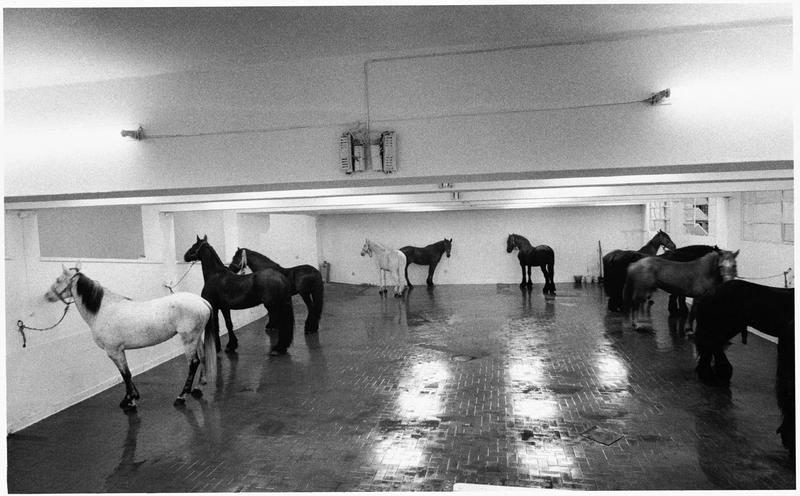
His materials became coal, iron, stone, earth, cacti, wood, fire. Sometimes live animals. In 1967, at Galleria L'Attico in Rome, he put his own parrot into a work. In 1969, in the same gallery, he brought in twelve horses, the story Penta tells in its essay on the twelve horses at L'Attico. Wool belongs on the same list. It was chosen not for beauty but because it is real and simple.
The critic Germano Celant, who named Arte Povera, described this shift in Kounellis as a move away from the written language of art towards a language of matter. Instead of speaking about a thing, the work lets the thing be present. The viewer does not need to read. They meet.
Some read his materials through history. Wool, coal, wood and horses were basic resources of older civilisations, of trade and herding in ancient Greece or the Middle Ages. In that reading the work does not look forward in a straight line; it circles back, as if progress were a loop.
Pollock, in sheep's wool
Years later Kounellis told Tate's curators something unexpected. The work was made partly in response to Jackson Pollock's Blue Poles: Number 11, 1952, now at the National Gallery of Australia in Canberra.
Pollock's canvas has blue poles running diagonally through layers of dripped paint. In Kounellis, real wooden posts stand in for painted ones. Blue and white wool is teased out and left to hang, imitating the drips. An abstract painting rebuilt from objects, by a man who had said he would no longer paint.
That detail changes the work. It is no longer only a rack of wool. It is a painting that has left the flat surface, walked into the room and leaned against the wall like someone tired.
When the wool must change
Wool lives in its own way. It gathers dust, flattens, mats with time. Before Zero to Infinity, Tate Modern's 2001 exhibition of Arte Povera from 1962 to 1972, Kounellis reworked the piece himself. He removed wool that had matted and put in fresh wool.
An oil painting is conserved to stay the same. Here, keeping the work means replacing part of it. The form remains, the idea remains, but the fibres seen today are not all the fibres of 1968.
Perhaps that is what makes it worth remembering. It does not pretend to be permanent. It admits that material has a life, fresh at times and weary at others. And the artist, instead of resisting that, chose to side with the material.
Modern Art