
Essays · Modern Art
Pino Pascali. Trappola.
The cheapest thing in the kitchen can become a trap.
Tate · Tate
A net hanging from the ceiling
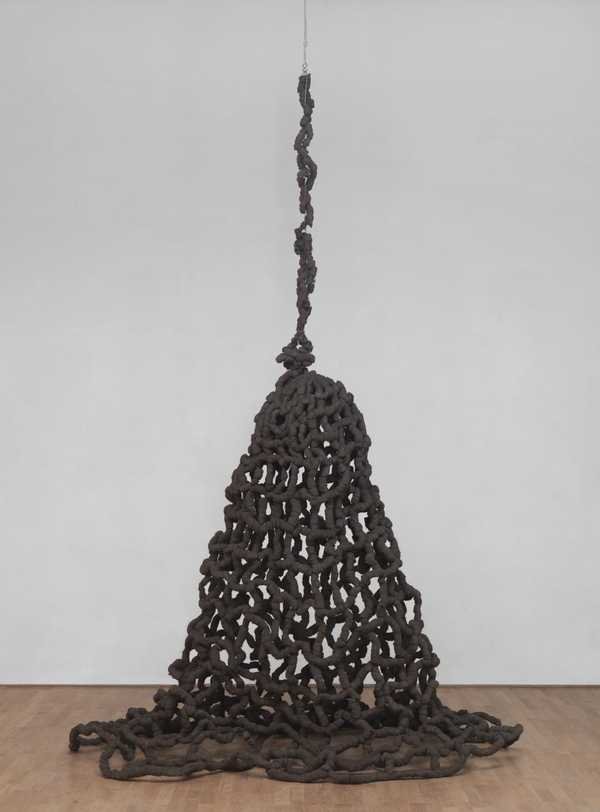
Trappola, in English Trap, is a work Pino Pascali made in 1968. Tate lists a single material: steel wool.
Installed, it stands about four metres high, two and a half metres wide and two metres deep. A thin cable hangs it from the ceiling. The top is a long stem, twisted like rope. Below, it swells into a bell shape, then spreads loosely across the floor in wide loops of net.
Up close, the mesh is made of thick strands of steel wool, wound into cords, curving and joined to each other. The colour is dark brown, dull, slightly rough like fur. Nothing shines the way we expect metal to.
The shape suggests many things at once. A fishing net. An upturned basket. A long dress touching the floor. A trap waiting for something to crawl in.
A kitchen material
Steel wool was in almost every Italian kitchen in the 1960s, as it was elsewhere. People scrubbed pots with it until it fell apart, then took a new pad. It was cheap, mass produced, unnoticed.
Pascali chose exactly that unnoticed thing. He did not cast bronze or carve stone. He bought an ordinary material in bulk and gave it a form entirely unlike its use.
What is striking is that the material is not hidden. Anyone who has held a pad of steel wool recognises the fibres, the tangle, the dull colour at once. The work does not ask us to forget the kitchen. It lets the kitchen and the giant trap exist in one object.
Around the same time Pascali made other works from cheap industrial materials, such as caterpillar like creatures made of synthetic brushes. He looked at materials the way a child looks at toys: to see what they could become.
The year 1968
Pascali is one of the artists linked to Arte Povera, the name the critic Germano Celant gave from 1967 to a group of Italian artists working with poor materials: earth, branches, cloth, stone, things with no market value. His generation included Mario Merz and his igloos built of glass, stone and earth.
But Pascali had his own voice. His work is lighter, more playful. He made seas from trays of water, animals from wooden frames covered in canvas, weapons from scrap. There is something of a game in the way he worked.
Trappola was made in 1968, Pascali's last year. That September he died after a motorcycle accident in Rome, at 32. His career lasted only a few years, yet the work from that short span is still being looked at today.
Tate bought Trappola in 2009. It has been shown at Camden Arts Centre in London in 2011, at Tate Modern from 2012 to 2016, and at Fondazione Prada in Milan in 2024.
A trap that catches nothing
A real trap has a clear purpose. It is made to catch something. Trappola catches nothing. It is too big for a fish, too open for a bird, and it hangs in a room with no prey.
Perhaps the viewer is what gets caught. We walk in, see a net taller than ourselves, circle it, peer through the mesh, try to guess what it is made of. When we realise it is steel wool, we smile, and look again.
The work swaps the large and the small, the disposable and the museum piece. A pad of steel wool lives a few weeks by the sink. Trappola has lived more than half a century.
Pascali did not explain much. He let the material do the work. And that material, looked at long enough, is no longer something for scrubbing pots.
Modern Art