
Essays · Contemporary Art
Giuseppe Penone. Tree of 12 Metres.
Inside every plank there is still a tree.
Tate · Tate
A beam, then a tree
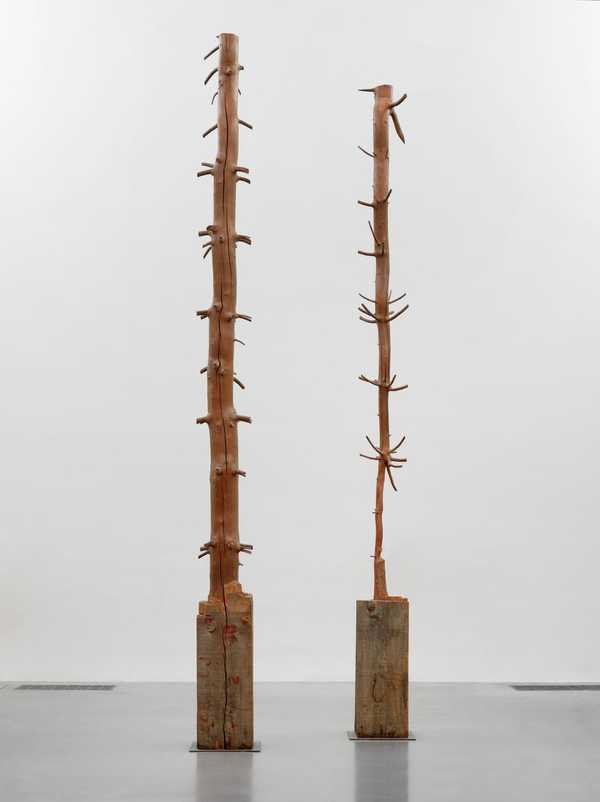
Tree of 12 Metres begins with a felled tree roughly sawn into a squared beam, the kind of industrial timber used in building. No bark, no branches, only a straight block of wood.
Giuseppe Penone took up a chisel and began to carve. He did not follow a drawing. He followed the knots. Each knot is where a branch once grew. Tracing them, peeling away ring after ring, Penone worked toward the narrow core of the trunk and its young, developing branches.
The aim was to return the tree to the form it had at an earlier stage of its life. Not the tree at the moment of felling, but the tree of many years before, when it was still slender and small.
What emerges is both a sculpture and a natural process, normally hidden inside the wood, made visible.
Two halves, one upside down
Tate's version was made between 1980 and 1982. Installed, it stands more than six metres tall. Penone left both ends of the beam uncarved, so the top and bottom of the tree remain trapped in the squared timber.
The beam is cut in two at its vertical midpoint. Each half stands on a base formed by the untouched beam. As a result the top of the tree is inverted: it grows downward, as if sinking back into the wood.
Standing between the two halves, the viewer sees two states at once. Here, sawn timber with straight edges and saw marks. There, a tree with curves and branches. The border between them is the line of Penone's chisel.
Tate acquired the work in 1989. Its Italian title is Albero di 12 metri.
Since 1969
Penone, born in 1947, is associated with Arte Povera, the Italian movement that also included Mario Merz and his igloos. He made the first of his Albero, or Tree, works in 1969.
In 1970 two Trees of 12 Metres were made as performances, one at the Moderna Museet in Stockholm, one at the Aktionsraum in Munich. Those early trees were still partly attached to their beams, emerging like reliefs, laid horizontally or propped diagonally against the wall.
Over time Penone learned to work thicker beams that held the whole core, and cut away all the supporting wood so the tree could stand upright alone. In the early 1980s he began leaving short lengths of beam untouched as bases from which the young trees rise. Tate's Tree of 12 Metres belongs to this period.
The time of the tree, the time of the hand
At a moment when many artists were leaving traditional sculptural techniques behind, Penone chose perhaps the oldest: carving. But he did not use it to shape figures or objects. He used it to go backward.
Penone has said that what intrigues him most is the relation between the real time of growth and his own time of flaying the wood. A tree takes decades to add its rings. The sculptor takes those years back by hand, layer by layer, at his own pace. Two kinds of time meet in one block of wood.
He has also said that every door, table, window frame and board contains the image of a tree. So each carving is the discovery of a new tree and a new story, not a repetition.
Tate reads the work as a view on industry and nature: even in an industrialised world, a sensitive approach to material remains possible. The beam is a product of the sawmill. The tree inside never disappeared. It was only waiting. Waiting for someone patient enough to follow each knot, and certain enough that a living shape remained inside the square block.

Contemporary Art