
Essays · Contemporary Art
Mario Merz. Igloo, Do We Go Around Houses, or Do Houses Go Around Us?
A house is something we carry inside us.
Tate · Tate
Slate, broken glass, a lightbox
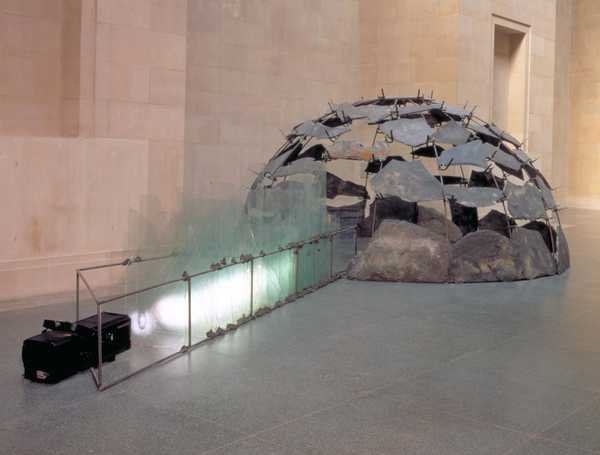
The work is a semicircular steel dome on which sixty five slate slabs spiral down from the top, fastened with G clamps and putty. It takes the shape of an igloo.
Cutting across the dome is a second, much longer steel frame that holds seventy four upright panes of broken glass, also set in putty. At the end of this row is a lightbox, shining electric light through the glass tunnel into the igloo.
The glass has sharp, irregular edges. Many panes are dusty, taped, smudged with putty. At Merz's wish, the glass must not be cleaned. The light struggles through the dirt, softening as it goes, and makes visible the long distance between the first pane and the last.
The whole work is more than ten metres long and nearly two point seven metres high. Tate bought it in 1990.
A work remade
The work carries two dates: 1977, reconstructed 1985. The 1985 version adapts a 1977 igloo with a very long title, roughly: Igloo, paving stones and broken glass from the destroyed house reactivated by art in a gallery, in a museum.
In 1977 the steel frame was covered with both slate and glass. In 1985 they were separated: slate on the dome, glass in the tunnel. The earlier title suggests materials from a ruined house brought back to life by art. According to Tate, some materials were indeed reclaimed, but there is no evidence they came from an actual destroyed house.
Taking ideas and materials from old works into new ones is typical of Merz. It is not repetition but renewal. A house is like that too: repaired, rebuilt, moved into, moved out of.
Igloos since 1968
Mario Merz, born in 1925 and died in 2003, was a central figure of Arte Povera, the Italian movement that stood against consumer society and chose humble materials on purpose. Earth, stone, branches, cloth, even the live horses of Jannis Kounellis.
Merz began building igloos in 1968, amid the student and worker protests in Italy and France. The first ones carried slogans that tied them directly to the ideals of the protesters. He went on to make dozens of versions, larger and more complex, from metal, glass, slate, cloth, earth, neon, wood, putty, fruit, wax, and once an antelope's head.
In 1971 Merz called the igloo the ideal organic shape, at once a world and a small house. He said he carried its basic image inside himself, and never stopped wrestling with it.
Do we go around houses, or do houses go around us
The title is a question Merz once posed: is space straight or curved? Do houses move around us, or do we move around houses? What does it mean to make a house?
The igloo is one of the oldest forms of dwelling: nomadic, quick to raise, made from what is at hand, left behind on departure. Merz placed it in a gallery, where visitors walk around it. And the question in the title starts to work. The viewer is walking around a house. Yet that house is also an image of a world, a dome like a sky, enclosing even those who stand outside.
The art historian Zdenek Felix described Merz's igloo as a trace of one of humanity's oldest building forms, a refuge in the mind, a place of meeting, and an ancient figure of the universe.
Slate is heavy and cold. Glass is broken and sharp. The light is weak. Nothing here promises comfort. But the shape, a closed dome, still speaks of shelter. Perhaps that is what Merz wanted to keep: a house does not need to be beautiful to be a house. It only needs to hold someone.

Contemporary Art