
Essays · Contemporary Art
Phyllida Barlow. dock.
Cheap materials, enormous forms. And a river just outside.
Tate Britain · Tate Britain
A hall made for sculpture
The Duveen Galleries at Tate Britain were the first public galleries in England designed specifically to display sculpture. Around a hundred metres long, barrel vaulted, pale stone, regular columns. A space built so that monuments could stand with dignity.
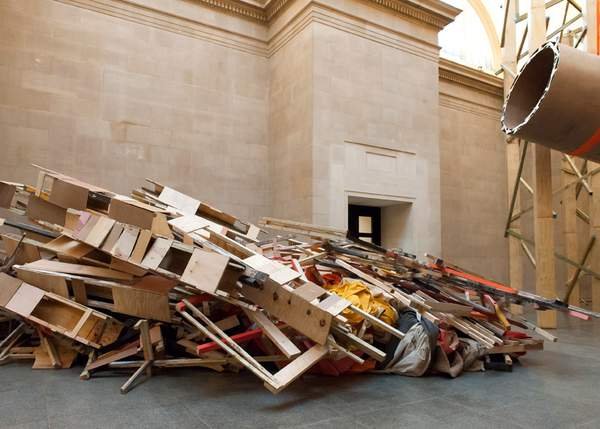
From 31 March to 19 October 2014, Phyllida Barlow filled it with dock, her Tate Britain Commission for that year and her largest, most ambitious installation in London.
dock is made of seven interrelated yet autonomous pieces. The materials are timber, metal, polystyrene, tarpaulin, canvas, cardboard and rope. Some forms look freshly smashed. Some look as if they are falling. All of them push into the space, blocking the way and crowding the view.
Things floating on the Thames
Tate Britain stands on the Thames. Barlow recalled leaving the dark, enclosed Duveens and stepping into winter light to see the black, shiny water, the quasi industrial riverside opposite, barges loaded with containers passing by. She thought at once: that is what I want to do.
For her, the container's cube was a plinth, a box, a vitrine, all the props of sculptural language. And it seemed weightless, held in water and air.
Along the central axis she built self supporting timber frames, using a construction method centuries old. From them hang blocks, barrels and abstract forms at different heights, in what she called a state of uncertainty, a limbo. Five rectangular forms among them came from the container she had seen on the river.
The title, then, is no distant metaphor. The dock is just outside. Barlow simply brought it in.
Arguing with a solemn space
Further in stands a timber cylinder about twelve metres tall, clad in cardboard and wrapped in coloured tape to hold it together. Barlow called it an absurd endless column. It stands beside the real pillars of the Octagon like a parody.
In the Octagon itself, a structure about nine metres high, built from timber frames and crates stacked like a staircase, blocks the view between the two halves of the hall. It is the only element with painted surfaces. In the north gallery, pieces that seem discarded lie beside carefully hung ones, and steel frames clad in timber are heaped with rope, polystyrene, cardboard, plastic and tape from her London studio.
There is no single place from which to see the whole. Visitors walk around, underneath, look up, look down. Barlow once called her sculptures obstacles, nuisances. In dock that is literally true.
Barlow described sculpture as a strange medium that takes up space. There is already too much stuff in the world, so making sculpture is absurd, and that absurdity fascinated her. She wanted her work to argue with space and to question the inherited masculine authority of buildings like this one.
Born in 1944, Barlow studied sculpture at Chelsea and then the Slade, where she later taught generations of students. One of them was Rachel Whiteread, who cast an entire house. Very different methods, one shared concern: the weight of the spaces we pass through every day without noticing.

Contemporary Art