
Essays · Contemporary Art
Joseph Beuys. The End of the Twentieth Century.
Even stone needs keeping warm.
Tate · Tate
Thirty one stones
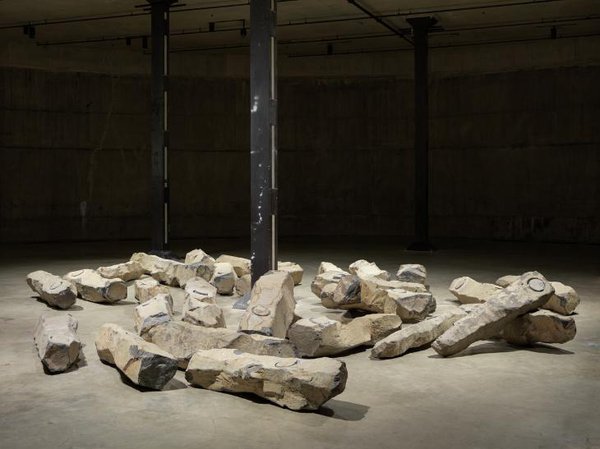
On the gallery floor lie thirty one rough, heavy blocks of basalt. Pale beige, mottled with grey. Each is between one and two and a half metres long. They sit in loose clusters that look like debris after an accident, but they are in fact arranged in two broad groups, leaving a long path down the middle for visitors to walk through.
Look closely and every block shares one detail. On its upper side, near one end, a cone shaped hole has been drilled. The hollow is smoothed and lined with clay and felt. The piece of stone taken out has been polished and set back in its place, like a plug.
This is The End of the Twentieth Century by the German artist Joseph Beuys. This version belongs to Tate in London, bought in 1991. The installation covers an area of floor about seven metres by twelve.
Three versions, one the artist never saw
Tate's version is the third in a series with the same title, made the same way. The first, of twenty one stones, was made in 1983 for the exhibition Tending Towards the Total Work of Art at the Kunsthalle Düsseldorf, after the curator Harald Szeemann asked Beuys for a new work. At the same time Beuys prepared another version of forty four stones.
In 1985 Beuys selected and prepared the stones for the third version himself. He died in January 1986, before it was installed. Tate describes it as the last large version he oversaw.
Beuys left a few sketches of possible arrangements, but no fixed rules. After Tate bought the work, the curator Sean Rainbird and Bernd Klüser, Beuys's former gallerist in Munich, drew on earlier displays and the artist's drawings to settle a layout. The work was first shown that way in 1992 and has barely changed since.
The stamp of a new world
The title names a moment: the end of the twentieth century, a century of violence and destruction. The art historian Mark Rosenthal read the work as the haphazard aftermath of a calamity.
Beuys spoke of it differently. In 1984 he explained, in substance, that this was the old world, on which he was pressing the stamp of the new. He said the plugs looked like plants from the stone age. He described drilling them out in a funnel shape and setting them back with felt and clay so they could not harm each other and could keep warm. In that solid mass, he said, there was something lively, as the basalt itself was once pushed out from the earth's interior.
Basalt is volcanic rock. Beuys cared about that origin, and the scholar Victoria Walters links it to his sense of very long, geological time. Felt, clay and basalt were all materials he used many times. Tate's gallery label calls the clay and felt lining of each hollow insulating.
From seven thousand oaks
The work is tied directly to another large project: 7000 Oaks, made for Documenta 7 in Kassel in 1982. Beuys had seven thousand stones piled in front of the Museum Fridericianum. Over the next five years each was removed and set beside a newly planted oak elsewhere in the city. In 1983 forty four of those stones were taken to Düsseldorf for an installation of The End of the Twentieth Century, then returned.
Beuys was then committed to the ecological movement and had helped found the German Green Party in 1980. Stone, tree, earth and felt belonged for him to one thought: that art could take part in bringing both nature and society back to life.
So standing among these stones, the viewer can see two things at once. A field of end of century ruin. And hollows carefully lined for warmth, as if someone believed that after the ruin there was still something to keep. Carl Andre laid bricks to speak of material and space. Beuys laid stones to speak of time.
Contemporary Art