
Essays · Contemporary Art
Nancy Holt. Sun Tunnels.
Light through a small hole becomes a clock.
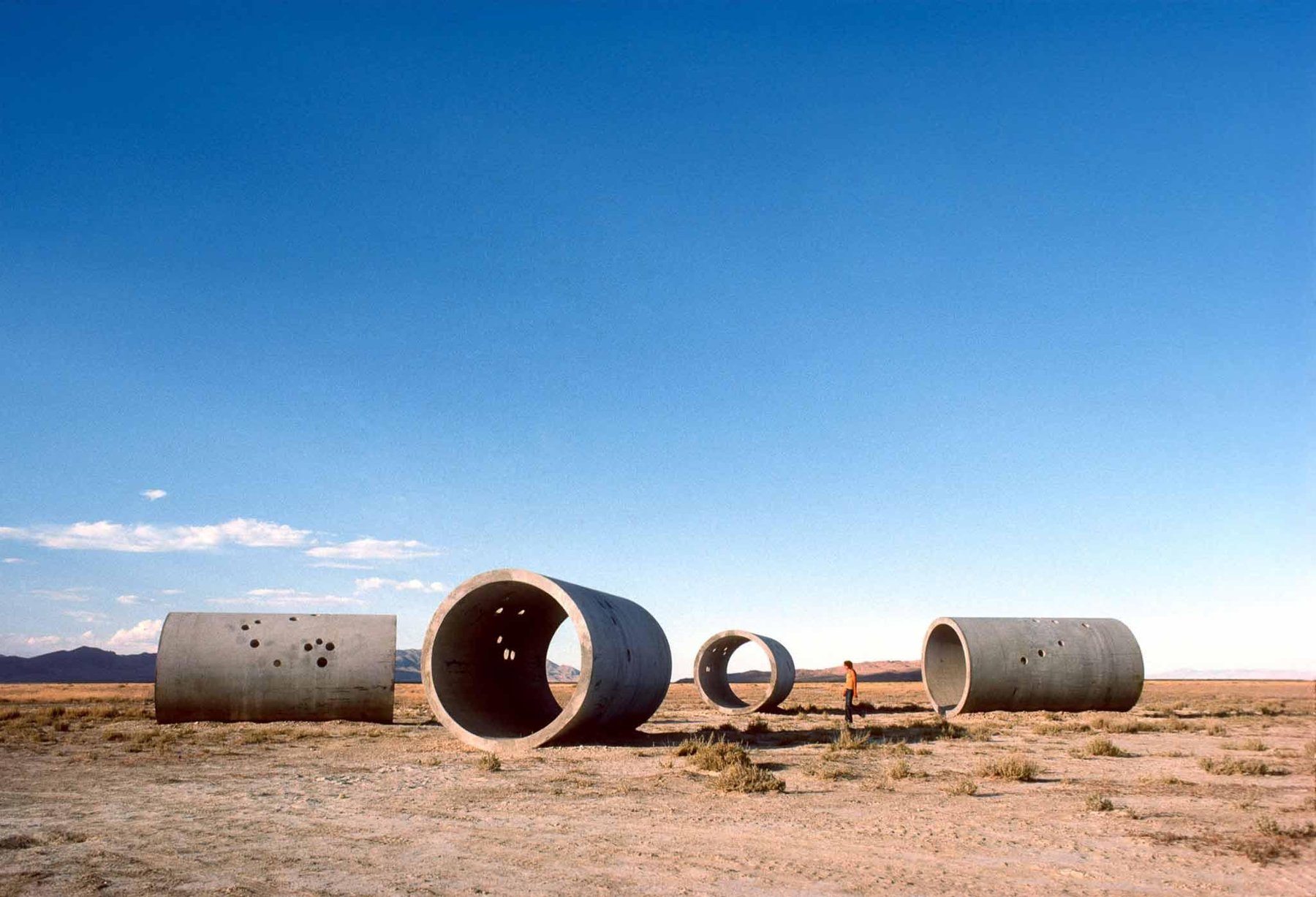
Photograph: Nancy Holt; © Holt/Smithson Foundation and Dia Art Foundation / Licensed by Artists Rights Society, New York · Holt/Smithson Foundation
Four concrete tubes in the desert
In northwestern Utah, in the Great Basin Desert, a few miles southeast of the ghost town of Lucin, four concrete tubes lie on flat ground. Each is about 18 feet long and 9 feet in diameter, tall enough for an adult to stand upright inside.
They are laid out in an open X. The longest diagonal of the whole arrangement is about 86 feet. Around them are pale earth, low shrubs, and a horizon with almost nothing in the way.
This is Sun Tunnels by Nancy Holt, made between 1973 and 1976. In 1974 she bought 40 acres here just to place the work. It is remote, far from any city. Those who want to see it must seek it out, and usually stay long enough to wait for the light to change.
The materials are simple: concrete, steel, earth. What makes the work is not on that list. It is the sun.
Summer and winter solstice
Two tubes are aligned with sunrise and sunset on the summer solstice. The other two are aligned with sunrise and sunset on the winter solstice. On those mornings and evenings, someone standing at the end of a tube sees the sun sitting inside the concrete circle, as if in a lens.
For the rest of the year the sun drifts off those axes, then returns. The work does not change. Only the position of the light changes. Staying there through a year, one would see the earth's movement around the sun marked by four tubes.
Holt recalled that the idea became clear while she was in the desert, watching the sun rise and set each day, as if keeping the earth's time. The work is her way of holding on to that watching.
Constellations in the walls
Each tube has round holes drilled through its concrete wall. They are not random. According to the Holt/Smithson Foundation, they correspond to four constellations: Draco, Perseus, Columba and Capricorn, one per tube.
By day, sunlight passes through the holes and casts round spots of light on the inside of the tube. As the sun moves, the spots slide slowly across the curved concrete. Someone sitting inside sees a sky of stars made of daylight, and sees it move.
Inside the tube there is shade, rare in that open land. The work is at once an astronomical instrument and a shelter in an empty desert.
The sky through a round frame
Nancy Holt belonged to the land art generation of the 1970s, artists who left the gallery to work directly with earth, rock and open space. Her husband, Robert Smithson, made Spiral Jetty on the Great Salt Lake, also in Utah. But Holt took her own path. She did not shape the ground. She shaped the way of looking.
The desert is so wide that the eye finds nothing to hold. The concrete tubes cut that width into round frames, just enough to see a part of the sky, a piece of the horizon. By being limited, the gaze becomes precise. A sky that is too wide we only skim. A piece of sky inside a round frame makes us stop, and start noticing which cloud is drifting, which way the light is leaning, whether our shadow is growing or shrinking.
Today Sun Tunnels belongs to the Dia Art Foundation, cared for together with the Holt/Smithson Foundation. It still stands there, unguarded, without tickets. The sun still rises right inside the tubes on the appointed days.

Contemporary Art