
Essays · Contemporary Art
Robert Smithson. Spiral Jetty.
Make a thing, then let the place finish it.
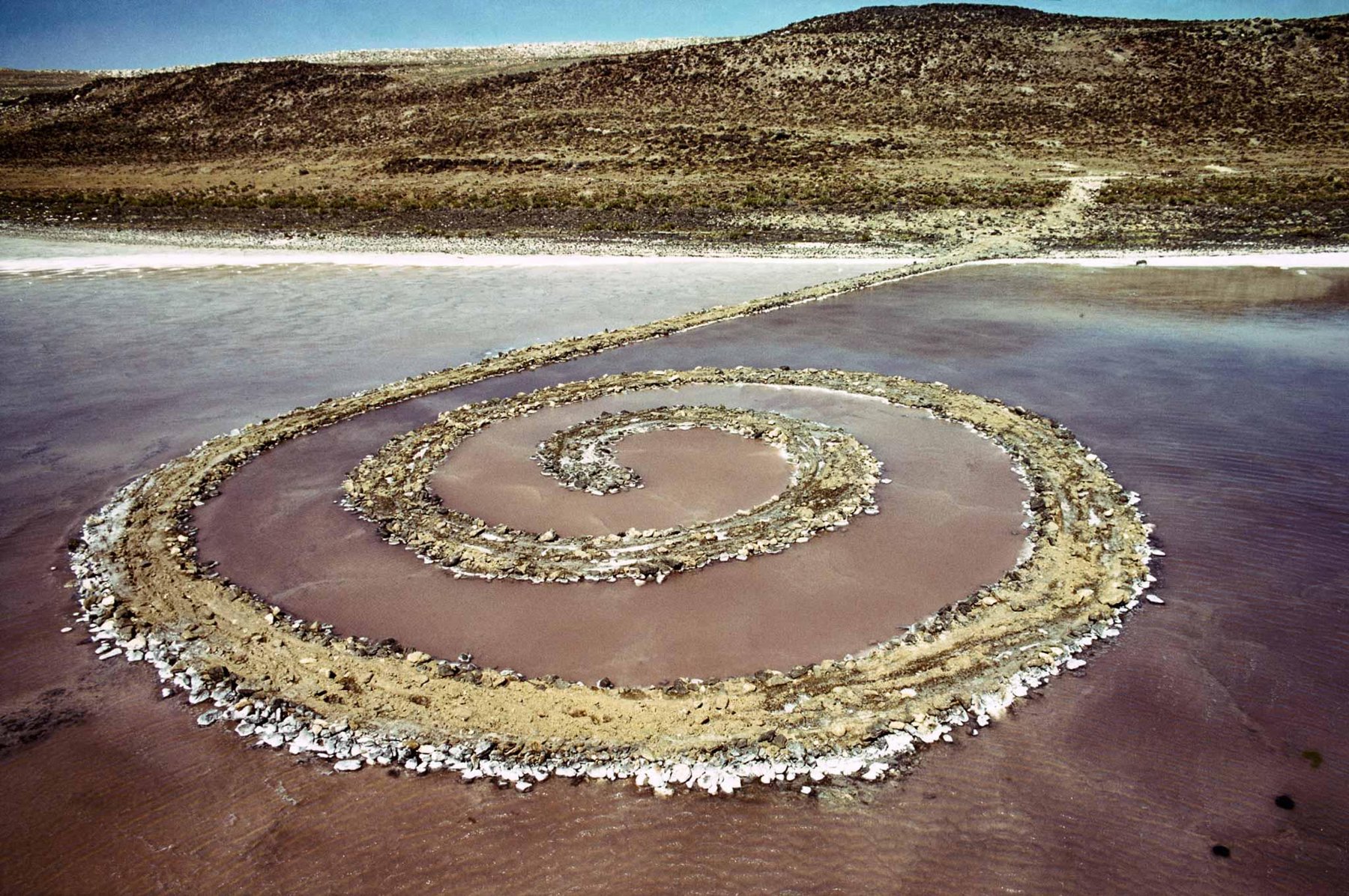
Photograph: Gianfranco Gorgoni; © Holt/Smithson Foundation and Dia Art Foundation / Licensed by Artists Rights Society, New York · Holt/Smithson Foundation
A spiral on a salt lake
On the northeastern shore of the Great Salt Lake in Utah there is a spit of land called Rozel Point. In April 1970 Robert Smithson built a low causeway here, running from the shore into the water and coiling into a counterclockwise spiral.
According to the Holt/Smithson Foundation, Spiral Jetty is about 457 metres long and 4.6 metres wide. It is made of some 6,650 tons of black basalt and earth taken from the site. Along with the rock come mud, precipitated salt crystals and lake water, all counted among its materials.
No plinth, no frame. The rock was tipped from trucks and levelled by machine. The work is a line drawn on the land, but a line weighing thousands of tons.
From the shore, visitors see only a stone causeway slowly curving. To see the whole spiral, one has to climb the slope behind or look from above.
Choosing a leftover place
Smithson did not choose Rozel Point for its beauty. The Holt/Smithson Foundation notes that he chose it partly for the industrial remains nearby: abandoned oil rigs and, not far away, Golden Spike, where America's two transcontinental railways met in 1869.
It was a landscape of things used and left behind. Smithson liked such places. He often wrote about entropy, the tendency of things to slide from order to disorder, from heat to cold, from form to collapse. Rusting rigs by the lake were entropy made visible.
His spiral does not resist that process. It is placed inside it. The work was conceived to interact with the changing conditions of its site.
The Great Salt Lake is many times saltier than the sea. Its level rises and falls with rain, drought and the water people draw off. At times the spiral has been under the surface. At times it lies exposed, black rock crusted with white salt.
One work, three forms
Spiral Jetty is not only the causeway. Right after building it, Smithson and Nancy Holt made a film, also called Spiral Jetty, in 1970. Two years later, in 1972, he wrote an essay with the same title.
For Smithson, all three belonged to one work. The causeway lies in Utah, far from any city, hard to reach. The film and the essay carried it to places the rock could not go. People could know Spiral Jetty from a screen or a page before ever standing on it.
Nancy Holt was his wife and a land artist in her own right. A few years later she built Sun Tunnels in the Great Basin Desert, also in Utah. Two works in one region, looking in different directions: he looked down at earth and water, she looked up at the sun.
In 1973 Smithson died in a plane crash while surveying the site for another work in Texas. He was 35. Spiral Jetty became the largest work he left behind.
Letting time continue
In 1999 Nancy Holt and the Estate of Robert Smithson gave Spiral Jetty to Dia Art Foundation. Since then Dia has cared for it together with the Holt/Smithson Foundation.
But care here does not mean keeping it unchanged. No one wipes the salt off the rocks or rebuilds what the waves wear away. The work is left open to its place, as intended. Salt crystals form and dissolve. Mud settles and dries.
Someone visiting today sees a different Spiral Jetty from 1970, and someone visiting in ten years will see another. No version is the original. The work is the whole process of change.
The spiral suits this idea. It does not close like a circle. It keeps turning inward, as if still on its way.
Contemporary Art