
Essays · Olfactory Art
Haegue Yang. Sol LeWitt Upside Down: K123456, Expanded 1078 Times, Doubled and Mirrored.
The eye sees a volume. The nose knows it is hollow.
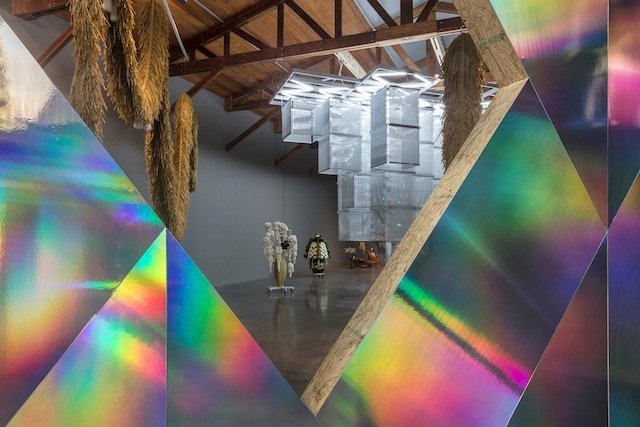
Haegue Yang, Ornament and Abstraction, 2017 · ArtReview
A cube turned over
The work's title reads like a formula: Sol LeWitt Upside Down, K123456, Expanded 1078 Times, Doubled and Mirrored. The Korean artist Haegue Yang made it in 2015.
The starting point is K123456, a cubic structure LeWitt made in 1997. LeWitt was a central figure of minimal and conceptual art. He worked with cubes, grids and rules that could be written down for others to carry out.
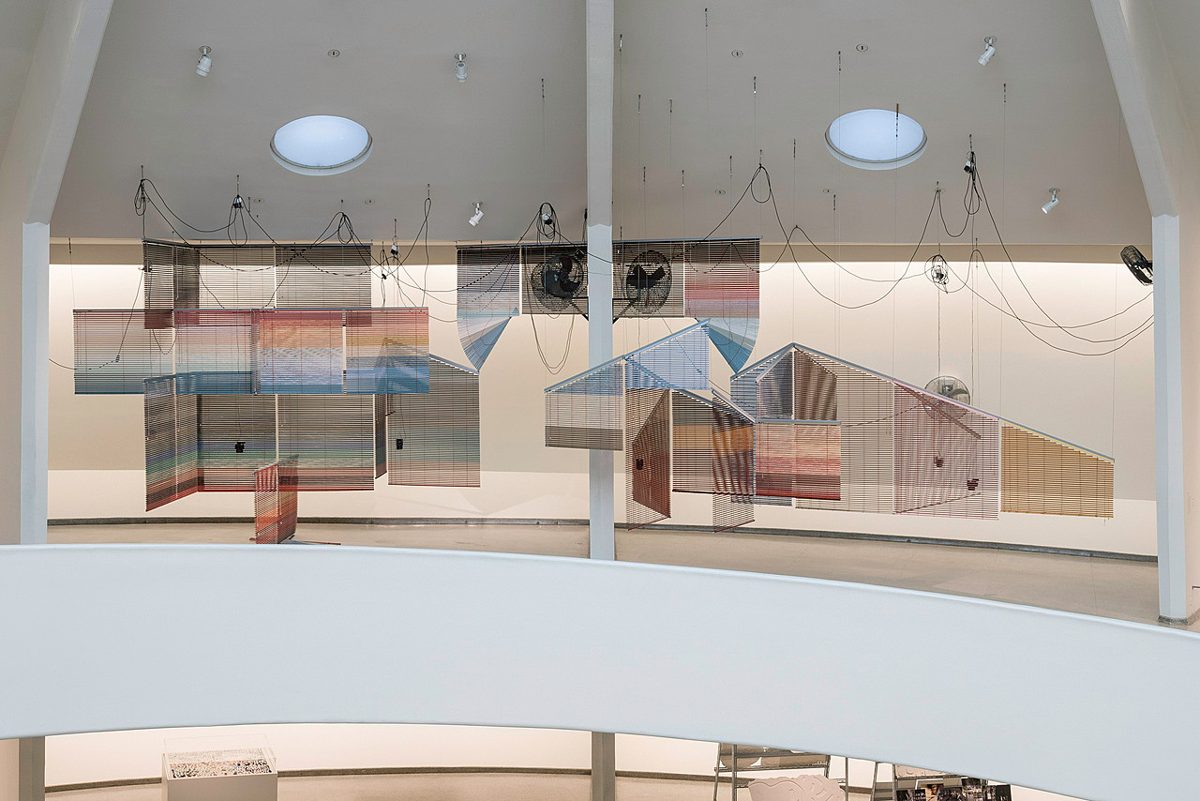
Yang reads the structure as a drawing that can be transformed. She enlarges it, doubles it into two volumes, mirrors them, and hangs them upside down from the ceiling. The final size is 840 × 562.5 × 1052.5 cm, the scale of a room.
The material is aluminium Venetian blinds, hung from a powder coated aluminium frame and held with steel wire.
Venetian blinds
Blinds have been part of Yang's vocabulary for years. They are found in offices, apartments and hotel rooms everywhere. Neither beautiful nor ugly, hardly noticed. Their job is to block and filter: light, sight, air.
At this scale they keep that job. Depending on the daylight and where one stands, the volume is solid as a wall or thin as a haze. Walking around it, visitors watch the form appear and dissolve.
One can walk around it and through it. Inside, the slats become thin partitions, dividing the space without closing it.
That is where visitors meet the smell. Yang placed aroma diffusers in the work. Scents appear as one passes, fade, return. Air and smell had appeared in her earlier works many times. Penta writes about one of them in Series of Vulnerable Arrangements.
Ornament and abstraction
In 2017 the work was shown in Yang's exhibition Ornament and Abstraction at kurimanzutto in Mexico City, from 1 April to 6 May. The title names her question: are ornament and abstraction really opposed?
Modernism treated ornament as excess, even something shameful. Abstraction, in that view, had to be clean and pure. Yang disagrees. The same show included The Intermediates, sculptures in synthetic materials with the striped saekdong colours of traditional Korean dress, and graphic works covering the walls. She sets folk elements, symbols and craft right beside geometry.
Sol LeWitt Upside Down sits exactly at that meeting point. The frame is pure abstraction. The material is a household object. The smell belongs neither to geometry nor to ornament.
Not parody, a reply
Turning a master's work upside down could read as mockery. Yang's approach is closer to a reply. She does not break LeWitt's logic. She extends it with new rules: enlarge, double, mirror, invert. LeWitt thought of the idea as a machine that makes the art. Yang runs the machine one more time.
Only one thing escapes the rules: the smell. It cannot be measured in metres, multiplied 1078 times or mirrored. It is simply present, stronger or fainter, depending on where one stands and when one breathes.
Perhaps that is what Yang truly adds. A minimal structure meant to be looked at must now be walked through and breathed. The geometry remains. But there is air inside it now.
Olfactory Art