
Essays · Olfactory Art
Haegue Yang. Sallim.
A kitchen known by its smell, not its walls.
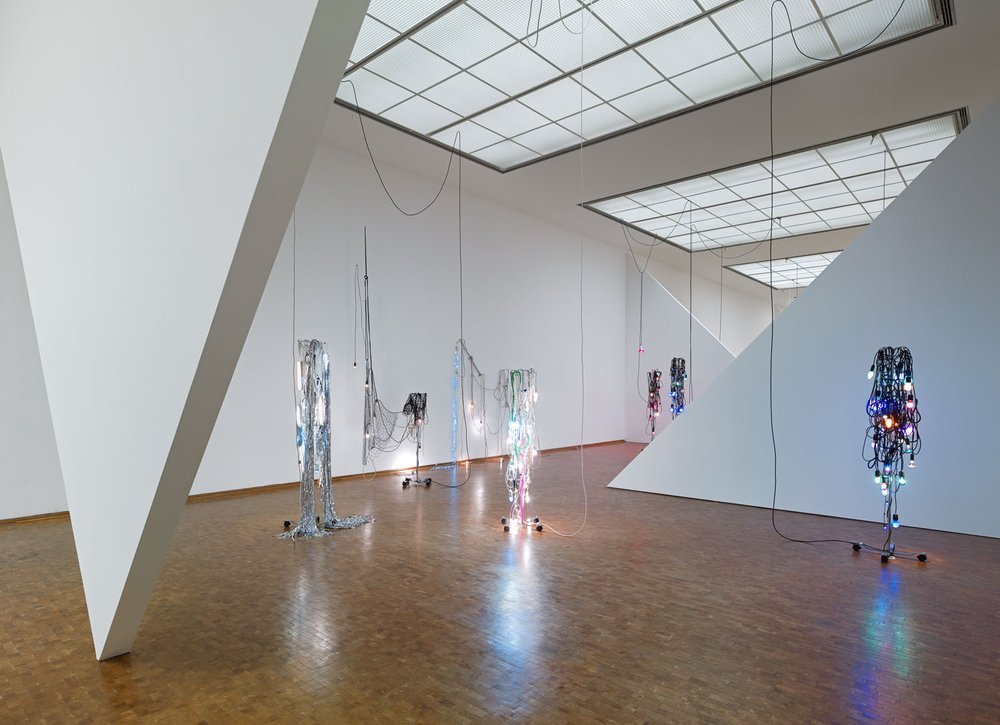
Installation view, "Haegue Yang: ETA 1994–2018", Museum Ludwig, Cologne, 2018. © Haegue Yang/Saša Fuis · ARTnews
A kitchen of steel frames
In 2009 Haegue Yang represented Korea at the 53rd Venice Biennale with the solo show Condensation in the Korean Pavilion. It ran from 7 June to 22 November 2009, with Eungie Joo as commissioner. One of its three works was Sallim.
Sallim is a full-scale model of the kitchen in Yang's Berlin apartment, where she both lived and worked. It is not a replica of an interior. No brick walls, no wooden cabinets. The kitchen is rebuilt in steel frame and perforated steel plate, like a three-dimensional drawing in the air.
The work is about 2.5 metres high, over 4 metres long and about 3 metres deep. Within the frame are cables, light bulbs, an electric fan, venetian blinds, and both mass-produced and hand-crafted objects. There are kitchen things. There is light. There is wind.
And there is smell. Scent emitters in the frame release the smells of food while the fan moves air through the kitchen. Visitors enter a kitchen that looks like a skeleton to the eye but smells to the nose as if someone were cooking.
Sallim, a hard word to translate
Sallim is a Korean word roughly meaning the running of a household. It covers cooking, cleaning, arranging, providing. Unpaid work, and so work that is rarely counted.
Yang sees the kitchen as a place of preparation. In the Korean Pavilion's words, it is a site of preparation for action and the organisation of life, a space outside commercial pressure. Before a person goes out to work, meet, make, there is a kitchen that fed them.
The piece also looks back to feminist art of the 1960s and 1970s, when many artists spoke about undervalued domestic labour. The kitchen was long a workplace for women that no one called a workplace. Yang put it into a national pavilion in Venice.
Yet Sallim does not speak as a manifesto. It is quiet. Only light, fan, and smell.
Condensation
The exhibition was titled Condensation. Like vapour gathering into drops on cold glass. Yang used the image for an indirect kind of communication: information passed between strangers, without clear function, yet meaningful to existence.
Smell is condensation of that kind. A kitchen smell says nothing specific. It does not tell what was cooked, by whom, for whom. But whoever smells it knows at once that there is life here. Someone stayed.
The other two works in the pavilion go the same way. Doubles and Halves, Events with Nameless Neighbors is a video essay joining two overlooked places: the Ahyun-dong neighbourhood of Seoul and the Biennale grounds themselves. Series of Vulnerable Arrangements, Voice and Wind stacks coloured venetian blinds with industrial fans and scent emitters; see the essay on Voice and Wind.
An artist between two places
Haegue Yang was born in 1971 in Seoul and works between Berlin and Seoul. That moving life shows in Sallim. A Berlin kitchen rebuilt in Venice, for a pavilion bearing Korea's name. A home carried like luggage.
For people living far from where they were born, the kitchen is often where home lasts longest. One can speak a new language and wear new clothes, but the smell of the food in one's kitchen is hard to change. Sallim does not say this outright. Yet a Berlin kitchen, belonging to a Korean artist, shown in Italy, is already a map.
Sallim later entered the collection of MoMA in New York. The frame, bulbs, fan and scent emitters are kept as sculpture. But the living part returns only when the machines are on, the air moves, and the smell comes out.
A kitchen does not need walls to be a kitchen. It needs someone who once cooked there.


Olfactory Art