
Essays · Contemporary Art
Haegue Yang. Series of Vulnerable Arrangements, Voice and Wind.
A name on a bottle is not a place.
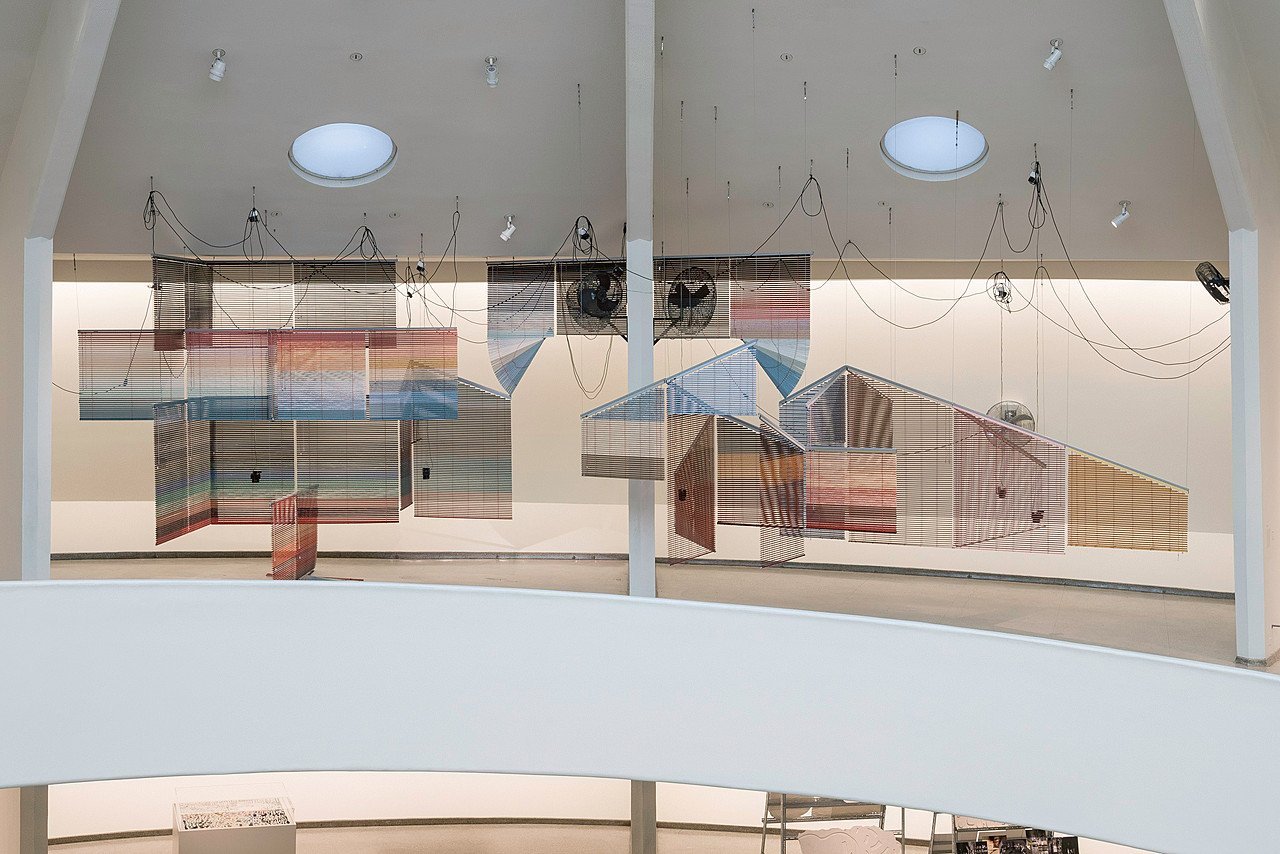
Solomon R. Guggenheim Museum · Solomon R. Guggenheim Museum
Blinds, fans and scent emitters
Series of Vulnerable Arrangements, Voice and Wind is a 2009 installation by Haegue Yang, now in the collection of the Solomon R. Guggenheim Museum in New York. Its dimensions change with each space.
The list of materials reads dryly: aluminium venetian blinds, aluminium frame, industrial electric fans, scent emitters, and scents. Nothing was made specially for the work. Everything can be bought.
The blinds hang as thin partitions, dividing the room into passages. The fans turn and the slats sway. Between those movements, scent drifts out of the emitters. Visitors walk through, look between the slats, and see other people only in narrow strips.
There is no main viewpoint. No object sits in the middle of the room. The work is the sum of wind, light through the gaps, the sound of fans, and smell.
Six names
The Guggenheim lists the six scents by name: Buddha Temple, Fresh Cut Grass, Rainforest, Ocean Mist, Cedar Wood and Eucalyptus.
Read together, the list is like a travel map. A temple in Asia, a suburban lawn, a tropical forest, a coast. All of it produced chemically and sold in identical machines.
According to the museum, Yang asks why mass production would try to capture sensations that are variable, culturally bound and sublime. The smell of a temple is not the same in two places. It depends on the wood, the incense, the person lighting it, the season. A machine cannot hold that. It can only hold the name.
When Buddha Temple drifts through an aluminium blind in a New York gallery, the distance between name and place becomes very clear. Visitors smell something. What that something is, each fills in for themselves.
Household things in the middle of the room
Blinds and fans belong to a home. The museum reads them as an allusion to home, and at the same time as partitions that divide the space and separate viewers from their surroundings and from each other.
Yang's work often turns on travel, displacement, living between places. A blind is what we lower for privacy. A fan is what we switch on when a room is stuffy. Brought into a public space, the private is put on show, yet it tells no particular person's story.
That is why the title carries the word vulnerable. Everything is light. The slats sway, the scent fades, the light shifts with the angle. Nothing is fixed. The arrangement holds only as long as the fans keep turning.
Three senses in one passage
The Guggenheim describes the work as an environment where smell, touch and sight collapse together. The eye sees the slats, the skin feels the wind, the nose picks up the scent. No sense leads.
This makes Voice and Wind hard to photograph. A picture keeps only the blinds and fans. Wind and scent, the two most important parts, vanish. Someone who never stood in the room will see only an aluminium installation.
Perhaps that is why the work leaves a question that outlasts its image. The names printed on the scents around us, in cars, hotels, shops: what places are they promising? And have we ever actually been there? Another work from the same series is discussed in Version Utrecht.
Contemporary Art