
Essays · Modern Art
Piero Manzoni. Artist's Breath.
The breath has gone. The skin stays.
Tate · Tate
A scrap of rubber on a wooden base
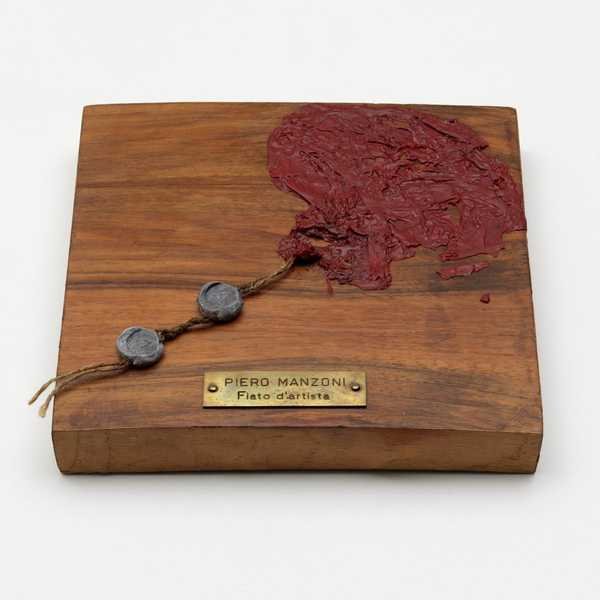
At first glance there is almost nothing. A low, square wooden base. On it, a crumpled scrap of red rubber stuck flat to the wood. A string tied to the rubber, carrying two small lead seals stamped with the name Piero Manzoni. A small metal plaque on the base giving the artist's name and the title in Italian: Fiato d'artista, artist's breath.
The scrap was once a fully inflated balloon. Manzoni filled it with his own breath in 1960 and mounted it on the base as a sculpture. Over time the air escaped, the balloon deflated and the rubber stuck to the wood beneath. Today it is brittle and in places very fragile.
This example is in Tate's collection in London, given by the collector Attilio Codognato in 2000. The whole object stands about three and a half centimetres high on a base some eighteen centimetres square. The string is fixed only where it meets the balloon; the rest lies in place under the weight of the two lead seals.
Selling the body by the litre
Manzoni did not make one balloon. He made several, and nobody is yet sure how many. The 1991 catalogue raisonné lists eleven; the Manzoni archive in Milan has since recorded more, in white, red and one blue.
Before Artist's Breath came Bodies of Air, made in 1959 and 1960. Each was a wooden box holding a balloon, a stand and a pump. The buyer could inflate the balloon, or pay extra for Manzoni to blow it up himself. Tate records that he priced his breath at 200 lire per litre.
In those years Manzoni made a run of works based on his own body. He drew lines of various lengths and named the works by their measure. He pressed his thumbprint onto eggs and then ate them. He signed a woman's body to declare her a living sculpture. Most famous is Artist's Shit of 1961, tins said to contain the artist's excrement, sold for their weight in gold.
In that sequence, breath is the lightest thing. It has no shape, no colour. To sell it, it needs a skin.
Eternal, then deflated
In 1960 Manzoni said that when he blew up a balloon he was breathing his soul into an object that would become eternal. The balloon was not eternal. It deflated. The thing that gave it value, the artist's breath, was the first thing to leave.
Tate calls this a paradox both comic and sad. One museum label writer recalls that on first seeing the work in person, the hairs on their neck stood up, though the object was slight, almost invisible. The deflated rubber can be read as an image of a body that has run out of air.
Manzoni was not the first to make art from air. In 1919 Marcel Duchamp sealed 50 cubic centimetres of Paris air in a pharmacy glass vessel. From 1959, Yves Klein sold zones of immaterial sensibility in exchange for gold. Manzoni went a step further: he took what was inside his own body as material.
Why the skin is worth remembering
Artist's Breath asks a simple question: what are we keeping, when the thing we wanted to keep has left? The museum preserves a scrap of rubber, a string, two lead seals. The breath is gone. Yet nobody says it is not the work.
Perhaps it is because the breath has gone that what remains means something. Inflated, it would only be a balloon. Deflated, it becomes evidence that a breath was once there, from a particular person, in a particular year.
Seen this way, the work is not a joke about value. It is a way of recording time through wear itself.
Modern Art