
Essays · Modern Art
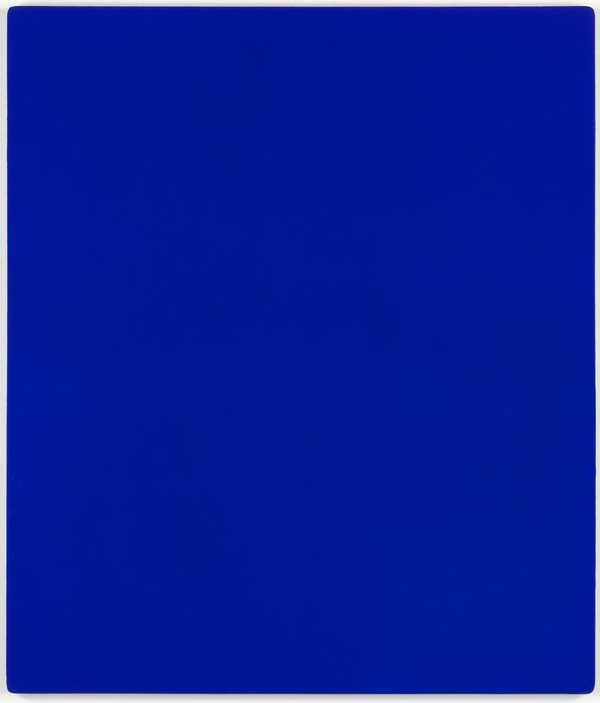
Yves Klein. IKB 79.
A colour that clings to nothing.
Tate · Tate
One canvas, one colour
IKB 79 is an upright rectangle, about 140 centimetres high, 120 wide and three deep. The entire front is covered in a deep blue. No border, no brushmark, no signature on the front.
The back carries Klein's personal sign, an eight pointed star, and the words IKB 79. According to Tate, that inscription is not in Klein's hand. The title was given after his death.
Klein made nearly two hundred blue monochromes in his short life. He died in June 1962, aged thirty four. He did not title them. After his death his widow, Rotraut Klein Moquay, numbered all the known ones from IKB 1 to IKB 194, not in the order they were made. Others found later were also given IKB numbers.
In 1974 Rotraut examined the Tate painting and wrote that she was fairly sure IKB 79 was one of about four similar works Klein made at Gelsenkirchen, West Germany, in 1959, when she was with him. Tate bought the work in 1972.
A blue with a man's name
IKB stands for International Klein Blue, a distinctive ultramarine. In 1957 Klein registered it as a trademark. That year he began what is known as his blue period, and he kept making blue monochromes until his death.
Klein believed this blue had a quality close to pure space. He linked it with immaterial values beyond what can be seen or touched. The card for his 1957 solo show at the Galleria Apollinaire in Milan called IKB a blue in itself, free of any functional reason.
He had made monochromes since the late 1940s, as a way of refusing that painting must represent anything, and so of reaching creative freedom. The early ones have uneven, rippled surfaces. Later ones, like IKB 79, are much finer and more even.
Pigment as if still wet
Klein's problem was pigment. As a powder, ultramarine is bright and deep. Mixed with oil or an ordinary binder, it dulls. Klein wanted the brilliance of the powder in a finished painting.
By around 1957 he had a method. Canvas or cotton scrim was stretched over a wooden backing treated with casein, a milk protein that helps paint adhere. Then with a roller he applied an industrial blue paint close to gouache, mixed with a highly volatile fixative.
When the paint dried, the fixative had mostly evaporated. The pigment seems to float over the surface, velvety, with a depth hard to explain. Close to IKB 79, one does not see a layer of paint. One sees a blue with no floor.
That is also why photographs always fail it. Screens and paper cannot hold the powderiness. To know what IKB 79 is, you have to stand in front of it.
Eleven identical paintings
In Milan in 1957 Klein hung eleven blue paintings that looked the same. Each had a different price. He said each had its own essence and atmosphere, though the blue and the treatment were identical. What struck him most were the buyers: each chose in their own way and paid the price asked.
Tate notes that many of Klein's actions, such as selling zones of immaterial space for gold, walked a thin line between the spiritual and the commercial. The monochromes were probably both a spiritual practice and something to sell.
Klein belonged to the Nouveaux Réalistes in France. Like Piero Manzoni in Italy, he drew on the daring and wit of Marcel Duchamp. They asked where a work's value lies: in the object, the idea, or the artist?
IKB 79 does not answer. It simply stands there, blue and silent. And the viewer, like the buyers in Milan, decides what they see.
Modern Art