
Essays · Contemporary Art
Steve McQueen. Bear.
In silence, we hear ourselves breathe.
Tate · Tate
Two bodies, one shaft of light
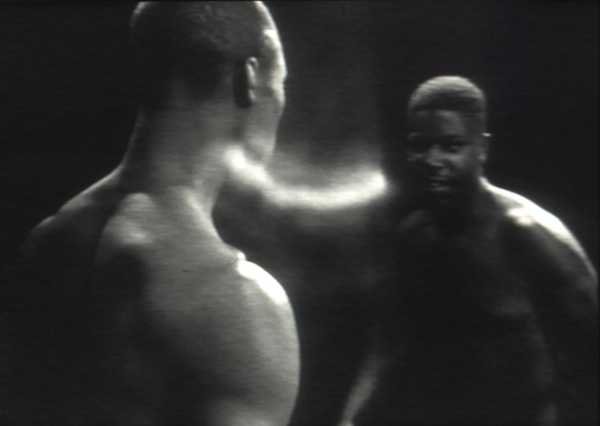
Bear was Steve McQueen's first major film, made in 1993. It was shot on 16mm film, black and white, silent, then transferred to video for projection. In 1996 Tate acquired it, presented by the Patrons of New Art.
The film shows two naked men. One of them is McQueen himself. They tease, tussle, wrestle, then stand and look at each other. The encounter swings between tenderness and aggression. There are no words. Only stares, glances, winks.
Tate describes that exchange of looks as an optical language of flirtation and threat. The viewer is never sure which language it is. Perhaps both.
The camera as a hand
Bear opens against cinematic habit. No establishing shot, no sense of place. The first frame is a close up of a man's shoulder. The camera moves slowly up and to the right across his face, so close it seems to feel its way over the skin.
In less than a minute that slow rhythm breaks. The two men spar, dodge, circle each other. They move through a shaft of light. Sometimes it glints on the sweat on their skin. Sometimes it throws them into shadow. Sometimes it strikes the lens full on and blinds the viewer for a second.
Some shots look up from beneath the two interlocked bodies, verging on abstraction, only limbs and shadow. Near the end, a sequence of feet circling the camera, taunting and dodging, is cut in a rhythm that recalls Eadweard Muybridge's nineteenth century studies of motion. McQueen's interest in early cinema shows here.
One wall, a polished floor
How Bear is shown is part of the work. The image fills a wall from floor to ceiling in a black room. The floor is highly polished, so the image is reflected across it too. There is nowhere to stand outside the picture.
The two bodies on the wall are larger than life. The viewer stands below them, between them and their reflection. McQueen explained that he wanted viewers to be truly involved in what is happening, participants rather than passive watchers.
The silence is deliberate. No music to steer feeling, no sound to announce a blow. McQueen wanted people entering the room to become sensitive to themselves as they watched. In that room the only sound is breathing, and it is the viewer's own.
What is left unsaid
Bear is not overtly political. No slogans, no commentary. Yet Tate notes that for many viewers it raises sensitive questions of race, homoeroticism and violence. Two naked men wrestling in darkness, watched by a room. Each viewer brings what they already think.
Because the film says nothing, viewers have to listen to their own thoughts. That is the real pressure of the work. The gaze inside the film turns back on those outside it.
Like all McQueen's early films, Bear is black and white. In those years several British artists stayed close to celluloid, among them Tacita Dean, who later made FILM for the Turbine Hall. In Bear, film is not nostalgia. It is a way for light to touch skin, and for viewers to feel touched.
Contemporary Art