
Essays · Contemporary Art
Tacita Dean. FILM.
Film is an object, not only an image.
Tate · Tate
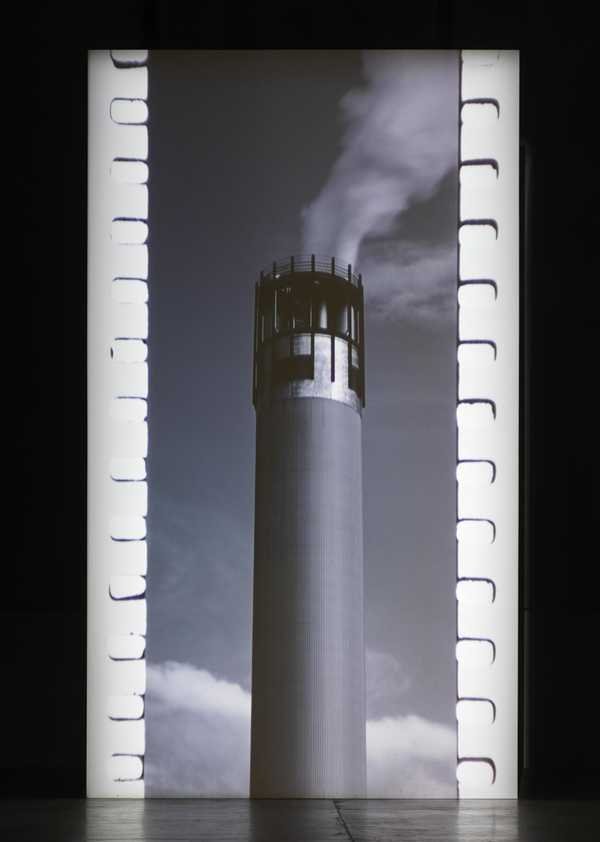
A strip of film standing upright
In 2011 Tacita Dean took on The Unilever Series, the programme that each year invites one artist to fill the Turbine Hall at Tate Modern. The hall was once the turbine room of a power station. It is long, high and hard to fill. Before her, Olafur Eliasson had hung an artificial sun there, and Ai Weiwei had spread millions of porcelain sunflower seeds across the floor.
Dean brought no objects. She brought an image. At the end of the hall stood a screen roughly 13 metres tall, and on it ran a silent 35mm film on a loop of about eleven minutes. The frame was not horizontal like a cinema screen. It stood upright, like a strip of film held up to a lamp.
Along both edges ran the sprocket holes that carry film through a projector. Viewers normally never see them. Here they framed everything.
Tate lists the medium plainly: 35mm film, projection, black and white and colour. The title is just as plain. FILM, all capitals, like a sign.
Everything made in the camera
Nothing on the screen was assembled on a computer. Dean built the images inside the camera using old cinematic techniques: masking part of the lens, exposing the same stretch of film several times, winding back, shooting again. Every layer is a moment when real light touched real emulsion.
The method is slow and forgives nothing. One failed exposure means starting over. But it produces images digital tools struggle to imitate: layers of light seeping into one another, colour slightly off, grain trembling in every frame.
A 2014 essay in Tate Etc. read the work in an unexpected way. FILM does not praise analogue film as simpler or more authentic than digital. Instead it shows that film was always a hybrid medium, able to create illusions and build worlds that do not exist. What Dean puts first is the act of making an image, not the machine recording the world.
In other words, FILM is not a photograph of reality. It is an object made by hand, frame by frame.
Portrait of a vanishing material
The timing matters. In the early 2010s cinema moved to digital very fast. Film stock factories closed and labs stopped processing. 16mm, the material Dean had used throughout her career, was at risk of no longer being made.
In 2006 she had made Kodak, a film of about 44 minutes shot in a Kodak film factory in France that was closing for lack of buyers. A film about the making of film. In 2011, before FILM opened, she circulated a petition to Kodak asking it to keep 16mm alive.
Dean did not say digital was worse. She said the two were different, and what she asked for was coexistence: that analogue film remain an option for those who want it, and that the rise of one need not mean the erasure of the other. She also suggested that the difference was not only emulsion against pixels but something closer to poetry.
FILM says this without words. An image as tall as a building, made from the very material being abandoned, placed inside an old power station. Two relics of the industrial age facing each other.
Why it stays
After the Turbine Hall showing, FILM entered the Tate collection as a gift from Tate Members. A work tied to one specific room is now kept as an object that can be projected again.
What makes it memorable is not any single image. Viewers rarely recall exactly what they saw in those eleven minutes. They remember standing beneath something very tall, very bright and very quiet, knowing that the light was passing through a real strip of plastic.
Film has weight. It carries the chemical smell of the darkroom, it scratches, it can burn, it can fade. FILM reminds us that every image once lay on an object like that. When the object disappears, a way of seeing goes with it.
Contemporary Art