
Essays · Contemporary Art
Olafur Eliasson. The weather project.
Weather is what everyone talks about, and no one looks at closely.
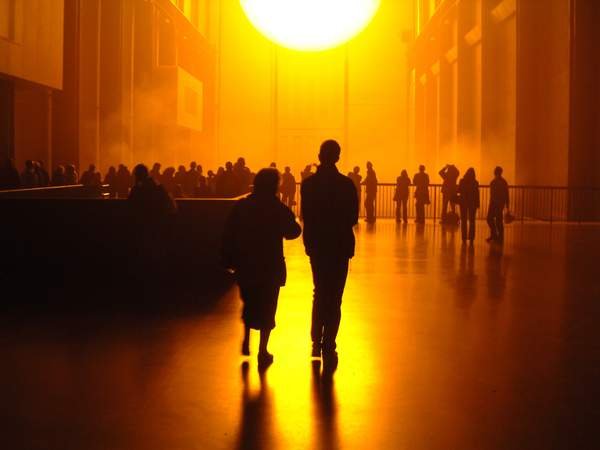
Tate Modern · Tate Modern
A sun in the Turbine Hall
The Turbine Hall is the largest space in Tate Modern, London, once the turbine room of a power station. Each year the museum invites an artist to make a work for that space alone, as part of The Unilever Series. In 2003, the fourth commission went to Olafur Eliasson, born in 1967.
The weather project ran from 16 October 2003 to 21 March 2004, free to enter. Throughout that London winter, a sun hung at the end of the hall.
The sun was made from about two hundred mono frequency lamps, the kind used for street lighting, arranged in a half circle behind a screen. The ceiling was covered with aluminium frames lined with mirror foil. Reflected above, the half circle became a whole one. In the mirror, the hall doubled in height.
Mist, mirror and yellow light
Mono frequency lamps give off a single narrow band of yellow orange light. Under it, other colours almost vanish. Clothes, faces, bags all fall into two tones: yellow and black. The hall looked like an old photograph.
Machines released mist into the air. It gathered into cloudlike forms, then thinned across the hall. At times the sun was sharp. At times it faded behind vapour. The indoor weather kept shifting, like real weather.
Eliasson did not hide the mechanism. Walking round or looking closely at the ceiling, visitors could see how it all worked: lamps, frames, machines. The illusion was not broken by that knowledge. It simply became one we chose to walk into.
People on the floor
What few expected was how the public responded. People did not just stand and look. They lay down on the concrete floor, in groups, in rows. They looked up into the mirror and saw themselves, tiny, lying beneath a sun. Some used their bodies to spell out words that could be read in the reflection.
A museum hall became a summer lawn in the middle of winter. Strangers lay beside strangers. No one had told them to.
So the work was not the sun, nor the mirror. It was what people did standing, then lying, beneath them. The viewers became part of the image, and saw themselves in it.
Perhaps that is why people stayed so long. A painting on a wall is looked at for a few minutes. An indoor sun invites you to sit, to lie down, to wait for the mist to come and go. Time in the hall slowed. No one hurried. In a large city heading into winter, here was a place where one was allowed to do nothing, only lie under a yellow light and look up.
Talking about the weather
Tate introduced the work with an eighteenth century remark by Samuel Johnson: when two Englishmen meet, their first talk is of the weather, hurrying to tell each other what both already know, that it is hot or cold, bright or cloudy, windy or calm.
Eliasson took that small talk as his subject. Weather is something we live inside every day, yet rarely look at as a phenomenon. By bringing it into a room and building it from lamps and machines, he made visitors ask: what am I seeing, and through what am I seeing it?
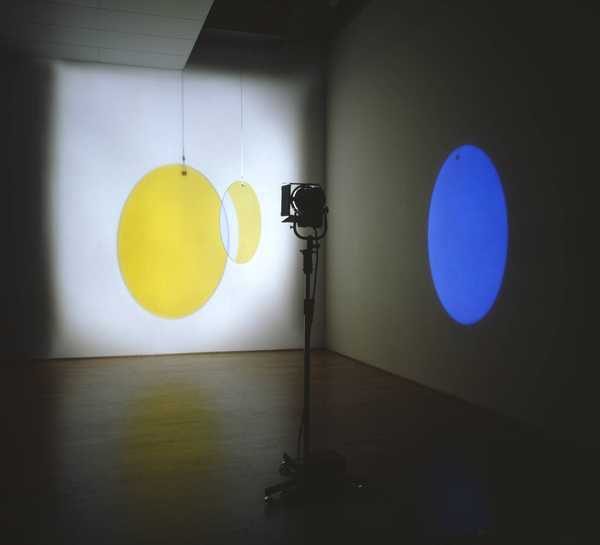
Eliasson has worked with light and colour in many other pieces, such as Yellow versus purple. But in The weather project a whole sky was built indoors, and the public answered with their bodies. Years later, talk of the Turbine Hall still tends to return to that indoor sunset.
Contemporary Art