
Essays · Contemporary Art
Olafur Eliasson. Yellow versus Purple.
Colour is not there. Colour happens.
Tate · Tate
A glass disc and a lamp
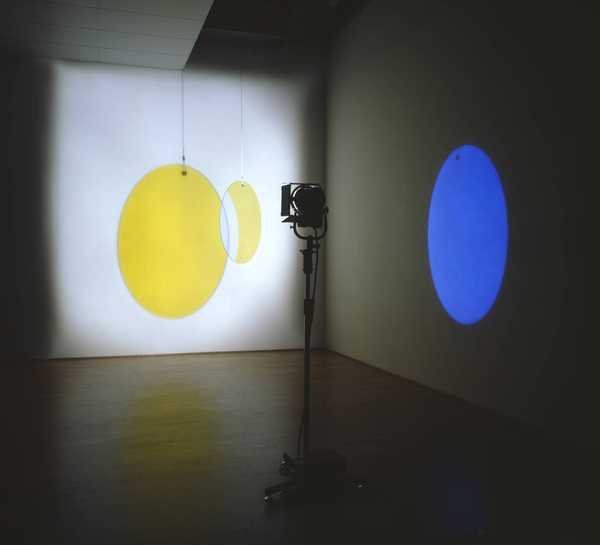
Yellow versus Purple is installed in a darkened room. At its centre hangs a transparent yellow disc of glass, 75 centimetres across. It hangs from a steel cable linked to a motor on the ceiling, and turns slowly. Facing it, a floodlight on a tripod throws a wide beam straight at the disc and the white wall behind.
Disc and lamp both sit 140 centimetres off the floor, at chest height for someone standing. Nothing is hidden. You see the lamp, the tripod, the wire, the motor. The work is the whole apparatus, and what it produces on the wall.
Olafur Eliasson made it in 2003. The same year Tate bought it through the Outset and Frieze Art Fair fund set up to build the collection. The record lists colour effect filter glass, spotlight, tripod, motor and wire. Dimensions: variable.
A yellow shadow, a purple trace
Light passing through the disc leaves a yellow shadow on the wall. As the disc turns, the shadow changes shape, from circle to ellipse and back. Like a moon waxing and waning, only much faster.
At the same time a special coating on the glass reflects part of the light. That reflection becomes a purple shape moving along the walls, as if orbiting the room. It too changes shape with the angle of the disc, and changes size with the distance from disc to wall.
The title suggests a contest. Yellow and purple sit opposite each other on the colour wheel; they are complementary. Stare at yellow, then at white, and the eye sees a purple after image. In this room the two colours do not need to beat each other. They need each other to appear.
Visitors may walk through the work. Stepping into the beam, they carry yellow and purple on their clothes, faces, hands. The body becomes a second wall.
An old depot in Berlin
Eliasson, born in 1967, is a Danish Icelandic artist. He studied at the Royal Academy of Arts in Copenhagen from 1989 to 1995 and, already as a student, began making works on light and colour that sit between art and science. In 1995 he moved to Berlin.
Yellow versus Purple was made there, in a studio inside an old train depot that he shared with other artists, among them Thomas Demand and Tacita Dean. The colour effect glass was not his own invention. It was a ready made product bought from a company in Germany.
Earlier, in 1997, he had made Room for one colour, a bank of lights flooding a room with yellow so that the eye, deprived of other colours, compensates and sees the neighbouring rooms tinged purple. Yellow versus Purple brings that idea into a smaller object that moves.
The viewer as screen
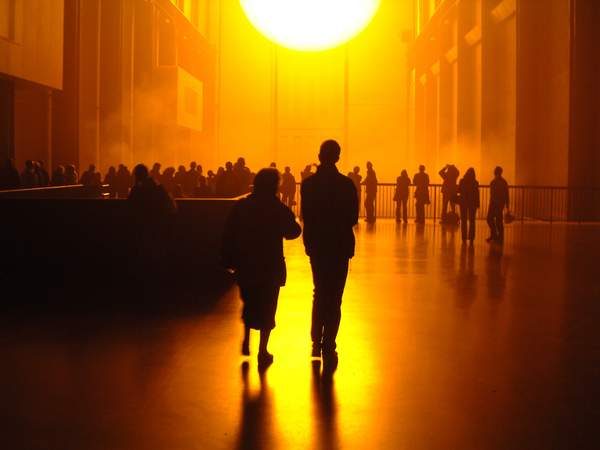
2003 was also the year Eliasson hung an artificial sun in Tate Modern's Turbine Hall, The weather project, with around two hundred yellow mono frequency lamps. The two works are far apart in scale. One fills the hall of a power station. The other is a disc and a lamp. Both ask the same thing: what are we seeing, and how much of it does the eye supply?
The critic Holger Broeker observed that in works like this, visitors do not only take part as viewers. Moving through the room, they become surfaces for the light as well. They are subject and object at once.
A Tate gallery caption from 2016 opens with a question: do colours exist when we are not looking at them? The work gives no spoken answer. It switches on a lamp, turns a disc, and lets people watch purple appear where nothing purple exists.
Contemporary Art