
Essays · Photography
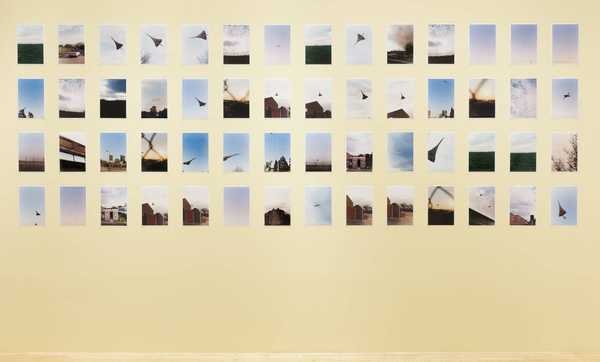
Wolfgang Tillmans. Concorde Grid.
Anyone on the ground can see the sky.
Tate · Tate
Fifty six times looking up
Concorde Grid is a grid of 56 colour C-prints, hung close together in rows and columns. Wolfgang Tillmans made it in 1997. All 56 pictures share one subject: Concorde, the supersonic passenger aircraft developed jointly by Britain and France.
Yet in most frames the aircraft is small. It is a white or dark triangle against the sky, sometimes almost lost in cloud. The rest of the frame is whatever surrounded the photographer: rooftops, lamp posts, power lines, wire fencing, grass near the airport. Some show take off, some show the plane already high, some catch it straight overhead as it passes.
Tillmans photographed in London, where Concorde came and went every day. He waited beneath the flight path, knowing when the plane would pass, and shot in the few seconds it was overhead. Then he waited again. The pictures were made to accompany his solo exhibition at Chisenhale Gallery, London, in 1997, titled I Didn't Inhale.
An icon seen from below
Concorde carried many meanings. It flew at twice the speed of sound and crossed the Atlantic in around three and a half hours. Tickets cost so much that only a few ever sat inside. For many it stood for the technological ambition of the twentieth century, a belief that the future would be faster.
Tillmans did not photograph that ambition from the side of those who owned it. He photographed it from the side of those who only saw it. It might be a child in a garden near the airport, a driver pulled over by the road, someone walking who looks up as the engines roar in. They would never board, but they were free to look. It is an unprivileged point of view.
The grid reinforces this. No picture is enlarged as the main image. None is the best moment. Fifty six frames stand level, like fifty six times someone stopped what they were doing to look up. Walking along the grid, the viewer sees one object again and again, each time different: sun, cloud, dusk, grey sky. The plane does not change. The sky and the person beneath it do.
Loose, unhierarchical hanging was a mark of Tillmans's installations in the 1990s. He often taped prints straight to the wall, mixing large and small. In Concorde Grid he chose a tighter, more even frame. That regularity makes the grid read like a log, a diary of attention.
An object that has left the sky
In 2000 the collectors Poju and Anita Zabludowicz gave Concorde Grid to Tate. It was shown again at Tate Britain in 2013 in Looking at the View, alongside centuries of British landscape painting.
In that company the grid reads differently. Landscape painters often treated the sky as permanent. Tillmans photographed the sky at the moment something crossed it, and that something no longer exists. Concorde stopped flying in 2003. Pictures that once recorded an everyday London sight are now a record of something lost.
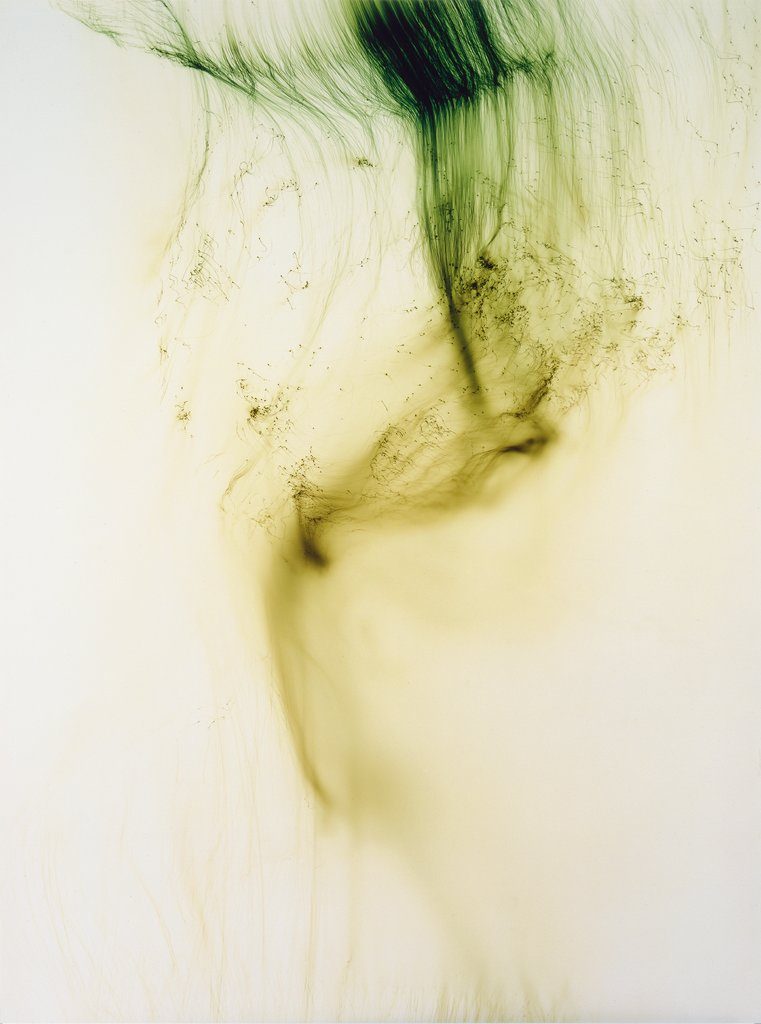
This is why Concorde Grid still carries weight almost thirty years on. When it was made, it was a series about the present. Now it is an archive. No one can stand under that flight path and take those frames again. There are only the people who once looked up, and 56 small photographs remembering on their behalf. A few years later Tillmans went the other way: he set the camera aside altogether and let light draw on paper in Freischwimmer.
Photography