
Essays · Modern Art
Wassily Kandinsky. Cosaques.
The image is not gone yet. It is dissolving into colour.
Tate · Tate
What can still be recognised
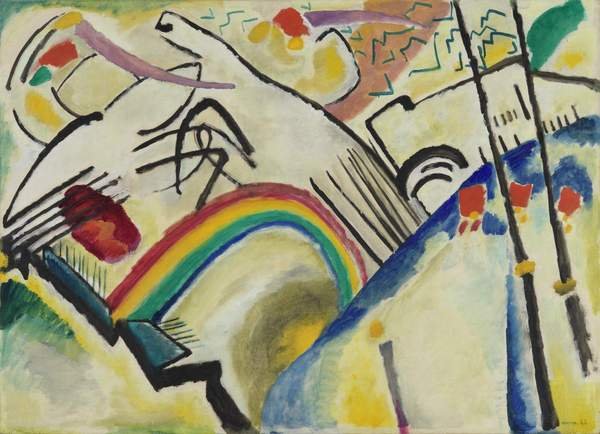
Cossacks, titled in French as Cosaques, is an oil painting on canvas made by Wassily Kandinsky over 1910 and 1911. It is in the collection of Tate in London.
At first glance it looks like colour spilled over a light ground. Look slowly and shapes begin to appear. There are tall orange red hats and upright lances in long black strokes: the Cossack riders. Elsewhere, two horsemen swing sabres, two black lines crossing. A rainbow arcs across the canvas. Further off a fortress stands on a hilltop. A few birds pass, just curved marks.
Nothing is drawn in full. Kandinsky kept just enough for the eye to recognise, then let the rest dissolve into colour.
Looking at this painting is like looking at a landscape through a fogged window. At first there are only patches of light and dark. Then the eye adjusts, and a roof, a tree, a figure emerge. Kandinsky stopped the picture right as the eye begins to adjust, before anything becomes clear.
Munich, the years of turning
Kandinsky was born in Moscow. He studied law and economics and was about thirty when he gave up that career to study painting in Munich. In the first years of the twentieth century Munich was where he lived and worked, among young German and Russian painters.
Around 1910 his painting changed quickly. Country landscapes with churches, hills and riders lost their outlines. Colour no longer filled in shapes. Colour stood by itself.
In the same period he wrote On the Spiritual in Art, published at the end of 1911. In it he compared colour with music: colour could act directly on the soul, like a note, with no need to describe an object. Also in 1911, with Franz Marc, he founded the group Der Blaue Reiter, the Blue Rider.
A larger sibling
Cossacks is closely linked with a larger Kandinsky painting, Composition IV of 1911. It too has riders with lances, a rainbow, a hill with a fortress, and forms dissolving into colour.
Side by side, the two show Kandinsky working like a composer writing variations. With the same set of images he tried other arrangements, other degrees of dissolution. Cossacks is tighter and easier to read. Composition IV is wider, with more open space.
These subjects were not chosen at random. Riders, battle, rainbows and mountain citadels recur in Kandinsky's paintings of these years, tied to an idea of great conflict followed by renewal.
At the edge of abstraction
A few years later Kandinsky was painting pictures in which nothing could be recognised. He is often named as one of the first to take European painting into abstraction. Soon after, in Russia, Malevich reached abstraction by a completely different route, with Black Square: not dissolving the image but erasing it.
Cossacks stands just before that turn. It still holds a story, but the story now matters less than the colour. You can search for the riders, or ignore them and simply look at a streak of orange beside a streak of blue.
Interestingly, many viewers today travel Kandinsky's road in reverse. They see colour first and find the forms later. The wall label tells them there are riders, and they go back to look. The title becomes a hint, a small key to a painting that almost no longer needs one.
Both ways of looking are right. The painting lets you choose which side of the edge to stand on.
Modern Art