
Essays · Modern Art
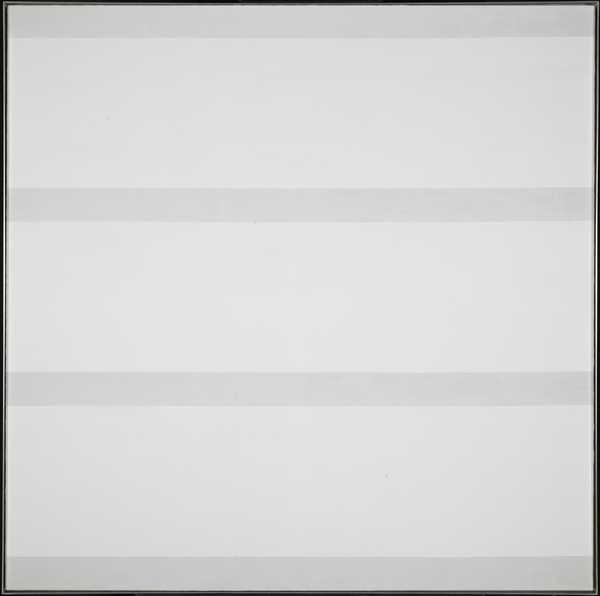
Agnes Martin. Untitled #5.
Perfect in the mind. Imperfect on the canvas.
Tate · Tate
Four grey bands
Untitled #5 is a square canvas, each side about one metre eighty three. On a light grey ground run four horizontal bands of dark grey, evenly spaced. That is all.
The paint is opaque. Yet within the dark bands the tone is not quite even. Brushstrokes are still visible, running across the canvas. Very close up, the edge of each band is not perfectly straight. Not a flaw. It is the trace of the person who painted it.
Agnes Martin, the Canadian born American painter, made it in 1991. It came to Tate in 2013 through the American Fund for the Tate Gallery, courtesy of Milly and Arne Glimcher, Martin's close friend and longtime dealer. It appeared in her major retrospective at Tate Modern in 2015 and in the ARTIST ROOMS displays devoted to her.
A small ruler, pencil, tape
Tate describes Martin's method in some detail. She primed the canvas with acrylic gesso. She measured the divisions for each band and ruled horizontal pencil lines across the canvas with a small ruler. Masking tape kept each edge crisp. The paint was grey acrylic, undiluted.
One detail is surprising. She did not paint the bands horizontally, as they hang. She painted them vertically, so the paint would not run outside the lines, and turned the canvas ninety degrees once it was dry.
Martin had worked in oil, but from around 1966 she used acrylic almost exclusively, mostly Liquitex, the first water based acrylic sold commercially in the United States, for its matt, translucent finish.
She said each painting came to her as a complete inspiration. She saw it in her mind, then measured to bring it onto canvas as she had seen it. But she was clear that we can see perfectly and cannot make perfectly. The wavering pencil lines and small bleeds are the distance between the two.
The grey years in Galisteo
In 1977 Martin moved to Galisteo, a small village in New Mexico. There she began the grey abstract paintings, and made them, among others, until 1992. In 1993 she left for Taos. Untitled #5 is therefore among the last of her grey paintings.
It is also one of the last in the six foot square format. Martin liked that size because it matched a human body; she described it as a size you could step into. But in her eighties the large canvas became too hard to handle, and from 1993 she moved to five feet.
The large format links her to abstract expressionists such as Barnett Newman and Jackson Pollock, and to the way Mark Rothko surrounds the viewer with colour in the Houston chapel. But Martin's canvases have no explosive brushwork. She is often placed beside minimalism too, and she showed with those artists in the 1960s. Unlike them, she used no industrial materials or mechanical process. Every line passed through her hand.
Looking for a long time
Untitled #5 has nothing to decode. No image, no story, no bright colour. Someone walking past might find it empty.
But the canvas is large enough to fill most of the field of vision. Stand still before it for a while and small differences appear: one band a shade darker than another, an edge that ripples slightly, a brushstroke catching the light. The painting does not change. The viewer does.
Martin wrote that her work was about perfection as we know it in the mind, while the paintings themselves were far from perfect, as we ourselves are. Perhaps that is why this grey painting stays with us. It promises nothing. It shows only that someone tried with great care, and left the marks of that trying.
Modern Art