
Essays · Modern Art
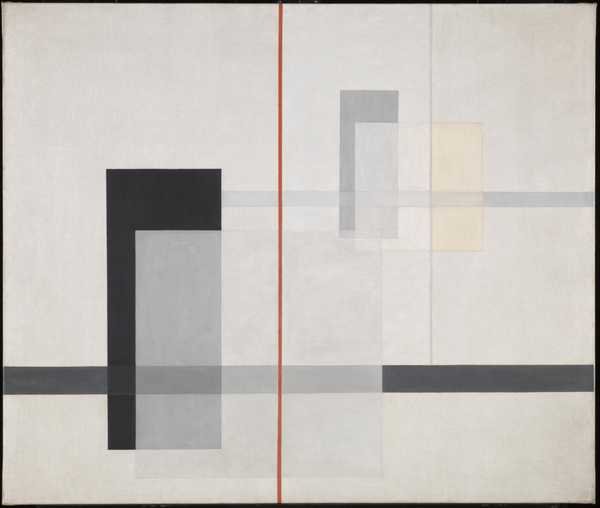
László Moholy-Nagy. K VII.
Light, built like a structure.
Tate · Tate
Transparent bars
K VII is an oil painting with graphite, roughly 115 by 136 centimetres, made in 1922. On a pale ground, long bars and geometric planes cross one another. Some bars are solid black. Some planes are pale grey, like frosted glass. Where they overlap, the colour is not covered but deepened, like two sheets of film laid on a light box.
There is no horizon. No vanishing point. No object to name. The eye does not travel into depth as in older painting; it slides between layers that sit almost flush with the canvas.
His second wife, Sibyl Moholy-Nagy, later described this kind of picture as the period when he carried his research into non-perspective space from paper collage onto canvas. She recalled his interest in luminous layers rather than dense planes. In K VII that idea is easy to see. Each bar reads like a thin sheet laid down, not a patch of colour pressed on.
The letter K and the number VII
Moholy-Nagy's titles are not entirely clear. According to Tate's records, his first wife Lucia Moholy remembered that K stood for Konstruktion, the German word for construction. She was unsure what the Roman numeral counted.
The idea has support. In 1924 a painting of his, very probably this one, was shown in Berlin as Konstruktion KVII, and several similar works were reproduced that year under names like Konstruktion IIc.
The title says a good deal about how he thought. Moholy-Nagy belonged to a generation that believed an artist could work like an engineer: measure, arrange, assemble. The painting is not a place to pour out feeling but a structure. That spirit sits close to Russian Constructivism, to Malevich's floating planes, and to what was about to happen at the Bauhaus.
From Berlin to the Bauhaus
K VII was painted while he lived in Berlin. Tate notes that it may have been in his first solo exhibition at the Der Sturm gallery in the winter of 1922, the show that led to his appointment at the Bauhaus.
In the summer of 1923 the Bauhaus in Weimar held a major exhibition. A photograph of the Moholy-Nagy room shows K VII on the wall, the firmest evidence of the painting's early life.
He worked far beyond painting: photography, typography, sculpture, industrial design. In 1928 he set up his own design studio in Berlin. In 1933 he was forced to leave. In 1935 he reached London, worked as a commercial artist and showed K VIII, from the same series, in an anti-fascist exhibition. In 1937 he moved to the United States, the same year his work was mocked in Hitler's Degenerate Art exhibition.
The painting took another route. After his death it passed through a Munich gallery and a London gallery, and Tate bought it in 1961.
Painting with light
Today, seen beside technical drawings or layered screens, K VII can look familiar. In 1922, dropping the object entirely and keeping only the relations between light and dark layers was still a new proposal.
What stays is not the shapes. Diagonal bars, circles and rectangles were common among his peers. What stays is the transparency. Oil paint is a dense, covering material. Moholy-Nagy made it look like glass, like film, like light through a screen.
He painted not things but the way light passes through things. And light, for him, could be arranged, the way steel beams are arranged in a building.
Modern Art