
Essays · Modern Art
Barnett Newman. Adam.
The first man carries the name of the earth.
Tate · Tate
Brown and red
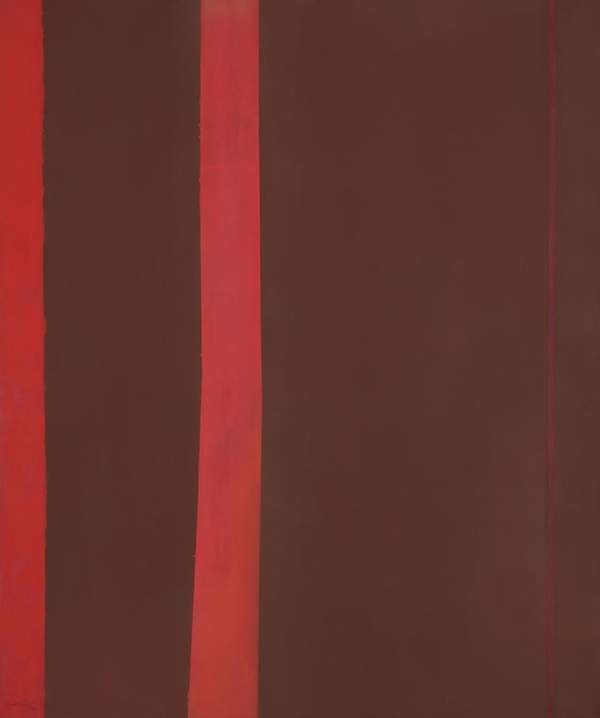
Adam is a large oil painting, about 243 centimetres high and 203 wide. Almost the whole surface is an earthy brown. Running from top to bottom are red bands: a soft-edged one at the left, a broad heavy one left of centre that bends slightly towards the base, and a very thin one on the right.
Vertical bands like these are Newman's signature. They are called zips. They do not divide the painting into compartments. They do the opposite: they make the whole field one continuous body, with a line of light running through it.
Up close the painting exceeds the field of view. You cannot see both edges at once. The viewer does not look at a shape but stands inside a colour.
A painting made twice
Adam and Eve were the last two paintings Newman finished before his second solo show at the Betty Parsons Gallery in New York in April and May 1951. At that point Adam had only two bands: the soft red one at the left and the thin zip at the right.
The following year Newman added the broad red band near the centre. So the painting carries two dates, 1951 and 1952, and his inscription says exactly that.
Tate's technical notes show how carefully he worked. Over a white ground he laid a thin crimson wash. When it dried he masked the bands with tape, brushed brown up to the tape and sharpened the edge with a knife. Where the tape did not hold, red escaped, and he covered it again with brown. For the third band he rubbed the brown down, in places to the bare cotton, before painting the new red. That band is slightly glossier than the rest. The painting is unvarnished.
It is less calm than it looks. It carries the mark of a return.
The name of the first man
Newman titled his paintings after finishing them. In a 1967 interview with David Sylvester he explained that he chose names that evoked the emotional content of the work, a kind of metaphor corresponding to its feeling.
From around 1946, after some five years of barely painting, he started again and wanted to rethink painting from the beginning. He often chose titles about creation, such as The Beginning and Genetic Moment, or Old Testament names such as Abraham and Joshua. Adam, the first man, belongs to that line.
Tate notes that the Hebrew adam means man and derives from adamah, earth, while adom means red and dam means blood. The brown and red may therefore be read as mankind's closeness to the earth. His wife Annalee Newman confirmed that she had heard him speak about these meanings of adam, though never in connection with the painting.
Tate adds that Newman's vertical bands may relate to mystical Jewish traditions in which God and man are imagined as a single beam of light.
Adam, Eve and a friend
Eve, painted in 1950, is narrower than Adam: a field of bright red with a thin purple band at the right edge. The two share names from Genesis, but according to Tate Newman did not think of them as a pair. Both are now in Tate's collection.
Adam's first owner was the collector Ben Heller. According to Annalee Newman, it was Jackson Pollock who introduced Heller to Newman. In 1957 Heller bought Adam directly from the studio and later acquired Vir Heroicus Sublimis as well. Tate bought Adam from the Hellers in 1968.
That detail links two very different painters of one generation. Pollock left paint running sideways, full of motion. Newman left still fields with a line of light running upward. Beside the dark canvases of Rothko's chapel, Adam shows another path in American painting of the time: no story, only a viewer standing before a colour, and a name.

Modern Art