
Essays · Modern Art
Kazimir Malevich. Black Square.
A black square. Colour still lies beneath.
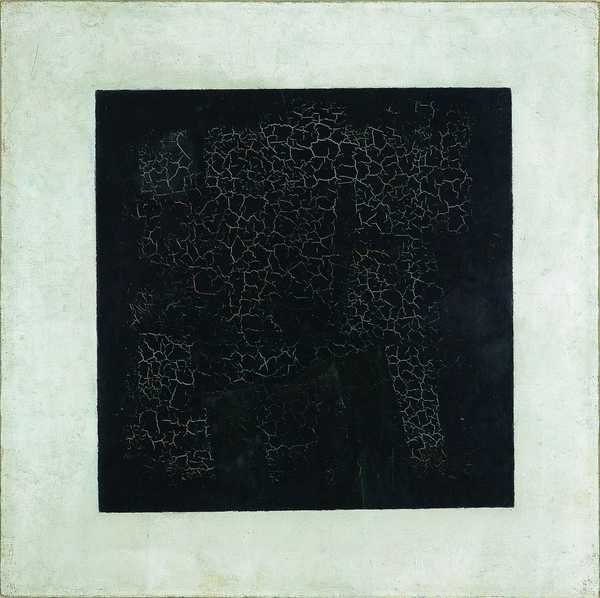
© State Tretyakov Gallery, Moscow · Tate
A curtain for an opera
The black square first appeared not in a painting but on a stage. In 1913 Kazimir Malevich worked with the composer Mikhail Matyushin and the poet Aleksei Kruchenykh on the futurist opera Victory over the Sun. Its characters set out to capture the sun and abolish time. The libretto was written in zaum, Kruchenykh's language of sounds without meaning.
Malevich did the design. The black square was already there in his design for the stage curtain. It later became the seed of the painting.
Years later, in a book published in 1927, Malevich wrote that in 1913, trying to free art from the weight of the real world, he took refuge in the square.
Hung in the corner
In December 1915, in Petrograd, as Saint Petersburg was then called, The Last Futurist Exhibition of Paintings 0.10 opened at N.E. Dobychina's salon. It ran into January 1916.
Malevich hung Black Square high on the wall, across the corner of the room. It was the place where Russian Orthodox homes hung their icons. The black square did not sit at eye level like a picture. It presided from above, as the emblem of the whole room.
The hanging said more than any statement. Malevich was not inviting viewers to look at a picture of something. He set up a new kind of object for contemplation, with no figure, no landscape, no story. In a handout at the show he claimed that until then no one had truly attempted painting as such, without any attribute of real life.
He called this direction Suprematism: colour and basic geometry above all description.
The date on the canvas and the real one
Malevich painted four versions of Black Square. The first, now in the State Tretyakov Gallery in Moscow, is dated 1913. Scholars think it was most likely painted in 1915, and that he backdated it to secure his place as the founder of abstraction.
Whether it is the first non representational painting at all is still debated. Malevich declared Black Square the first Suprematist work. Yet X rays reveal a multicoloured Suprematist composition under the black. The painting taken as a zero point turns out to have a past.
This does not make Black Square smaller. It shows that the square was a decision, not a start from blank canvas. Malevich had colour, had form, and chose to cover it all to leave one square.
The square after the painter
Malevich died in 1935. At his funeral the car carrying his body bore a black square on its front. Mourners held flags decorated with black squares. His coffin and grave were marked with the square too. The emblem he had hung in a corner twenty years earlier went with him to the end.
Then the square vanished from public view. Socialist realism became the official art of the Soviet Union under Stalin, and Malevich's paintings were put away. Only in the 1980s did Black Square return to viewers.
Tate suggests at least five ways to look at the painting: as the first non representational work, as a stage curtain, as the symbol of a movement, as an icon, and as an open question. None is the only correct one.
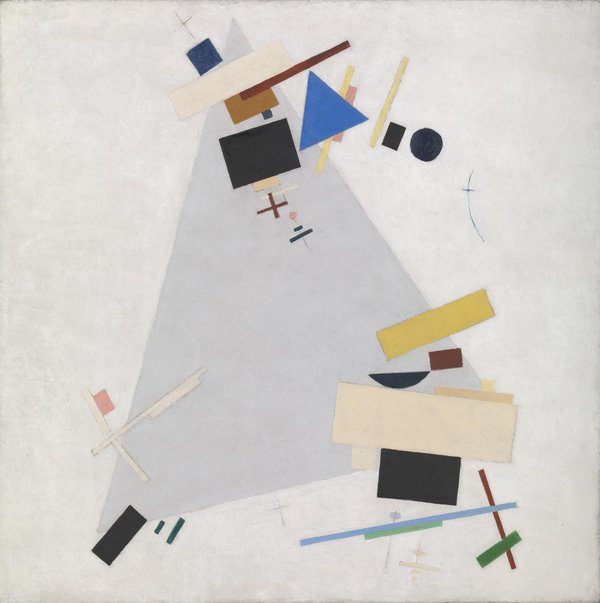
After Black Square, Malevich moved to compositions of many colours and forms floating on white, such as Dynamic Suprematism. In 1916 he began his white on white works. But the black square remained the mark against which everything after had to be measured.
Modern Art