
Essays · Modern Art
Hilma af Klint: Paintings for the Future.
Paintings addressed to a time not yet come.
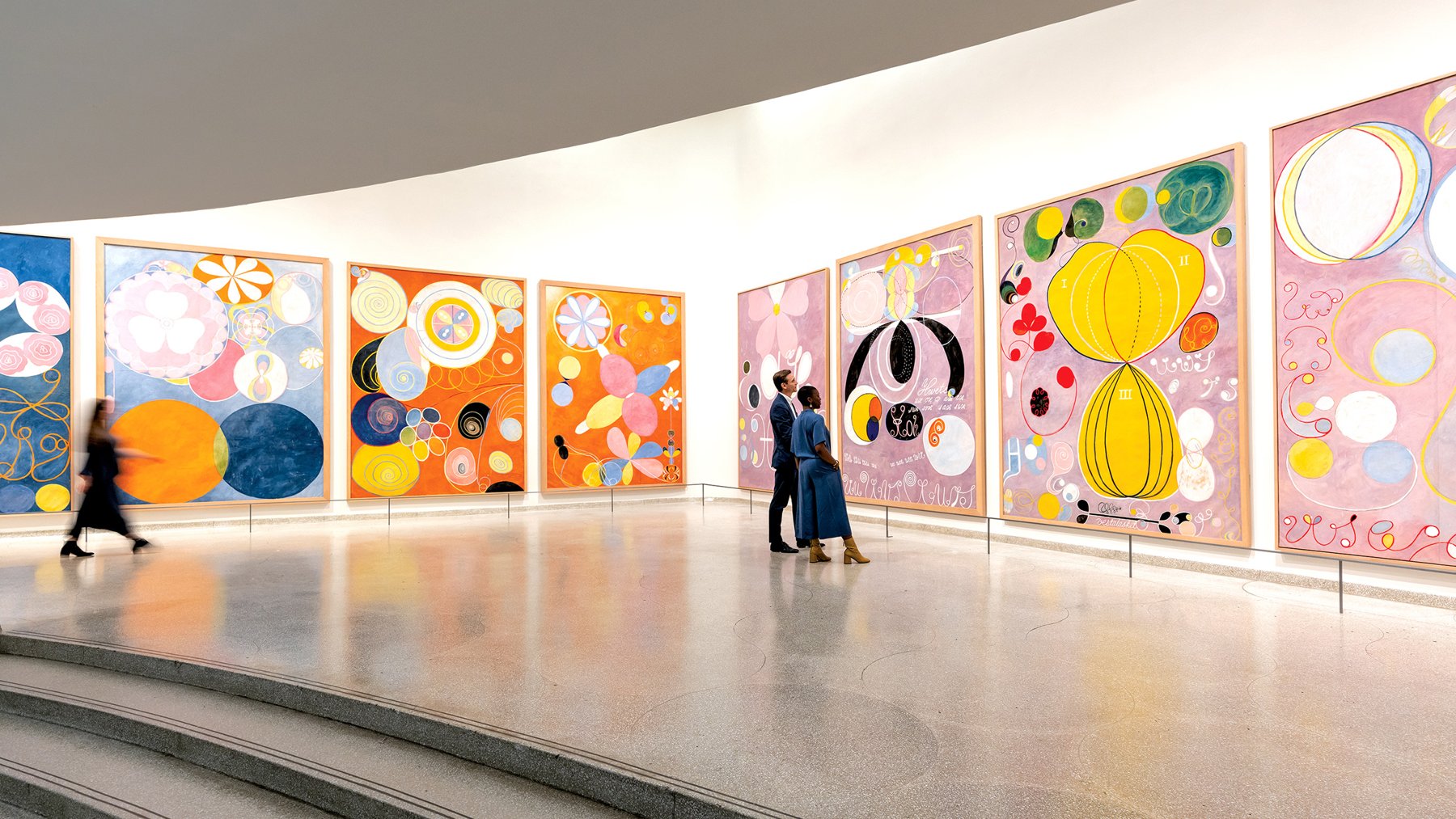
Solomon R. Guggenheim Museum · Solomon R. Guggenheim Museum
An exhibition more than a century late
From 12 October 2018 to 23 April 2019, the Solomon R. Guggenheim Museum in New York hung more than 170 works by Hilma af Klint along its spiral ramp. It was her first major solo exhibition in the United States. It was curated by Tracey Bashkoff with curatorial assistant David Horowitz, in cooperation with the Hilma af Klint Foundation in Stockholm.
The show focused on her breakthrough years, 1906 to 1920, when she began to paint pictures that described nothing in the visible world. Its title, Paintings for the Future, takes the artist at her word: these works were meant for later.
One coincidence is hard to ignore. Af Klint dreamed of hanging her paintings in a spiral temple. Frank Lloyd Wright's Guggenheim building, with its coiling ramp, was itself once described as a temple of spirit.
Painting abstraction from 1906
Hilma af Klint was born in Stockholm in 1862. She studied painting at the Royal Academy of Fine Arts and graduated with honours in 1887. She became a respected Stockholm painter, showing skilful figurative work, and served briefly as secretary of an association of Swedish women artists.
Alongside this she immersed herself in the spiritual movements then popular across Europe and America: spiritualism, Rosicrucianism, Theosophy. She attended séances from 1879, as a teenager. By 1896 she was meeting regularly with four other women to hold them.
In 1906, at one such meeting, a spirit the group often channelled asked af Klint to make a cycle of paintings. She accepted at once. She was forty three. What she painted from then on was bold, colourful and anchored in no recognisable image. It would be several years before Kandinsky, Malevich, Mondrian and others took similar steps.
Paintings for a temple
Between 1906 and 1915 af Klint completed 193 paintings and works on paper, together called The Paintings for the Temple. They vary enormously: biomorphic and geometric, vast and intimate, crowded and nearly bare.
The best known group is The Ten Largest, painted in 1907. Ten huge canvases about the stages of life: childhood, youth, adulthood, old age. They draw on plants, creatures and objects, then drift into imagined realms. Af Klint wanted the ten hung together as a kind of wall covering.
The final group, the Altarpieces, three large canvases finished in 1915, uses metal leaf. They were meant for the innermost part of the temple, reached only after passing every other painting.
In a notebook dated 1930 and 1931, af Klint sketched the temple: a nearly round building on three levels joined by a spiral staircase, with a four storey tower and an altar room at the top. It was never built.
Paintings held in reserve
While her contemporaries published manifestos and exhibited widely, af Klint kept her abstract work largely to herself. Recent research suggests the Altarpieces may have been shown in London in 1928, the only known public display in her lifetime.
Convinced the world was not ready to understand them, she stipulated that the paintings not be exhibited for twenty years after her death. She died in 1944. Her abstractions were not shown until 1986, and only in the three decades since have they received serious attention.
Alongside the exhibition, the Guggenheim showed new paintings by R. H. Quaytman, a contemporary artist interested in af Klint since 1989. One painter working for the future, and one from the future answering back.
Modern Art